New Delhi put out the red carpet for Lamichhane in a way that has been hard to come by since PM Balendra Shah came in. It is the first real outreach from Kathmandu since the 2025 anti-corruption uprisings, and it puts border spats, how much Nepal leans on India for trade, and energy ties all in one room for the two capitals to deal with.
Why this is happening now
It is not easy to get in to see Nepal’s new top brass these days. You have to look at the fact that Foreign Secretary Vikram Misri had to put his plans to see Shah on hold, or how the prime minister turned down a sit-down with US Ambassador Sergio Gor back in April. He’s treading a line of neutrality.
Then there is Shah. A 36-year-old who made the jump from rapping to politics, he was handed a landslide in the March elections and has made a point of not travelling for the first year of his term. All of this is in the wake of the youth protests in 2025 that unseated the old guard and put him in the driver’s seat.
The word from Delhi and Kathmandu
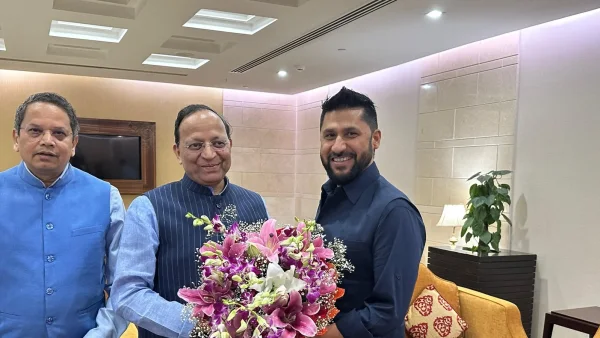
When Lamichhane got to New Delhi on Monday, he was given a proper send-off the next day at the BJP’s office, with dhol and rose petals. It is not something you hand out to every foreign party chief, and it says they want to keep the lines of communication open no matter what.
Party people say he is in for some high-level talks, possibly with Narendra Modi. On Tuesday he was with Nitin Nabin and others from the BJP – an exchange, as they put it, between parties.
You could see the planning in it: senior BJP hands at the airport to make the welcome, then the national president at the HQ. One Nepalese observer put it that India is making a point of this, even if where it leads is still an open question.
What he is on about
Lamichhane, who has been both deputy PM and interior minister, has been making the case for a closer bond with India. In a piece he put out not long ago, he put it like this: “a stable and prosperous Nepal is a natural guardrail along India’s northern border.” In short, for India, it is a strategic must to see Nepal develop.
He has been on about hydropower, too. “Nepal’s hydropower potential is no longer just a domestic asset; it is a clean, green engine capable of powering the industrial corridors of a rising India,” he wrote. The idea is that if you work together on energy and building, you get a more steady neighbourhood.
The hard facts on trade and strategy
You have a landlocked country of 30 million in the Himalayas trying to play off India and China. India is still the big one for trade, taking in close to 60 per cent of what Nepal imports, with China in second place.
In Kathmandu they are well aware of what geography allows. With a 1,800 km border in common, things like power exports and who is financing infrastructure are at the heart of how Nepal grows and how India sees the region.
A border row and some home-grown prudence
All this is going on while the Lipulekh Pass issue is in the news again. Shah has been saying both sides have overstepped and need to sort it out in good order. It is a way to let off steam without giving up on the sovereignty story for his own people.
Shah has been keeping his distance from foreign envoys so as not to be seen as favouring one side or the other. For New Delhi, talking to Lamichhane is a sensible way to stay in the loop with the ruling class when the PM is not available for it.
How it has gone down
Some of the highlights of the visit:
– He touches down in New Delhi on Monday
– Gets a ceremonial reception at the BJP on Tuesday
– Sits down with Nitin Nabin
– Part of the ‘Know BJP’ outreach
– The first time the two ruling parties have spoken in a quarter or so
– A meeting with the prime minister is in the works
Looking ahead
It will come down to two things. Will the talk with Modi put some dates on the table for energy and investment? And can the parties keep up a dialogue while Shah is busy with his own house?
If they are in sync, you might see the border issue de-escalate and some of those hydropower ideas become reality. If not, it is just for show, with Kathmandu holding to its neutral ground and India wanting to know where it stands.