New Delhi has been firm with the United Nations, labelling Pakistan’s comments on Jammu and Kashmir as ‘unwarranted’ and restating that the Union Territory is its own business. You could say the hard line is to put a stop to any attempt to turn a Security Council platform into a political one, and to stand by where we have always stood.
India pushes back at UNSC Arria meeting
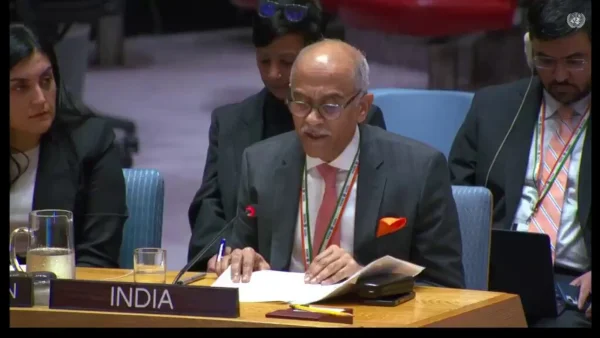
It was all part of an Arria-formula discussion on ‘Bridging the Implementation Gap: UNSC Resolutions and Maintenance of International Peace and Security’. India’s Permanent Representative, Ambassador Parvathaneni Harish, was there to make his case. He put down Pakistan’s interjection and left no room for doubt: Jammu and Kashmir is not for the world to discuss.
That kind of reply is in keeping with New Delhi’s way of doing things at the UN. The government has been at it time and again – if it is about Jammu and Kashmir, it is up to us.
Co-chair conduct questioned
Harish didn’t mince words when it came to how the session was being run. ‘It is incredible that a co-chair expected to be balanced and unbiased in conduct has chosen to politicise this forum,’ he put it, seeing it as a step too far from the neutral role they should be playing.
Positions restated amid recurring UN exchanges
Pakistan put Kashmir on the table during the proceedings, as is their wont, and that set the stage for Harish to respond in India’s name. He was having none of it, charging Islamabad with trying to bring politics into a place meant for mulling over the Council’s work.
You could sum up the debate like this:
– India: Jammu and Kashmir is an internal matter, period
– Pakistan: brought up the subject in the course of the meeting
– India: says Islamabad is making a political show of it
– India: our position ‘has been, is, and will remain so’
What was said in the room
‘I also refer to the unwarranted remarks made by the representative of Pakistan,’ Harish said, right to them. His point was that you can’t let bilateral squabbles get in the way of the priorities of this room.
He then put it in plain English. ‘The Union Territory of Jammu and Kashmir is a matter strictly internal to India.’ And to be done with it: ‘It always has been, is, and will remain so.’
Why the framing matters for the UNSC
Arria meetings are supposed to be a more relaxed venue for Council members to talk shop on international security. When India talks of ‘politicising this forum’, it is because there is a worry that these thematic talks can be derailed by disputes that don’t belong there.
Context and the immediate stakes
Then there is the matter of Pakistan’s Asim Iftikhar Ahmad, who had put in a word on Kashmir. That drew the Indian fire and the side-eye for the co-chair. In calling out both, India is saying that how you do things is as important as what you say.
With his statement, Harish is also putting India in the role of the one upholding some discipline in the Council. There is a drive to keep these sessions on track with implementation, not to be sidetracked by old contentions.
What comes next
There was no formal resolution to be had at an informal get-together, but the sparring made the lines in the sand even clearer. New Delhi is of the view that Jammu and Kashmir is not for international consumption, and it is tying that to the expectation of a level head at the UN.
For those in the diplomatic game, it is a case in point. Even in the more open UN settings, tempers can be tested. India has made its feelings known and there is no mistaking how it will take it if Kashmir is put forward in a forum it doesn’t think is the right one for it.