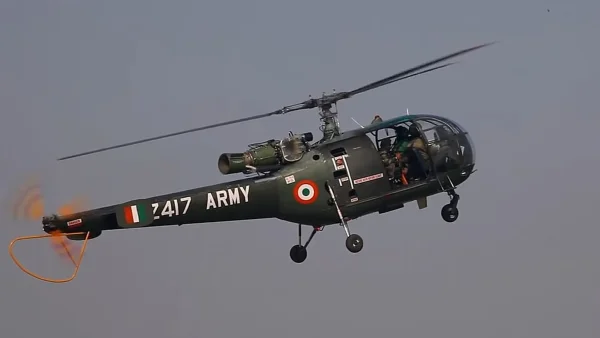
It was supposed to be a run-of-the-mill sortie in Ladakh on May 20 but it became a close call when the Cheetah crashed in the vicinity of Leh. Three officers, a division commander among them, were hurt. They’re in no danger now, but you can bet this has some in the service looking at the light fleet with a more critical eye.
What happened near Leh
According to those in the know, the single-engine Cheetah put down in the Tangste area while on a high-altitude assignment. The passengers included a lieutenant colonel, a major and the 3 Infantry Division’s GOC, Major General Sachin Mehta.
They made it out with nothing too serious. Even with the kind of terrain you find in the mountains, they put some distance between themselves and the remains of the chopper. Some would say it’s a bit of a miracle they are here to tell the tale.
Injuries and official response
We have word from the top that the two pilots and the divisional commander are fine. A Court of Inquiry has been set in motion to piece together the flight, the weather and any technical hiccups to see where things went off the rails.
Here is what officials have put on the record:
– Injuries to three
– All are in stable condition
– Court of Inquiry is in session
– Date of the crash: May 20
The Army will have more to say once they’ve done their due diligence. For the time being, they are running through the usual post-accident protocols and safety reviews.
Why this is significant
You can expect to hear more about the Cheetah and Chetak in these kinds of conditions. They have been the only way to get around in places like Ladakh and Siachen for a long time, but at those altitudes the thin air puts a strain on the machine and its rotors.
Up above 18,000 feet, even the most normal of jobs can mean a few trips. And in some of the more isolated outposts, 19,600 to 21,000 feet up, there is no road to be had for most of the year. This is just another reminder of how much the crews have to work with.
What’s in store
The Army is on a path to modernise and will be putting the old Cheetahs and Chetaks to rest over the next ten years or so. In their place will come the HAL Light Utility Helicopter, a project given the go-ahead back in 2009 for just these kinds of environments.
The Cheetah’s legacy
Since 1971, the Cheetah has been the workhorse of the Himalayas. It has been the flying jeep, the post van, the spotter for the artillery, and when it came to it, the air ambulance for the forward elements.
There is no denying what it has done for us in terms of evacuating the wounded or making a quick recon where a vehicle can’t. Even as we look to replace it, the platform has had its day.
The LUH
The new bird is built for where the oxygen is hard to come by. With the Shakti-1U under the hood, it can make 21,300 feet, touch down on the Saltoro Ridge helipad and do 235 km/h if need be.
It is a 3-tonner for a two-man crew and six soldiers. You have a glass cockpit that works with your night-vision for everything from medevac to a VIP run. It’s all meant to take some of the pressure off the men in the cockpit.
What comes next
The inquiry will go over the timeline and the technical side of the Tangste sector. What they find will likely inform how we train and maintain our gear going forward.
We’ll be making the switch to the newer utility models in the years to come. For the ones posted in some of the toughest spots on the planet, that’s a change they can’t wait for.