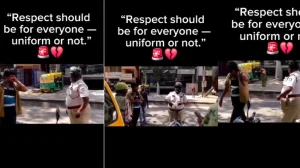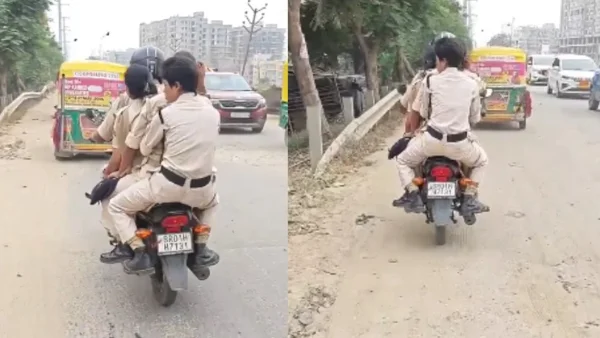
A viral video from Bihar showing four policemen riding on a single motorcycle has sparked laughter, memes, and criticism across social media.
For many, it was funny.
For others, it raised a far more serious question.
If those responsible for enforcing traffic laws appear to violate them, what message does it send to the public?
The issue isn’t about one motorcycle.
It’s about public confidence in the rule of law.
The Law Doesn’t Change With the Uniform
Every day across India, traffic police stop people for riding without helmets, triple riding, speeding, and other violations.
Citizens are expected to follow the rules because they are meant to protect lives.
The same expectation applies to everyone—including those who enforce the law.
Now, it is possible that the officers in the viral video were responding to an emergency or faced exceptional circumstances. Without official clarification, it would be unfair to assume the reason behind the incident.
However, in the absence of an explanation, public perception often fills the gap.
And perception matters.
One Video Can Damage Years of Awareness
Governments spend crores every year on road safety campaigns.
“Wear a helmet.”
“Don’t overload your vehicle.”
“Follow traffic rules.”
These messages are repeated through advertisements, schools, and enforcement drives.
But one viral clip showing apparent non-compliance by authorities can undermine months of public messaging.
Leadership is not just about making rules.
It is also about following them.
The Bigger Problem Is Consistency
The law derives its strength from consistency.
If a college student is fined for triple riding, the public naturally expects the same standards to apply to everyone else.
Justice is respected when it appears equal.
It becomes questioned when exceptions appear without explanation.
The debate is therefore larger than this one incident.
It is about whether accountability is seen as universal.
Public Reaction
As expected, social media wasted no time.
Some comments reflected humour.
Others reflected frustration.
“The motorcycle had four riders. Accountability couldn’t find a seat.”
“Traffic rules were invited, but the bike was already full.”
“If this was an Olympic event, the bike deserved a gold medal for balance.”
“The only passenger missing was the traffic rulebook.”
“Apparently, the motorcycle was on official overtime.”
Behind the jokes lies a serious concern.
People expect those in authority to set an example.
What Should Happen?
Rather than turning this into a political controversy, the appropriate response is straightforward.
If the officers were responding to an emergency, the department should clarify the circumstances.
If traffic rules were violated without justification, appropriate departmental action should follow.
Public confidence grows when institutions acknowledge mistakes instead of ignoring them.
Road Safety Begins With Example
India records one of the world’s highest numbers of road accident fatalities every year.
That makes road safety more than a matter of fines—it is a matter of public responsibility.
Every helmet worn by a police officer sends a message.
Every seat belt fastened by an official reinforces the importance of compliance.
Likewise, every apparent violation by authorities weakens that message.
Rules gain respect not because they are written in law books, but because people see them being followed.
The Road Ahead
The viral video will eventually disappear from timelines.
Another controversy will replace it.
But the question it raises will remain.
Can those who enforce the law also be seen consistently following it?
Because the strength of policing is not measured only by the number of challans issued.
It is measured by the example set on the road.
And sometimes, one overloaded motorcycle can carry far more than four people.
It can carry a nation’s debate about equality before the law.