The ICC Men’s T20 World Cup 2026 Player of the Tournament competition is now officially underway, the ICC having shown the eight players on March 6. Because the final is March 8 in Ahmedabad, the award is still available. Sanju Samson is the only player from India to be named to the list.
The shortlist – and what the players are competing for
The Player of the Tournament is meant to honor consistently good play throughout the T20 World Cup, looking at how a player affects the game, key moments where they won a match, and how often they play well. This year’s eight nominees come from a lively tournament that gave us high-scoring, exciting games, close endings, and truly good bowling performances.
New Zealand and South Africa each have two nominees, showing how far their teams got, and how well-rounded they were. With the final coming up, a really good performance in Ahmedabad could be the thing that decides who wins; history shows that the last playoff games usually decide how the tournament is remembered, and this group of players is close enough that the final could change everything.
ICC names the nominees
The ICC’s list includes Sanju Samson (India), Will Jacks (England), Sahibzada Farhan (Pakistan), Lungi Ngidi (South Africa), Aiden Markram (South Africa), Rachin Ravindra (New Zealand), Shadley van Schalkwyk (USA), and Tim Seifert (New Zealand). These players have quickly made a lot of runs, taken a lot of wickets, and won a lot of player-of-the-match awards.
Every nominee has an interesting story. Some have led their teams to win when the pressure was on. Others have changed games with their bowling, or finished batting innings in a way that changed the game’s odds. As a whole, they show how many different jobs and styles there were in this tournament.
Sanju Samson represents India’s hopes
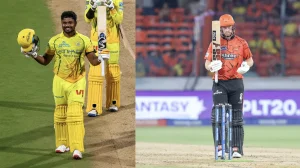
Sanju Samson has been India’s best player during this tournament. In four matches, he’s made 232 runs with an average of 77.33 and a very fast strike rate of 201.73 – a level of play which has been the base for India’s best batting days.
He won the Player of the Match award two times in a row in India’s most recent two games, including an undefeated 97 against the West Indies in the Super 8s. He then made a quick 89 at Wankhede Stadium, setting up India’s huge 253 against England in the semi-final.
Samson’s value is more than just his numbers. His ability to control the speed of the game, and his range against both fast and spin bowling, gave India chances to build repeatable platforms. Very few batters combined a willingness to take chances with actually doing it well in the powerplay and middle overs. If the voters value how much a player affects each game, Samson has a very good chance.
All-round players pushing their teams forward
Will Jacks of England has had a classic tournament for a modern T20 all-rounder. In eight matches, he got 226 runs at a strike rate of 176.56, and took nine wickets with his off-spin, winning four Player of the Match awards in England’s six wins.
Jacks’ 53 off 22 balls against Italy saved England, bringing them from 105 for 5 to 202 for 7. He was just as important with the ball, destroying Sri Lanka’s middle order with 3 for 22, and making a vital 2 for 23 and 32 in a four-wicket win over New Zealand. His power in finishing and his smart bowling made him essential.
Rachin Ravindra of New Zealand also stands out because of what he can do in both batting and bowling. He has 11 wickets and 128 runs, with 4 for 27 and 32 against Sri Lanka being the best of them, and which crushed the other co-host. He followed that up with 3 for 19 against England. Ravindra’s ability to change how a game is going with the ball has been a major benefit for the Black Caps.
Batters who are making their mark on the tournament
Sahibzada Farhan of Pakistan has broken tournament records. Over seven games, he totalled 383 runs at an average of 76.60 and a strike rate of 160.25 – the highest in any one Men’s T20 World Cup. He also became the first person to make two hundreds in a tournament, getting them against Sri Lanka and Namibia.
The partnerships Farhan began with Fakhar Zaman regularly gave Pakistan some forward movement, even if the team’s overall progress was up and down. In a tournament where quick starts so often decided results, Farhan’s control of the powerplay was a clear and important benefit.
New Zealand’s Tim Seifert has set the tone in their reaching the final. He has 274 runs at 45.66 with a strike rate of 161.17, and three fifties. His 58 in the semi-final against South Africa – part of a 117-run opening partnership with Finn Allen – made a comfortable chase of 170 possible at a vital moment.
South Africa’s captain Aiden Markram has been the Proteas’ most consistent top-order player. He scored 286 runs in eight matches, including three half-centuries, and made two times 86 not out in important chases. Against New Zealand, he led a chase of 176 in 17.1 overs; against the West Indies, he stayed in to chase 177 in 16.1.
Markram’s one wicket in the tournament was also well-timed – getting Ishan Kishan in a very important win over India. Though, the bigger thing is his leading through careful attacking play in difficult chases, which is what this South Africa side is known for.
Pace and accuracy: the bowlers who changed games
Lungi Ngidi has been South Africa’s most reliable fast bowler, taking 12 wickets in seven matches at an economy rate of 7.19. He started the tournament with four wickets against Canada, then 3 for 26 against Afghanistan in a match which went to two Super Overs. He then got three against the West Indies in the Super 8s.
Even in a game against India where he didn’t get a wicket, Ngidi only let in 15 runs in four overs with excellent off-cutters and changes of speed. In a tournament good for batters, his control was noticeable. He repeatedly made wins possible by holding back run rates and getting wickets in groups.
Shadley van Schalkwyk was the best new pace bowler for the USA. In four matches, he took 13 wickets at an economy rate of 6.80, equal best in the tournament, even though his team went out early. His opening spell against India gave him four wickets and briefly had the joint-hosts in trouble at 77 for 6.
He then took 4 for 25 against Pakistan, using clever changes and lengths to make the batters make mistakes. Van Schalkwyk’s returns in a short period show how quickly a fast bowler can change T20 games with self-control and trickery.
How the final could decide things
With the final at Narendra Modi Stadium on March 8, who gets Player of the Tournament is still open. Performances in knock-out games often mean more, and many people who might get it are still in with a chance to add a final important part to their story in Ahmedabad.
For batters, a quick fifty in a chase or a base-making 70 at a high strike rate could change what people think. For bowlers, a double-wicket in the powerplay or a very tight final overs spell can be just as important. In a field this close, the differences are small and moments matter.
The 2026 short list also shows larger changes in T20. Players who finish – like Will Jacks, who bat deep and bowl smart overs – are becoming more useful. Players who hold things together with different speeds – like Aiden Markram and Tim Seifert – are essential in planned chases. And high-effect bursts – such as Sanju Samson’s two match awards in a row – can change how a tournament goes.
As fans wait for the trophy to be lifted in Ahmedabad, the Player of the Tournament talk is richer than a single number or job. It is about who did well when the stakes were highest, who changed fastest, and who left a mark on the T20 World Cup 2026. Based on what has happened so far, several people could be that one from a field of equals. The final may choose one.