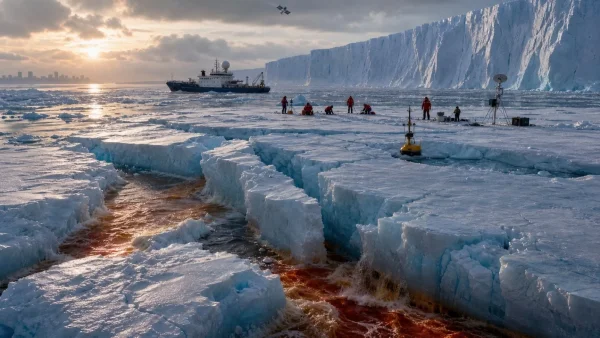
We have passed the point of mere warning when it comes to the most scrutinized glacier in Antarctica. The so-called Doomsday Glacier has an eastern ice shelf that is so riddled with fractures, according to the experts, it may not last out the year. Should it go, you lose the only thing holding back one of the planet’s largest ice drains, and the effects won’t be confined to the poles.
What disintegration means now
To be clear, the floating shelf is not the glacier. Even if it breaks up, you won’t see the tides go up right away since it is already in the water. The trouble is what you get in its absence.
Lose the shelf and you lose the buttress. Then land ice is free to pour into the Southern Ocean. Sea levels don’t just inch up; they make a steeper run for your harbours and deltas and the like.
Why the risk is higher than before
With the International Thwaites Glacier Collaboration, researchers are seeing the results of ocean circulation being altered by the climate. Warmer, saltier water is being channeled under the shelf, and it is making the cracks wider and the key anchor points thinner.
You can see it in the satellite photos: the eastern side is coming apart. Ice is flaking off at double the rate of a year ago, which is what you expect of a system at a breaking point.
‘The last of the ice shelf in front of the glacier is set to go,’ says Robert Larter, a glaciologist with the British Antarctic Survey. ‘We can’t say how, but it is happening.’
The hidden mechanics beneath the ice
Picture the shelf as a wedge propping up a heavy door. It keeps the door from swinging. But now, warmer water from the depths, pushed up by winds in the Southern Hemisphere that have been affected by climate change, is wearing that wedge down from underneath.
There is some talk among the science community over the finer details of how the ocean and air are interacting. No one can argue, though, that human influence is a big part of the story here.
Thwaites in perspective
It is the broadest of them all, on the order of Great Britain in size. You can find stretches of it 75 miles wide and 6,500 feet or more in thickness. Out on the West Antarctic coast, it is the line in the sand for much of the ice sheet.
Warm water has been at it for a while. If you go back to the early 1990s, the numbers show a retreat of 12 miles (20 km) or so. The writing is on the wall: it has been pushed back, bit by bit.
Right now we are talking about hundreds of billions of tons of ice going out the door each year. Some figures put that at 200 billion by 2067, a reminder of how quickly the scales can tip.
For those of us on the ground
Put it all together and, if the glacier yields, you are looking at a 2.1 foot (65 cm) increase in the global average. You don’t need a storm for this to happen. It is more than sufficient to inundate the lower parts of town and force salt into our freshwater.
Not every coastline will be hit in the same way. But for places like Bangladesh, the Maldives or some of the Pacific island states, it means floodwaters, no good drinking water and people uprooted from their homes. When the sea starts to encroach on where you live and work, the human cost is right there in front of you.
Then there are the big cities. New York and Shanghai may have to put up with more flooding. Miami and Jakarta can expect steeper storm surges. You even have the Netherlands, with all its defences, which will have to deal with the kind of engineering and money problems that come with the territory.
And if Thwaites goes, it won’t be an isolated incident. The glaciers next door could be thrown off balance, and you have the entire West Antarctic ice sheet in the mix. We’re talking about a 10-foot (3.3 m) or more increase in sea level – enough to put a new face on the map for a long time to come.
The timeline question
An ice shelf breaking up isn’t going to cause a worldwide deluge overnight. Even as it comes apart, the thinning and speed-up is a process. Most scientists will tell you a total collapse is a matter of decades, maybe centuries.
There’s some room for error in the models, and they are being updated as we get fresh numbers. But the bottom line doesn’t change: we are on a one-way street and every new crack is just another step along it.
Experts want to keep things in perspective. Not knowing exactly when something will happen is not the same as not being at risk. What is going on at Thwaites has a bearing on how we plan for the future and on the reality for those living on the coast.
A turning point for the West Antarctic ice system
The eastern ice shelf is what holds it all together. Take it away and you lose the check on the glacier where it runs into the ocean. Without that barrier, the pressure inside can build and you’ll see land ice moving to the sea in a hurry.
What’s driving it is the warm, briny water under the glacier. With the winds in the Southern Hemisphere, you have currents churning up deep water and putting heat right where the ice can’t get rid of it.
Those on the ground say the shelf is near the end of its rope. The way the cracks are spreading and it’s pulling away from the ridge on the seafloor shows you that it’s not only about melting; a little bit of mechanical give can make for a sudden change.
Here is how the researchers put it:
– The eastern shelf may be gone before the year is out
– A breakup in itself won’t put the seas up right away
– But without that support, the land ice will move faster
– 2.1 feet of rise if Thwaites is done for
– Over 10 feet if the whole of West Antarctica gives way
What comes next
The international crews on the ice and in the water are watching closer than ever. They want to know how the glacier will react if the shelf lets go, so they are on top of the fractures, the flow, and the water temps.
It’s not a matter of if the coasts will have to cope with higher water, but how quickly it will come. That is down to how fast things accelerate once the buttress is no more and if the neighbouring glaciers decide to follow suit.
It is a sobering thought. Something so far off is inextricably linked to your day-to-day life. Every reading from a satellite or a probe in the ice is a reminder of how what happens in Antarctica is tied to the security of a place like Miami or Mumbai.
Don’t let it get to you, but do pay attention. The signs are hard to miss. In the tale of rising tides, Thwaites is the star, and we may be on the cusp of its next act.