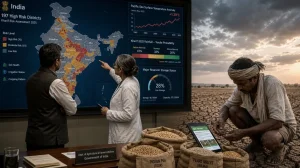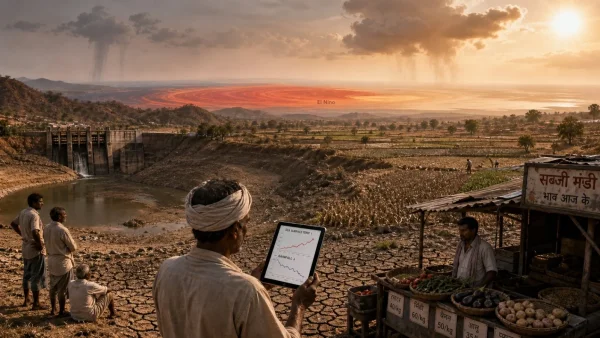
In many ways, a fast-building Super El Nino is the year’s top weather variable for India. It could well constrict the southwest monsoon, rattle farm yields and make groceries more expensive. The writing is on the wall with the way the oceans are behaving, so everyone from the household to the policymaker is in for some tough calls this season.
You won’t find much of a difference of opinion between India’s own weather watchers and their global counterparts: El Nino is here and may only get stronger come monsoon time. Should that hold, we could be looking at a peak in the winter, right when our water and crop systems will be feeling the aftereffects of a lackluster rainy period.
Why a Super El Nino now
When you have a Super El Nino, you’re talking about an unusually potent and long-lasting warm-up in the Pacific. In June, NOAA put out an evaluation that made for some sobering reading: “There is a 63% chance of a very strong El Nino during November-January, that would rank among the largest El Nino events in the historical record going back to 1950.”
We’ve been down this road before. The 1997-98 and 2015-16 Super El Ninos made waves in economies and weather patterns around the world, and 1982-83 is another case in point. They have a way of moving the goalposts on rainfall and temperature, with consequences that ripple through the markets and the fields.
How it forms and why India is exposed
Normally, the trade winds do their job of shoving the warm waters in the Pacific to the west. An El Nino is when those winds let up and the warmth goes east, which in turn changes how the ocean and air move. You end up with a reordering of where the rain falls – some places go dry, others can’t handle it.
For India, the vulnerability is built in. The whole of farm life, from refilling reservoirs to rural spending, is tied to the southwest monsoon. A forceful El Nino has a habit of making for sub-par and unpredictable rains. The records show us as far back as 1876-78 for some of the harshest drought-famine times. Lately, 2002, 2009 and 2015 were all marked by strong El Nino activity and drought.
Monsoon, crops and rural demand
The farming schedule doesn’t allow for much give. If the kharif staples like rice and pulses don’t get sown on time because of fitful rain, it’s a problem. And with almost half the land having no guarantee of irrigation, a general shortcoming in the monsoon is no minor matter; it’s a risk to the bottom line.
Then you have the issue of reservoirs and groundwater not filling up as they should, which makes for a leaner time on the water front. Not to mention the heat, which is something of a signature of El Nino.
You can expect hotter, longer heat waves in the north, centre and west of India. They put more strain on crops and up the need for water at a time when you can least count on it.
Farmers at the front line
What happens in the field has a way of piling up. When rain doesn’t come on schedule or is patchy, you get moisture-deprived crops, pests and a question mark over yields. It’s a recipe for thinning farm profits and putting off spending in rural areas, which ripples out from the farm.
Keep an eye on these four things as we go:
– How the rain is spread out, not the monthly figure
– What’s in the reservoirs and the water table
– How sowing is going for rice, pulses and oilseeds
– The price of perishables in the major mandis
What it means for you
Tighten the supply and the price tag goes up. Cereals, veg and pulses are usually the first to show the El Nino effect. You’ll see it in the cost of tomatoes, onions and potatoes when production wanes. If there’s less land under tur or moong, or the harvest is light, they will be harder to come by. A poor showing from oilseeds can do the same to cooking oil, with rice and sugar not far behind.
It all adds up for the household. If food prices keep ticking up, a family that puts in Rs 8,000 for the month’s groceries could be looking at a few hundred rupees more. That kind of hit is felt most by those on a lower or middle income and doesn’t let up until the market right itself.
And it’s not just the local store. Less than average rain means lower reservoirs and less hydropower. Utilities have to make up the difference with more expensive alternatives, and that cost is passed on.
The word from the agencies
NOAA says El Nino is in play in the tropical Pacific; sea surface temps have run past the 0.5C mark their scientists use to make the call. India’s IMD is in agreement, saying the ocean-atmosphere setup has all the hallmarks of one.
IMD’s models point to a build-up from June to September. Those are the months that will tell us what we’re in for with the monsoon, how much we’ll put in the ground and how much water we have for the rabi.
Looking forward
We are better at forecasting and being ready for this now, which gives the government some breathing room. Good monitoring and farm guidance can soften the impact if not take it away. But the real task is to hold the line on food inflation and deal with the shocks.
The signs are plain. See how the monsoon does in the coming months and if the warming in the ocean takes us to the next level of El Nino by winter. With the way things are going, we could be in for one of the most potent in a long time, and you will feel it in your power bill and on your plate.