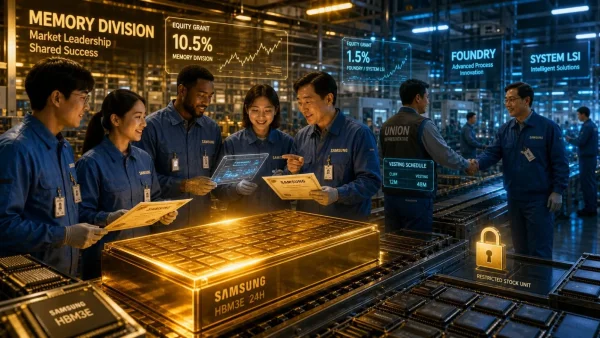
It’s a way of turning a market upswing into a tool for retention. We’re talking about some hefty equity-linked payouts here. In the memory division, for instance, an employee could be looking at close to $399,000. The average across the board? Put it at 513 million won, or $340,000. A bit of deal-making with the union made it all possible and put a stop to any talk of a strike.
The competitive squeeze and labour calculus
Then there’s the internal divide. Memory is where the action is; foundry and System LSI are not in the same league right now. And with SK Hynix and TSMC nipping at their heels, you can’t afford to get your incentives wrong.
The numbers tell the story. Under a last-minute understanding with the union, Samsung is set to put out some 40 trillion won ($26.6 billion) for 78,000 of its semiconductor staff this year. That works out to an average of 513 million won per person.
How the performance-linked formula works
How it breaks down: 10.5% of the profit will go to stock, plus another 1.5% in cold hard cash. It’s a 10-year plan, as long as the targets are hit, with the first of these checks due in early 2027.
Here are the essentials investors and employees are watching:
– 10.5% of profit in stock bonuses
– 1.5% of profit in cash bonuses
– Payout poised for early 2027
– Programme horizon of 10 years
It’s no secret what’s at stake. You have Samsung, SK Hynix and TSMC propping up the world’s supply of top-tier chips. If things go sideways, it’s more than just a problem for Korea.
Key terms shaping this cycle
There is also a performance angle to this. The total pot is pegged to 10.5% of what is thought to be operating profit. Should the chip side of the house hit a 300 trillion won mark this year, the pool swells to 31.5 trillion won.
From there, it’s a two-tier system. Some 40% is for everyone in the semiconductor division, role or not. Do the math and you’re at nearly 160 million won for each of the 78,000 or so workers.
But the other 60% is where you see the difference. Memory has the upper hand. Strong demand from the AI side of things means those employees could be handed an extra 380 million won.
Why memory workers may approach $399,000
And that’s before you add in the Overall Performance Incentive, which can be as much as half your yearly salary. Make 100 million won and you could pocket 50 million on top of it. All in, a memory worker might be up to 600 million won, or $399,000. Over in the red-ink units like foundry, they’ll be making do with the 160 million won that goes around.
Don’t expect to see it in cash, though. After taxes, the special bonus is in shares. You can offload a third of it right away; the rest is put in a vault for one and two years.
SK Hynix has been doing the same kind of thing, and with data centres for AI popping up everywhere, how you pay your people is the new front line in this industry.
“With Samsung and SK Hynix vying for global talent, you have to have a package to match,” says Bumki Son of Barclays. He cautions that the way the labour market is set up can give workers a “free option” – they’re protected when times are tough and well-rewarded when they aren’t.
What the next year could bring
Some have Samsung’s 2026 operating profit on track to heptuple to 333 trillion won. The company won’t confirm it, but if that holds, the proposed bonuses are well within reach.
Of course, it’s a 10-year framework in a cyclical business. Profits wane, the pool dries up. So the AI wave is as important to the guy on the factory floor as it is to the shareholders.
The bottom line for Samsung’s chip edge
You have a generational shift in AI and a war for the right kind of headcount. By linking big stock awards to results, Samsung is making a bet. If memory keeps sizzling, the gap in the company will only grow. If it doesn’t, they have ten years to adjust. For the time being, the word on the street is that Samsung is willing to put up the money to be in the game.