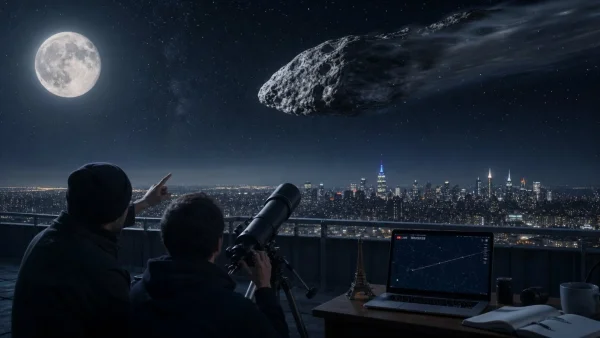
Think of it as a skyscraper making its way by Earth this weekend. 1997 NC1, which is many times the height of the Eiffel Tower, will come within 2.6 million kilometres (1.6 million miles) on 27 June 2026. There’s no danger in it, but you won’t want to miss it.
Key facts at a glance
The short version for your planning:
– 11:14 UTC on 27 June is when it is nearest.
– Roughly 2.6 million km, or 1.6 million miles, out.
– Some 710 to 1,600 metres in diameter.
– An Aten group asteroid.
– Livestream is on from 23:00 UTC on 26 and 27 June.
Why this flyby matters
We do get large near-Earth asteroids from time to time, but one of this calibre is not a common occurrence. The figures speak for themselves: 1997 NC1 is up to 1,600 metres wide, so it makes a show of itself and is visible even with a humble telescope if you have the right set-up.
There is no cause for concern, just some good science. Juan Luis Cano from the ESA’s Planetary Defence Office was direct about it: ‘You don’t get an object of this magnitude coming in close every day, though the moon being up and bright could make for a harder view at the point of closest approach.’ It is an interesting encounter, nothing more.
When and how to watch
Leave the home observatory at home. The Virtual Telescope Project has you covered with a stream of the action on 26 and 27 June, starting at 23:00 UTC. You can expect to see the rock move in front of a backdrop of stars.
Astrophysicist Gianluca Masi will be at the helm of the feed. On your screen it may not be as dramatic as in the movies, but you will spot the tell-tale sign of a real-time pass as it drifts from one frame to the next as a moving speck of light.
What we know about 1997 NC1
Astronomers have been keeping an eye on this one for a while. The NEAT survey found it back in 1997 and we have been following it ever since, which gives us a very clear picture of where it is going. That means we can be sure of the timing for this weekend and what to expect down the line.
It is an Aten type, so for the most part it is in and out of Earth’s orbit, but it does cross our way. If the records are to be believed, the last time it came anywhere near was 1993. You won’t have another chance to see anything like this until 2088, which is what makes this weekend’s viewing so much of an event.
Where to look and what you will see
Point a telescope at it and don’t be looking for a showstopper. At an estimated magnitude 10, 1997 NC1 is well beyond what you can spot with the naked eye, but a small scope or some good binoculars in a dark spot will do the trick. A 100 mm aperture should be enough to make out a faint dot that you can watch inch along over a few minutes.
There is some appeal in the way it moves. In the vicinity of its closest approach, the object will put on a bit of a display, drifting from Lyra down toward Norma. It has a deceptively quick pace for something you are peering through a lens – about 40 arcseconds a minute – if you are paying close attention.
The Moon is in the way, though. Being only a day or two from full, it will put a lot of light in the sky and wash out the weaker stars, particularly if you are in town. That kind of glare is no friend to an asteroid, so if you can’t get away from it, the livestream is a fine alternative.
Safety, scale, and perspective
In the grand scheme of things, the flyby is at a safe remove. We are talking 2.6 million kilometres, or some seven times the Earth-Moon distance. The agencies are clear on it: the trajectory is unremarkable and there is zero danger.
The draw here is the sheer size of the thing. 1997 NC1 is put at anywhere from 710 to 1,600 metres across, making it many times the height of the Eiffel Tower. You can see why planetary scientists keep an eye on objects of that order, but for once, we aren’t worried about a collision.
What comes next
Once the weekend is over, the asteroid will go back to its old ways of hanging around the Sun and making the occasional stop in our part of the solar system. We have been watching it for long enough to know where it is going.
For those of us with a pair of eyes to the sky, it is a rare year or so since we’ve had such a good vantage on a near-Earth giant. If the weather or the Moon have other plans, you can always let an online telescope do the work for you.
It is also a case in point for how far we have come in monitoring the planets. Back when 1997 NC1 was first put in the books in ’97, it was more of a chore to follow up. Now, with all the data we have, we can time its arrival to the minute – 11:14 UTC to be exact.
So if you are heading to the backyard, be patient. Have a chart of Lyra handy and work your way south. Don’t count on much contrast with the Moon up, but you should be able to spot the motion. Or just put your feet up and follow the feed.
This is not just a matter of interest. It is a good example of how we can make a number on a page into something you can see, whether you are part of a pro network or using a home rig. 1997 NC1 is not coming back for a repeat performance any time soon, so 27 June 2026 is the day to be on it.