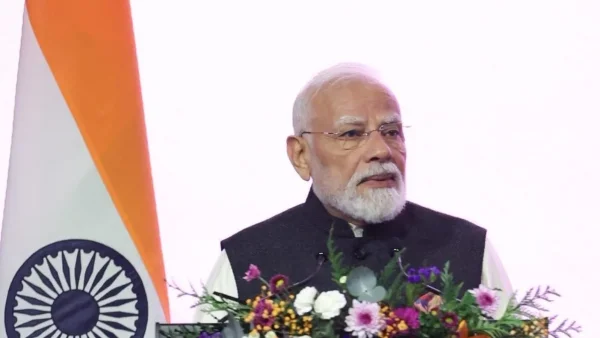
Make in India has shifted from slogan to signal. In Melbourne, Prime Minister Narendra Modi said the initiative is now a global brand and framed a next-step goal: India aims to be among the world’s top three economies, linking manufacturing depth with digital scale and defence credibility.
Manufacturing momentum and economic ambition
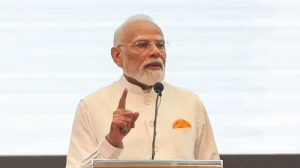
Modi told the Indian community that 12 years of Make in India have pushed locally made goods into worldwide circulation. He cited mobile phones and electronics, alongside automobiles and pharmaceuticals, as examples of products expanding their global footprint.
He argued that rising demand for Indian-made goods reflects a trusted production hub in the making. Setting an aggressive horizon, he added: ‘We aspire to become one of the world’s top three economies as soon as possible, driven by the motto ‘Grow more, achieve more’.’
Digital scale meets startup energy
The Prime Minister spotlighted innovation as a force multiplier. India has become the world’s third-largest startup ecosystem over the past decade, he said, adding that an Indian private space startup is preparing to launch a satellite using its own rocket for the first time.
On connectivity, he said India is now the world’s second-largest 5G market. The country is also working on Made in India 6G technology, a push that could enhance advanced manufacturing, services exports and secure communications.
Transport upgrade reshaping cities
Urban mobility is scaling fast. Over the last 12 years, India’s metro network has expanded to more than two dozen cities. More than 12.5 million people now use metro services every day, placing India among the world’s third-largest metro rail networks.
The government, Modi said, is accelerating semi-high-speed rail. Namo Bharat Rapid Rail and Vande Bharat trains are central to that plan, aimed at shrinking travel times, improving freight efficiency and modernising the wider transport backbone.
Security message and global posture
Linking industry with sovereignty, Modi said the world is witnessing the capability and credibility of India’s defence platforms. He pointed to Operation Sindoor as a demonstration that resonated beyond the immediate battlefield.
Operation Sindoor was launched by the Indian Armed Forces in May 2025 following the 22 April 2025 terrorist attack in Pahalgam that killed 26 people, mostly tourists. The operation involved coordinated precision strikes on terrorist infrastructure in Pakistan.
He paired hard power with soft power, stressing India’s humanitarian approach. ‘When India extends a helping hand, it does not look at passports; when India sends aid, it does not look at the colour of the passport,’ he said.
India-Australia ties and diaspora effect
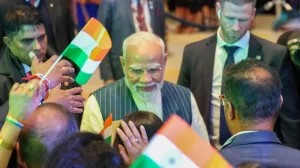
The Melbourne Meets Modi event drew tens of thousands, underscoring the diaspora’s role in bilateral ties. Modi called the community a key driver and noted this was his third visit to Australia in 12 years, reflecting a relationship moving at pace.
Australian Prime Minister Anthony Albanese and Victoria Premier Jacinta Allan addressed the gathering, signalling confidence in the partnership. Modi highlighted growing collaboration in education and innovation as a durable pillar of that engagement.
He pointed to concrete moves on campuses: Deakin University and the University of Wollongong have established campuses in India, with more Australian universities expected to follow. Such links aim to align skills, research and industry demand.
What to watch next
Four markers could define the next leg of this story:
– First private rocket-satellite launch by an Indian startup
– Progress on Made in India 6G development
– Faster rollout of Namo Bharat and Vande Bharat routes
– Further export gains under the Make in India brand
The message from Melbourne was directional, not ceremonial. Manufacturing breadth, digital infrastructure and defence credibility are being pitched as reinforcing loops. If execution holds, the push to join the world’s top three economies could move from aspiration to timeline.