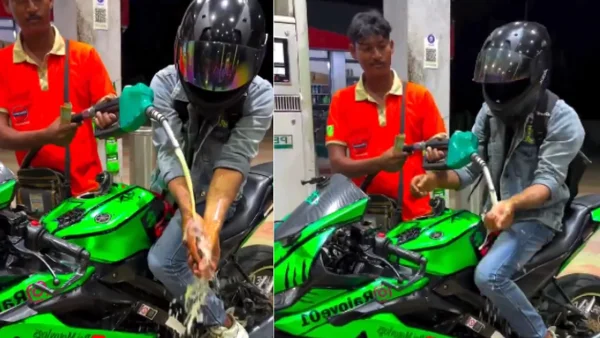
A viral video showing alleged unsafe behaviour at a petrol pump has once again triggered outrage on social media. While the authenticity and context of each viral clip should always be verified before drawing conclusions, the incident has reopened an important debate: Is India becoming too casual about public safety?
The issue is bigger than one employee or one petrol station.
It reflects a broader culture where safety rules are often treated as formalities until an accident happens.
Safety Rules Exist—But Are They Being Followed?
Every petrol station in India displays clear safety instructions:
No smoking.
Switch off the engine.
Avoid open flames.
Follow staff instructions while refuelling.
These rules exist because petrol vapours are highly flammable, and even a small ignition source can create a dangerous situation under the wrong conditions.
Yet videos of unsafe practices—whether by customers or staff—continue to surface from time to time.
The obvious question is: If safety rules are displayed everywhere, why do violations still occur?
Is This Just a Petrol Pump Problem?
Not really.
The same pattern can be seen across different sectors.
Construction workers without helmets.
People crossing railway tracks despite footbridges.
Ignoring fire exits in commercial buildings.
Overloaded electrical wiring in markets.
Unsafe handling of LPG cylinders.
In many cases, accidents are discussed only after lives are lost.
Preventive safety rarely receives the same attention.
Why Does This Keep Happening?
Experts often point to three recurring problems:
Poor enforcement: Rules exist, but inspections and follow-up action may not always be consistent.
Complacency: Many people believe, “Nothing has happened before, so nothing will happen now.”
Lack of regular training: Safety procedures need continuous reinforcement, especially in workplaces dealing with hazardous materials.
Social Media Has Changed the Conversation
Years ago, such incidents might have gone unnoticed.
Today, almost every unsafe act can be recorded and shared online within minutes.
That has two consequences.
On one hand, viral videos expose negligence that might otherwise remain hidden.
On the other, some people appear willing to take unnecessary risks simply because a camera is recording.
The pursuit of online attention should never come at the cost of public safety.
Should Authorities Take Stronger Action?
Whenever videos showing apparent safety violations emerge, the public naturally expects a response.
Authorities and oil marketing companies could consider:
Prompt investigations into verified incidents.
Mandatory refresher training for petrol pump staff.
Regular surprise inspections.
Strict disciplinary action for repeated violations.
Greater use of CCTV footage for internal safety audits.
The objective should be prevention rather than reaction.
Public Sentiment
Many social media users expressed frustration.
Some comments reflected genuine concern.
Others used humour to highlight the issue.
“The safety board seems to be the only one following the rules.”
“We spend crores on infrastructure but sometimes ignore the basics.”
“One careless moment can put dozens of lives at risk.”
"Public safety shouldn’t depend on whether someone records a video.”
While humorous, these reactions reflect a growing concern that safety compliance often becomes a priority only after something goes wrong.
The Larger Issue
This is not about blaming one employee or one petrol pump.
It is about building a culture where safety is treated as a professional responsibility rather than an optional guideline.
India has made remarkable progress in infrastructure, transport, and energy distribution over the years. But public infrastructure is only as safe as the people operating it.
A country does not become safer simply by writing rules.
It becomes safer when those rules are consistently followed, regularly monitored, and fairly enforced.
One viral video may fade from public memory within days.
The question it raises should not.
Are we waiting for the next accident before we start taking safety seriously?