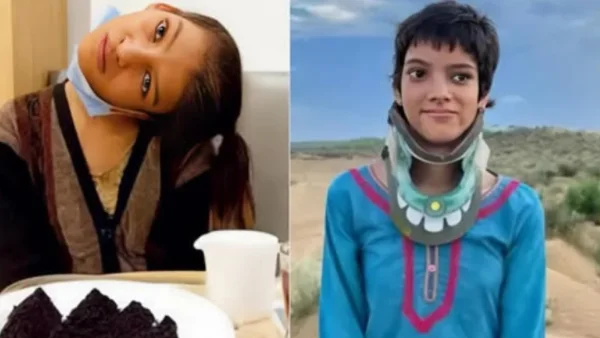
For most people, looking up is something they do without thinking. For Afsheen Gul, a young girl from Pakistan, it was an impossible dream for years.
A childhood injury left Afsheen with a severe spinal deformity that permanently bent her neck at nearly a 90-degree angle, forcing her to spend much of her life looking only at the ground.
Simple tasks became daily struggles. Walking, eating, making eye contact, and interacting with others were all affected by a condition that drastically limited her independence and quality of life.
Her life changed when Dr. Rajagopalan Krishnan, an Indian spine surgeon, learned about her condition and decided to help—offering to perform the highly complex surgery free of charge.
Everyday Life Became an Extraordinary Challenge
What began as a childhood injury gradually developed into one of the rarest and most severe spinal deformities.
Unable to lift her head, Afsheen reportedly faced years of physical discomfort and emotional hardship.
Activities many people consider routine became major obstacles.
She could not look people in the eye.
She could not easily attend school.
Even walking safely required constant effort.
For years, her world remained physically—and emotionally—tilted toward the ground.
A Cross-Border Act of Compassion
After learning about Afsheen’s condition, Dr. Rajagopalan Krishnan offered to undertake one of the most challenging procedures in spinal surgery without charging the family.
Correcting such a deformity required meticulous planning, multiple surgical stages, and months of rehabilitation.
The operation was considered medically complex because of the delicate nature of the spine and the risks involved in restoring the neck to a natural position.
Following surgery and rehabilitation, Afsheen achieved something she had not experienced in years:
She could finally hold her head upright.
Looking Straight Ahead for the First Time
Recovery was gradual.
Months of rehabilitation followed the surgery.
But with each stage, Afsheen regained strength, confidence, and independence.
The most emotional milestone came when she was finally able to look straight ahead instead of constantly looking toward the ground.
For her family, it was more than a medical success.
It was the return of possibilities that had once seemed lost forever.
When Medicine Succeeds Where Politics Often Struggles
India and Pakistan have experienced decades of political tensions.
Yet stories like Afsheen’s remind people that compassion often reaches places where diplomacy cannot.
Doctors take an oath to heal.
Disease recognizes no nationality.
Pain carries no passport.
Acts of medical care can sometimes build bridges that politics struggles to construct.
A Story That Touched Hearts Across Borders
The story has drawn widespread admiration online.
Among the reactions:
“Humanity has no nationality.”
“This is what real diplomacy looks like.”
“Doctors don’t see borders—they see patients.”
“A reminder that kindness can travel farther than conflict.”
“Some of the strongest bridges are built in hospital operating rooms.”
These comments reflect public reactions shared online.
Healthcare Can Unite Where Politics Divides
Cross-border medical treatment has long served as a quiet reminder that healthcare often transcends political boundaries.
Doctors, nurses, and hospitals routinely care for patients regardless of nationality, religion, or language.
Such stories highlight the universal values of medicine: compassion, expertise, and the commitment to improve lives.
She Didn’t Just Lift Her Head—She Lifted a Powerful Message
For years, Afsheen Gul saw only the road beneath her feet.
Today, she can look toward the horizon.
Her journey is more than a remarkable medical achievement—it is a reminder that the greatest victories are sometimes measured not in political agreements or diplomatic statements, but in the life of a single patient who is given another chance.