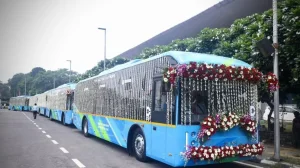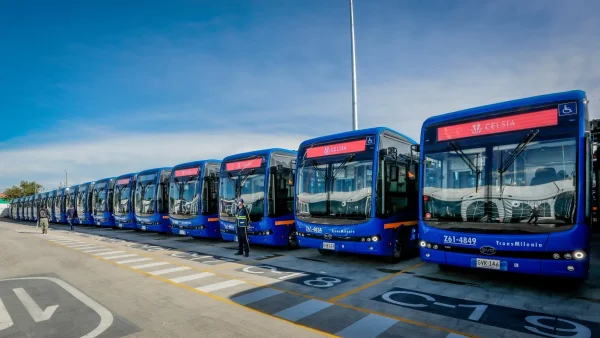
If you’re an operator thinking of making the switch, the sticker price is what gives you pause. E-buses and e-trucks run 2 to 2.5 times the cost of a diesel equivalent, so having credit on hand is what makes them work. The ministry has been clear about this, and for its part, it has signalled some support to make up for it.
“We see e-buses as the new backbone of passenger movement and e-trucks as the way forward for sustainable logistics,” said H.D. Kumaraswamy, the Union Minister for Heavy Industries and Steel. “We want to make sure the policy is something you can actually do in the real world.”
Who joined the push
That was the point of the get-together. It wasn’t just officials like Secretary Kamran Rizvi and Additional Secretary Hanif Qureshi in the room; there were people from across the electric mobility space, from the All India Motor Transport Congress to the South India Motor Transport Association. Lenders were there too, with heads from SBI, PNB, Canara, Central Bank, HDFC and Sidbi all in attendance.
What stakeholders flagged
They put the hard questions on the table: how to get the money, where to charge, when to deploy, and whether it will be viable in the long run.
Key takeaways from the consultation were clear for market participants:
– Financing design will determine early winners
– Charging build-out must match fleet scale
– Operator feedback will shape policy
– Banks are central to unlocking adoption
Charging is the one thing that stands out as a problem. Shyamasis Das of the Centre for Social and Economic Progress put it plainly: these are big batteries and they need to be topped up fast, and that puts a strain on the grid. You can’t have one without the other.
What changes could follow
The ministry is looking to smooth the path by better coordinating with industry and opening up credit lines that fit the way commercial fleets make their money. There was a hint at a new scheme back on April 29 to give private operators a leg up, and while the details are still to come, it’s a start.
Buyer checklist: planning an e-bus or e-truck fleet
For any company mulling over an electric fleet, the message from the day is to be practical. Do the math on total cost, pitting the higher buy-in against what you’ll save to run it. Make a case for your lender that holds water in terms of routes and utilisation. Talk to the financiers and the utilities before you even take delivery.
For operators, three near-term priorities emerged from the consultation:
– Shape bankable proposals with clear utilisation data
– Secure dependable, fast charging access
– Track credit-support schemes for timing and eligibility
In the end, as the experts would have it, this is the next big step for India. The ministry’s latest move is a matter of urgency: cut the red tape, put some faith in the charging network and get the vehicles moving.