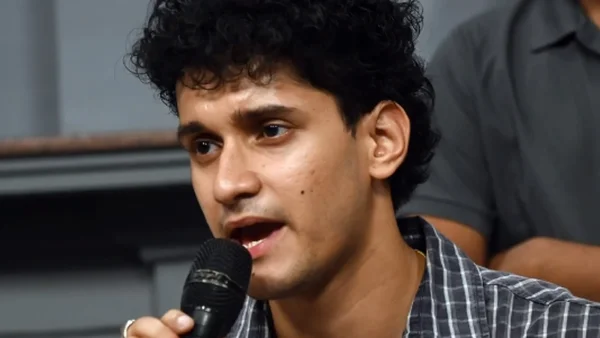
Civil rights activist and Citizens for Justice and Peace (CJP) member Saurav Das has sparked political debate with a statement questioning law enforcement priorities. Referring to reports that many Members of Parliament have declared criminal cases in their election affidavits, Das said:
“50% of Lok Sabha MPs have criminal cases against them, close to 100 MPs in the BJP. The Police can focus their energy towards them, not a 25-year-old harmless girl.”
The remarks have reignited discussions about criminal cases involving elected representatives, police discretion, and whether law enforcement agencies apply the law uniformly.
What Does the Statement Mean?
Das’s criticism is centered on priorities rather than merely statistics.
His argument is that if lawmakers facing serious criminal allegations continue to hold office while police devote significant resources to cases involving individuals who are not accused of violent crimes, questions about proportionality and fairness naturally arise.
Supporters of his view say this reflects a broader concern about selective enforcement.
Critics, however, argue that every legal complaint must be handled according to the law and that comparisons between unrelated investigations can be misleading.
Understanding the Numbers
The claim that around half of Lok Sabha MPs have criminal cases is based on analyses of self-declared election affidavits submitted by candidates to the Election Commission.
It is important to distinguish between:
Declared Criminal Cases
Candidates are legally required to disclose pending criminal cases when contesting elections.
A declared criminal case does not establish guilt.
Conviction vs. Allegation
Under India’s legal system, every accused person is presumed innocent unless proven guilty in a court of law.
Many cases remain pending for years, while others may eventually end in acquittal or conviction.
The Larger Question: Police Priorities
Das’s statement shifts attention to an issue that often surfaces in political debates:
Should Law Enforcement Focus More on Powerful Individuals?
Critics of the current system argue that investigations involving influential politicians frequently move slowly, while action against activists, students, journalists, or ordinary citizens can appear much faster.
Others reject this characterization, arguing that police investigate cases based on available evidence, legal procedures, and judicial oversight rather than political status.
The issue ultimately raises questions about consistency and public confidence in the justice system.
Public Reaction
The remarks have generated contrasting reactions.
Supporters viewed the statement as highlighting concerns about equality before the law. They argue that institutions should demonstrate the same urgency regardless of a person’s political position or influence.
Critics responded that merely having a pending criminal case does not make someone guilty and that police cannot ignore complaints simply because an accused person is an elected representative.
Some also argued that unrelated legal matters should not be compared, as each case must be assessed on its own facts.
The Broader Debate
India has long debated the issue of candidates with pending criminal cases contesting elections.
Election reform advocates have called for:
Faster trials involving elected representatives.
Greater political accountability in candidate selection.
Judicial reforms to reduce delays in criminal proceedings.
Increased transparency regarding criminal records disclosed in election affidavits.
These proposals seek to strengthen public confidence in democratic institutions while preserving the principle that guilt must be determined by courts, not public opinion.
Conclusion
Saurav Das’s statement has added to an ongoing debate about policing, political accountability, and equal application of the law.
Whether one agrees with his criticism or not, the larger questions remain significant: Should criminal cases involving public representatives be resolved more quickly? Are law enforcement priorities perceived as fair by the public? And how can institutions ensure that justice is applied consistently, irrespective of political influence or social status?
In a constitutional democracy, those questions are likely to remain central to discussions about governance, accountability, and the rule of law.