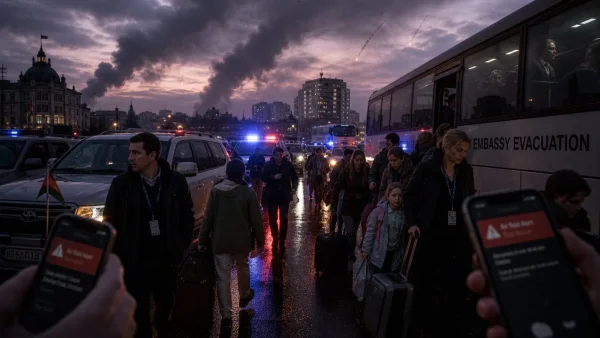
In an advisory put out on May 25, 2026, Russia has put the onus on diplomatic staff and other foreigners to make their way out of the city. They’ve been warned of new blows to ‘decision-making centres’ and the like. You can read it as a sterner turn in the war, one that may well see embassy operations put on hold for an evacuation while the fighting and the toll it takes continue to build.
Why the warning matters now
According to the Foreign Ministry in Moscow, the next round of attacks will be focused on what they see as Ukraine’s military command and defence industry. They have asked any foreign citizens or those working for international bodies to be gone from the city ‘as soon as possible’.
They won’t say when or exactly where. For once, there are direct word to the effect to the diplomatic community, which says something after one of the worst beatings the capital has taken since this all started.
What Moscow says it will target
It is being put forward as a fresh wave of action in the Ukrainian capital. The line from Russia is that they have command posts and so-called ‘decision-making centres’ in their sights, along with the rest of the defence apparatus in Kyiv.
The official word is of a ‘series of strikes’ but don’t expect a schedule. That kind of vagueness is leaving it to the embassies and agencies to figure out their security with not much to go on.
Implications for diplomatic and aid operations
You can only assume that if they do go after the command infrastructure in Kyiv, it will throw a wrench in the work of the internationals there. An exodus would put the brakes on consular and humanitarian efforts at a time when you’d want them running smooth.
It also means foreign governments have to have a hard look at their travel rules, their people on the ground and whether a mission needs to be moved for a while.
Escalation across the front
This comes on the heels of a day in which eight people have been put in the ground by missiles and drones on both sides of the border. Even with some talk of diplomacy, the violence is stoking the idea of a bigger push to come.
Down in the Kherson area of southern Ukraine, we have had two dead and 16 hurt in the last 24 hours, per the authorities. Over by Kharkiv, a Russian missile on Derhachi left one person dead and two with injuries.
Civilian toll on both sides
Over in Belgorod, right on the edge of Ukraine, a man was killed and another made ill by strikes that also cut off power and water. In Horlivka, in the east under Russian control, four are dead, two of them young.
There have been more in Dnipropetrovsk and Zaporizhzhia in the southeast, with eight wounded, a six-year-old among them. If you look at the photos from emergency services in Pavlohrad, you can see the smoke still coming off a nine-storey block after a drone hit it.
Competing claims and stalled diplomacy
Moscow is vowing to make an example of the one it says was a Ukrainian drone on a student dorm in Luhansk. Ukraine has no part of that, saying they were after an elite Russian unit and not civilians.
Neither side will admit to going after non-combatants since the full-scale invasion in 2022. But the finger-pointing shows how vulnerable these areas are, no matter who is in the right.
For all the work our partners have put into trying to get a ceasefire, there is no headway. Zelenskyy is calling for more of it, and for some extra muscle in the north, while he and his opposite number in Moscow keep trading barbs over who is ratcheting up the tension.
Here is the bottom line on what has happened:
– Russia has told its foreign guests and diplomats to vacate Kyiv
– ‘Decision-making centres’ and the like are on the list for the next strike
– No dates or specifics have been put on the table
– A minimum of eight have died in the last day in the two countries
– Ukraine stands by its actions in Luhansk, denying any civilian harm
Now it is a matter of seeing if the embassies make a move and if the promised strikes in Kyiv come to pass. With nothing in writing on when, the equation for any foreigner in the city is different, and we may see the focus of the war turn back to the heart of Ukraine’s political and military life.