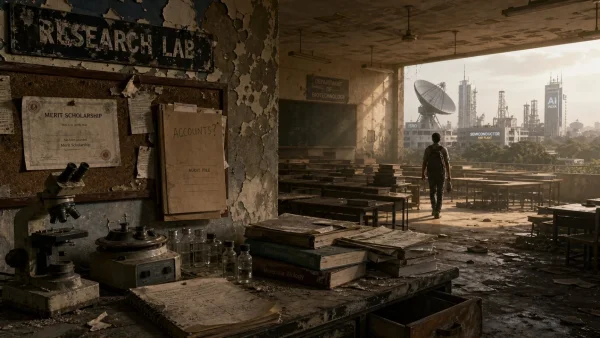
A country cannot build a scientific powerhouse merely by announcing ambitious targets. It needs functioning universities, research laboratories, libraries, classrooms, laboratories and—most importantly—a sustained commitment to students and researchers.
Yet concerns over deteriorating educational infrastructure have increasingly brought a larger question into focus:
What happens to the next generation of scientists if the institutions that are supposed to produce them are allowed to weaken? A damaged classroom can be repaired.
A neglected laboratory can eventually be upgraded.
But when inadequate infrastructure becomes a long-term condition, the damage can extend far beyond a building. It can affect the quality of teaching, research opportunities, student motivation and the country’s scientific pipeline.
Education Is Not Just Another Government Expense
Schools and universities are often discussed in terms of budgets and expenditure.
But education is better understood as long-term national infrastructure.
A laboratory is infrastructure.
A library is infrastructure.
A research centre is infrastructure.
A trained professor is infrastructure.
A scholarship that allows a talented student to continue studying is infrastructure too.
These investments may not produce an immediate political return, but their effects can last for decades.
The scientist working in a laboratory today may be training the researcher who develops tomorrow’s vaccine, semiconductor technology, space technology or clean-energy solution.
What Happens When the Foundation Weakens?
The consequences of institutional deterioration aren’t always immediately visible.
A student may start with inadequate laboratory equipment.
Another may struggle because research facilities are unavailable.
A PhD scholar may face delays because equipment is outdated or unavailable.
A talented researcher may eventually decide to pursue opportunities elsewhere.
Individually, these may look like isolated problems.
Collectively, they can weaken the entire research pipeline.
And that creates a difficult question:
If the country wants to become a global scientific and technological power, where will its scientists come from?
The Funding Question Cannot Be Ignored
Whenever an educational institution struggles despite receiving public funding, citizens are entitled to ask where the money went.
But there is an important distinction between asking for transparency and alleging that funds were actually diverted.
Claims of political horse-trading, diversion or misuse of educational funds require documentary evidence, audit findings or an official investigation.
Without such evidence, they remain allegations—not established facts.
That does not make the transparency question less important.
Quite the opposite.
Public money demands public accountability. If funds were sanctioned for laboratories, classrooms, hostels or research infrastructure, citizens should be able to see:
How much money was allocated?
How much was actually released?
Which institution received it?
What was the money supposed to build?
How much has been spent?
What remains incomplete?
Who was responsible for implementation?
Were independent audits conducted?
Political Priorities vs Educational Priorities
The deeper concern is about priorities.
Governments have limited resources and constantly make political choices about where money and administrative attention go.
Infrastructure projects can be inaugurated with ceremonies.
New schemes can be advertised.
Political announcements can generate immediate visibility.
But improving a university laboratory rarely produces the same spectacle.
A modern research facility may take years to deliver results.
Science requires patience. Politics often operates on deadlines. That mismatch can become dangerous if short-term political considerations consistently outweigh long-term educational investment.
The Scientist Who Never Gets the Opportunity
Perhaps the most overlooked consequence is the student we never hear about.
The teenager who could have become a physicist.
The undergraduate who could have become a biomedical researcher.
The engineering student who could have developed a new technology.
The doctoral candidate who could have produced internationally significant research.
If that student leaves science because the system provides inadequate facilities, poor mentorship or insufficient research support, there is no headline announcing what the country lost.
The loss is invisible. That is precisely why educational investment requires long-term thinking.
India’s Scientific Ambition Needs Strong Institutions
India has ambitious goals in areas including space research, artificial intelligence, biotechnology, semiconductors, quantum technology and advanced manufacturing.
But technological ambition cannot exist independently of educational capacity.
You cannot have world-class research without:
world-class researchers.
And you cannot consistently produce world-class researchers without:
strong institutions.
That means universities and research institutes need more than buildings.
They need functioning laboratories, competitive research grants, modern equipment, skilled faculty, scholarships, academic freedom and reliable administrative systems.
The Accountability Should Be Non-Partisan
This issue should not become another argument between political camps.
If a university is deteriorating under one government, it deserves scrutiny.
If the same thing happens under another government, it deserves the same scrutiny.
Public institutions belong to the public.
Their condition should not depend on which political party currently controls the government.
The simplest standard should be:
Was public money spent for its stated purpose, and did students and researchers receive the promised facilities? If yes, publish the evidence.
If no, investigate.
What Needs to Change?
A serious education policy should focus not merely on announcing new institutions but on maintaining and strengthening existing ones.
That means:
1. Transparent funding
Every major infrastructure allocation should be publicly trackable.
2. Independent audits
Large education and research projects should face regular financial and performance audits.
3. Infrastructure maintenance
Buildings and laboratories need recurring maintenance budgets—not just inauguration-day funding.
4. Research support
Students and researchers need reliable grants, equipment and access to laboratories.
5. Faculty recruitment
Vacancies cannot remain unresolved indefinitely if institutions are expected to deliver quality education.
6. Accountability for delays
When sanctioned projects remain incomplete for years, responsibility should be clearly established.
A nation can survive without another political slogan.
It cannot build a scientific future without strong educational institutions. Every broken laboratory, vacant teaching position, neglected library and unfinished research facility represents more than an infrastructure problem.
It represents a potential opportunity lost.
The real question is therefore not simply:
“How much money did the government allocate?”
It is:
“What did that money actually build—and what did it enable a student to become?” Because today’s neglected classroom could mean tomorrow’s missing scientist.
And if India genuinely wants to lead in science and technology, the first investment must be in the institutions that teach the people who will build that future.