Forecasters have it in their books: a fast-moving solar burst will be on us come Monday, June 8, 2026, with a good chance of it making its way to India. Nasa has put out a G3 watch, so if the skies are right, you could see some auroras in the north of India, as well as in Europe and down under.
The Space Weather Prediction Center put out a watch for the 8th and 9th after a CME was sent our way. We’re talking about a cloud moving at about 1,400 kps.
They expect it to be no slouch. The forecast is for a strong G3, with the possibility of some severe G4 intervals if things don’t go as planned. But agencies are saying any trouble for your power or satellites should be within reason and easy to handle.
“Region 4461 let one rip and we have a fast solar storm heading in,” says Dr Tamitha Skov, a space weather scientist. “Get ready for the 8th.” That’s in line with what we’re seeing in the alerts now.
What makes this eruption different
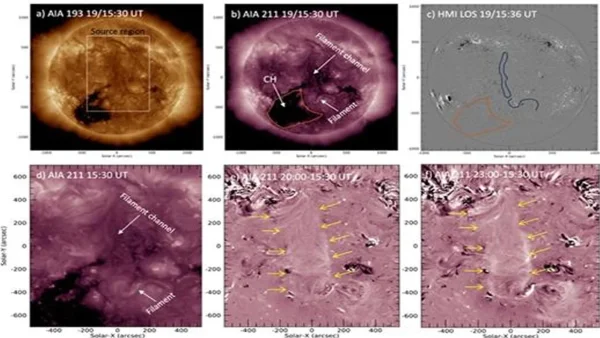
Don’t confuse this with your average flare. Back on the morning of June 6, 2026, Active Region 4461 put out an M1.8 flare with a thick, magnetised core filament pointed at us. Those kind of cores have a way of holding up and hitting with more force, and that’s what has people looking.
You can picture a filament like a river of cool, heavy plasma held in place by some unseen magnetic rigging. Let that rigging give way and it hurls the plasma out, taking powerful magnetic fields along for the ride and setting up for a more pronounced reaction once it gets here.
That same outburst made for an X-ray flare that topped out near 13:40 UTC (7:10 PM IST) on the 6th. It also put a billion-tonne mass of plasma in motion at over 1,400 km per second, which is enough to rattle things up a bit.
Who might see the aurora and when
Barring a change in the forecast, the auroras have the potential to go well past the poles. In the right conditions, you might spot a faint glow in northern India. Central Europe, the U.S. north and even some of southern Australia and New Zealand are fair game when the storm is at full strength.
What to do now
A G3 is enough to nudge the auroral oval south. If it were to veer into G4 for a time, you’d see the viewing area open up. To have any luck, you’ll want to be out where it’s dark and clear, and have some patience on the night of the 8th.
If you want to be in the running for a view of the aurora on Monday, here is my advice:
– Get to where the sky is as dark as you can make it
– In India, look north; in Australia, head south
– Make sure the clouds won’t be in your way
– Give your eyes 20 minutes to get used to the dark
– Stay on top of the official word as the night goes on
There’s been a lot of buzz. A timelapse of the aurora over Zhongshan Station in Antarctica has been making the rounds, and you can bet the photographers are getting in position for Monday.
The one variable that decides intensity
Our magnetic field will do its job and block the brunt of it, but there is one thing that will tell us how hard the storm really is.
There’s a magnetic field in the cloud. If the Bz component is pointing south when it gets here, it will make a good connection with our own.
Once they couple up, you can expect a rush of energy and stronger currents; the auroras will put on a show and move to lower latitudes. The more Bz holds its southward course, the better the display and the higher the storm rating.
It all comes down to timing, though. We can’t be sure about Bz until the cloud is 1.5 million kilometres out and in range of our monitoring spacecraft. That gives us a 15- to 60-minute heads-up before we know if the skies over northern India, Europe or Australia are going to light up.
A restless Sun and a complicating twist
The Sun has been in a mood this week, with eruptions coming one after another. A few days ago, back on June 3, Active Region 4455 was the source of some G2-level storms and left the solar wind in a bit of a tangle.
Sometimes a fast ejection will overtake a slower one and you get what we call a cannibal CME. They put together a heavier, more potent package. Monday could bring an interaction like that, and we’re on it.
Then there is the matter of the magnetic geometry. We saw an S-shaped, or sigmoidal, set-up in Active Region 4461, which means there was a lot of coiled-up energy in those fields. When they let go and reconnected, it was explosive – hence the flare and the CME.
Don’t be alarmed. For the most part, this is for the skywatchers. The agencies don’t foresee any major trouble. You might have a momentary blip on the radio, and satellite and power companies will be keeping an eye on things just in case.
The SWPC has a watch in for June 8-9, so don’t be surprised if there is some carry-over into the next night. Your best bet is usually between midnight and the early hours, but it depends on how the storm plays out.
Why this matters now
We see more of these flares and CMEs at the height of a solar cycle, but they don’t always come our way. This one is on track, it’s moving quick, and it has a dense core to it. That makes for a rare chance to see something from well away from the poles.
You can tell the enthusiasts are ready. Some have already put up photos from the smaller stuff we’ve had, and many are counting on this to be the highlight of the week. Nasa and the SWPC are on it, and we’ll have more to say as the CME closes in.
But until we have a hard number on the Bz, we can only guess. It will be the difference between a strong storm and a severe one, and whether the horizon in northern India is green or black. For the time being, the sky is holding on to its cards until Monday.