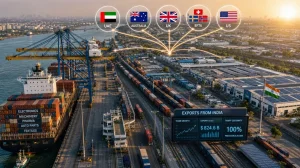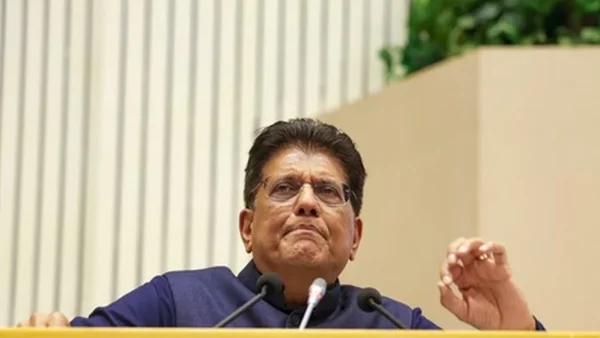
You could say India is looking to make a virtue of a potential tariff problem. Piyush Goyal, the Commerce and Industry Minister, has made it plain that as the US mulls over Section 301, they will be on guard for their side. In his view, what makes or breaks the value of the India-US deal is whether we can get that kind of preferential treatment.
It’s a no-nonsense position: your share of the market doesn’t just come from having a lower duty, but from being in a spot where you’re not paying more than the rest of Asia. Goyal says that is what is driving the current good headway in Washington, despite the fact that their own numbers are still being run.
Goyal has a way of putting the case for a trade pact in terms anyone can follow. The crux of it is preferential access. If a rival in a given market has to pay up, you have the upper hand; if they don’t, that edge is gone.
This is especially true in the hard-nosed world of textiles, apparel, leather, gems, marine products, carpets and the like. They are all about price. A little bit of a difference in duties is all it takes for a US buyer to look at Bangladesh or Vietnam or Sri Lanka instead of us.
Section 301: leverage and risk in one package
There is a way to work the system to our benefit, Goyal implies, using the tools already in place in US law. “We are trying to find a mechanism through which we can get a competitive advantage over our peers and competitors,” he put it, with an eye on the Section 301 process as the only way to do so.
The minister isn’t one to sound the alarm, but he is clear on the stakes. He sees Section 301 as the final legal avenue for the US to put a tariff on us, and while they will try to make the most of it, India will be there to see to its own interests.
In a word, here is how Goyal puts it when it comes to 301:
– We are in engagement and watching tariffs closely
– We are going to protect India’s interest
– I am confident that a deal will come through
He is confident the talks are on track and a deal is in the offing. But he has a caveat: the worth of it will be in the details, and if the 301 process tacks on extra tariffs to our exports, the final tally could be very different from what we have on paper.
Then there is the US proposal on forced-labour import controls. It’s not set in stone and is still being talked out. The rub is that the investigation isn’t on whether we use forced labour, but whether we are too lenient on imports from countries that do.
What the numbers mean for exporters
The figures are where the story is. In the last go-round on forced labour, US officials put forward a 10 per cent add-on for some of our neighbours and the EU, and 12.5 per cent for 54 others, India and China among them.
Put another way, the USTR has been talking of a 12.5% rate for India and up to 12.5% for 59 other nations. That’s why we are keeping a close watch on who gets hit with 10 and who with 12.5.
For an exporter, the math is simple. You can have a good deal on the table, but if a 301 surcharge is layered on, the profit is less. On the flip side, if your competition is facing a steeper 301, you come out ahead. It’s a matter of pricing room in the end.
So here is what will be on the minds of the boardroom and the trading floor:
– It’s the duty gap, not the absolute cut, that counts
– 301 can be a headwind or a tailwind
– Clarity now means you can plan for peak season
As for what’s next, Goyal has it down to a T: US Trade Representative Jamieson Greer is in India in the coming fortnight to have a further word on the interim deal. He had put it out there before that a deal might be in the offing by July, but he was careful not to put a hard date on any of it. “India is for fair and equitable trade; we don’t negotiate with a deadline over our heads,” he said, vowing that whatever New Delhi puts its name to will be even-keeled. As for 301, he made it clear no one has to lose sleep over it: they’ll handle it in India’s best interest.
In a way, Goyal is trying to put his own spin on things. He posits that Washington’s turn to Section 301 is as much about the hand Congress has put on reciprocal tariffs as it is an effort to put India in a better position. It’s a play for relative advantage, not just some big headline number on tariff reductions.
Beyond the US: making room for the UK, rethinking China
Then there is the matter of the UK. The minister made it known that if London goes ahead with its new steel import rules, India can have its concessions back in the CETA talks. And London has been blunt: from July 2026, they are capping tariff-free steel and will put a 50% levy on anything over the line, which is a 60% cut in the overall quota.
With China, Goyal’s message is that investment is fine so long as it’s in the right kind of sector and not some opportunistic move. In fact, the government has opened a 60-day window for fast-tracking FDI of up to 49% from our neighbours in certain areas.
Financial muscle and looking outward
Don’t expect him to waver on RCEP. He sees no point in going back on the decision to sit it out, given we already have pacts with most of the members. We’ll make up for the $112.4 billion merchandise deficit with China in 2025-26 by putting up a fight against dumping and building up at home.
Any suggestion of clamping down on capital or repatriation is something he waves off. With CAD under 2% and forex in good shape, there’s no need for it. His advice to the banks and corporates is to get out of their shells and go after the world, UPI and all.
He has put nine bilateral deals in the bag in the last three and a half years with 38 of the more developed economies, and he’s not done. You can find us in talks with everyone from Israel and Canada to Chile, Peru, Mexico, and the Mercosur and Eurasian blocs.
We’re looking to hit $1 trillion in combined goods and services this year, up from the $863 billion in 2025-26. Down the road, the goal is $2 trillion by 2030-31 and $6 trillion by 2047.
What to watch
The coming fortnight with the US will be the true test: can we secure some preferential treatment without 301 chipping away at it? It’s not only about lower tariffs, but whether our products can be put on the shelf in the US at a better rate than the competition.
For those in textiles, leather, gems, or engineering, a 10 or 12.5 per cent difference in what a US buyer has to pay can change the order of the day in a hurry. One way or the other, you either get the business or you don’t.
Goyal is using some deft diplomacy to make a virtue of the situation. If the 301 numbers end up putting our rivals in a bind, our side of the table will come out ahead. If not, he has made it plain we have other options.