It was a no-nonsense decision to put commerce on both sides of the Atlantic on firmer ground. On 16 June 2026, the Parliament gave the nod to the deal, allowing Brussels to head off any fresh American impositions and offer the kind of certainty that businesses are after. You could say the vote puts an end to months of hardball and paves the way for a quick rollout once the red tape is out of the way.
Immediate impact and stakes
This means the EU is on track to make good on a July 4 line in the sand drawn by President Donald Trump and put to rest his warnings about tariffs on our vehicles. In a $2 trillion relationship, you can’t put a price on predictability, especially after a year of one tariff shock after another.
Then there was the barrage of duties on steel, aluminium and the like when Trump made his way back to the White House. Commission President Ursula von der Leyen was on the case, looking for a way to lower the tone with Washington and get some stability back.
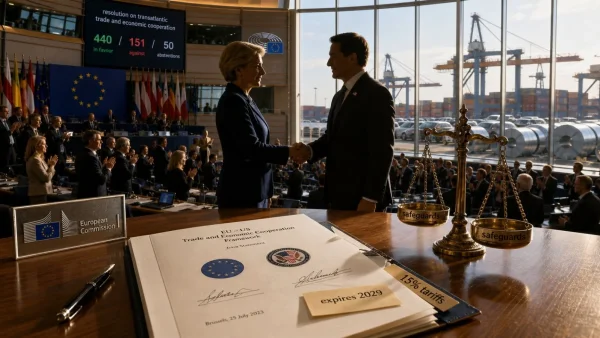
What happened in Tuesday’s vote is why the timing is so much on people’s minds:
– 440 in favour of the deal
– 151 against, 50 who sat this one out
– A way to keep new auto tariffs at bay
– A foundation for a $2 trillion partnership
Brussels hardens the rulebook
The Parliament has put in place some safeguards to even things out. Come the end of 2029, the agreement is done for unless it is renewed. And if the US side of the equation should falter on its word or get in the way of trade, the Commission has the authority to put a stop to it.
You won’t see the same kind of jitters we’ve had of late. After some delays caused by a Supreme Court ruling and some of Trump’s posturing over Greenland, lawmakers have given the Commission some more bite in the form of a sturdier pact.
Lawmakers underline leverage
“It’s not without its flaws,” says Bernd Lange, who heads the trade committee. “But it is a lot stronger.” He made it clear they will be watching to see how it is put into practice and won’t let the US side get away with any oversteps.
For Karin Karlsbro, a centrist, the vote was a way to stand up to those kinds of tactics.
“Parliament did the right thing in not caving to Trump’s pressure,” she put it, adding that the deal is a necessary base for some stability, no matter how combative Washington may be.
How the numbers lined up
You had the backing of Europe’s two biggest conservative blocs – the European People’s Party and the hard-line European Conservatives and Reformists. That was what made the 440-151 vote possible and showed there’s a willingness on both sides of the aisle to have some certainty after last year’s whiplash.
Jorgen Warborn of the EPP was blunt: the tariff arrangement is the only one that makes sense and is as good as it’s going to get for EU companies. “In an uncertain world, a stable transatlantic economy is just what we need in Europe,” said Michael Strauss, a voice for the ECR.
Then you have the opposition from the Greens, the Left and some in the centre. They feel the bloc is still too soft on its own interests. It’s a debate in Europe that hasn’t been settled: how much do you push back when the U.S. does as it pleases?
What the agreement actually does and what is next
The terms were put in place back in July. We’re looking at 15 percent on most of the bloc’s wares, with Brussels giving the U.S. a free pass on their industrial output. The EU capitals have already given the nod, so Tuesday was the last political formality.
Now it’s down to the nitty-gritty: a few more weeks for member states to put their stamp on it and for it to be published in the official journal. After that, it’s law.
It was a long road to get here. There were months of hold-ups after Trump's posturing over Greenland and a Supreme Court ruling that voided some of his tariffs. But von der Leyen’s people moved to put something in place to manage the damage.
Some, like Brando Benifei, want Brussels to put on a sterner face. “We have the text to act if we have to,” he said, seeing the package as a way to buy time without leaving the door open for Washington to renege.
Strategic positioning for the next round
Don’t be fooled into thinking the safeguards are for show, the EU says. As Bernd Lange has it, Parliament won’t let any deal from the U.S. go through if it doesn’t serve us.
Warborn is on the Commission to stay in touch with Washington and make inroads for our businesses. The message is that this is a springboard, not a standing still.
At the end of the day, it’s simple. You give your exporters some peace of mind, you have a legal safety net, and you don’t have to worry about another tiff over European cars. Whether those guardrails will stand up to a change in the wind is the question for down the line.