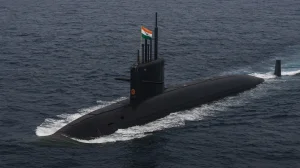
Defence Minister Rajnath Singh oversaw INS Aridhaman becoming part of the Navy in Visakhapatnam. The event was fairly private, but Singh wrote a short, strong statement on X (formerly Twitter) saying “It’s not just talk, it’s power, Aridhaman!”
INS Aridhaman: design and propulsion
INS Aridhaman is an SSBN of the Arihant type, built at the Ship Building Centre in Visakhapatnam as part of the Advanced Technology Vessel project. It’s about 7,000 tons in weight, so bigger than the ones before it, and has been improved in its design to go further and be harder to detect.
It’s powered by an 83 MW Compact Light Water Reactor, which is a more advanced type of pressurized water reactor, and is made to be very quiet. A propeller with seven blades, and special covering on the hull both help reduce noise, and allow the submarine to go around 24 knots (around 28 mph) while underwater.
Missile loadout and combat systems
Aridhaman has eight places to launch missiles from straight up, more than the four on the previous submarines. These places can be used for a variety of missiles: the K-15 Sagarika (a shorter-range missile launched from a submarine), the K-4 (a medium-range missile) and, in the future, the longer-range K-5 missile.
The submarine’s ability to find other ships and to survive being attacked is improved by advanced Indian sonar systems (USHUS and Panchendriya) and special tiles on the outside that absorb sound (anechoic tiles). It can carry many different missile types, giving flexibility in what it can target and ensuring a strong ability to respond with a nuclear attack if needed.
Strategic significance and Continuous At-Sea Deterrence
Now that INS Aridhaman is in use, a very important stage in India’s plan for having a nuclear weapon capability at sea is complete. With Arihant, Arighat and now Aridhaman, India is getting closer to having a SSBN constantly on patrol, meaning it will always have the ability to launch a nuclear weapon from the sea. This is called Continuous At-Sea Deterrence.
Having a believable fleet of SSBNs makes it much more complicated for any enemy to make a strategic decision. It also puts India in a very small group of countries that have nuclear-powered submarines with ballistic missiles, and makes India’s ability to deter attack in the Indian Ocean region even stronger.
Fleet context and future submarine plans
INS Arihant was launched in and officially joined the Navy in 2016. INS Arighat became part of the Navy in 2024. The fourth and fifth SSBNs are already being worked on, and they are expected to be larger and more advanced than the Arihant-class.
The Navy also intends to build its own nuclear attack submarines (SSNs), with the first one in 2036 or 2037 and the second about two years later. The Cabinet Committee on Security has said construction of these first SSNs can go ahead, showing a long-term move towards designing and building nuclear submarines in India.
Bases, command and wider procurement efforts
INS Aridhaman will likely be based at Project Varsha, a secret Navy base with underground shelters for strategic submarines near Visakhapatnam. Once it’s fully working, these SSBNs will be controlled by the Strategic Forces Command.
Alongside building the submarines in India, the country is also improving its abilities with help from other countries. India is planning to lease an Akula-class attack submarine, and is discussing getting more advanced diesel-electric submarines under Project-75(I) to update its regular submarine fleet.
Program challenges and long-term outlook
Developing the submarine program has had its problems with technology, the ability of industry to make them, and how much they cost. In 1999 the Navy had a long-term plan for 24 regular submarines by 2030, but only a small number of those have been added to the Navy so far, showing how difficult it has been to buy and have enough submarines.
However, INS Aridhaman becoming part of the Navy is definitely a big step forward in making India more strategically modern. With more SSBNs, the SSNs coming up, and other regular submarine projects happening at the same time, India is investing in a variety of submarines to support the country’s ability to deter attack and keep the seas safe.