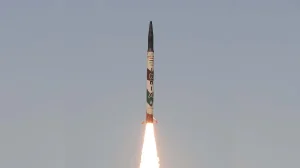
India’s push for precision artillery took a decisive step on Wednesday as DRDO’s Pinaka Long Range Guided Rocket completed a successful flight-test in Chandipur, Odisha. Defence Minister Rajnath Singh called it a major milestone, after the rocket executed all planned manoeuvres and struck the target exactly as predicted.
Why this test matters
The LRGR is the guided evolution of the indigenous Pinaka system, built to deliver accurate strikes at extended ranges. Under the Aatmanirbhar Bharat initiative, such upgrades aim to strengthen Army firepower while reducing import dependence.
The government noted that India’s long-range rocket artillery is being steadily modernised through developmental and user trials across the country.
Proving precision at the minimum range
According to the defence ministry, Wednesday’s test validated the user defined minimum range of 60 kilometres. The round performed all in-flight manoeuvres and impacted as forecast, affirming guidance, control and mission planning at shorter ranges.
The rocket was launched from the Pinaka launcher already in service, ensuring compatibility with existing Army inventories and easing future induction planning.
Range envelope and recent milestones
The LRGR’s maiden test flight in December 2025 was conducted for the range of 120 kms at the same Integrated Test Range in Chandipur. With the latest validation at 60 kilometres, the effective range currently spans between 60 and 120 kms, covering a key tactical envelope.
In March, the Pinaka Extended Range Rocket underwent a separate proof trial at the Pokhran Field Firing Range in Rajasthan, where 24 rockets were test-fired to confirm accuracy, consistency and lethality before operational induction.
Who built it and how it was overseen
The government said the High Energy Materials Research Laboratory and Armament Research and Development Establishment led development of the LRGR, with support from Defence Research and Development Laboratory and Research Centre Imarat.
DRDO Chairman Rajesh Kumar Singh, who is also Defence Secretary and Secretary of the Department of Defence R&D, personally monitored and assisted the teams during the test, underscoring the programme’s priority.
Key developments at a glance
Here are the essential takeaways from the latest trial and recent progress:
– Minimum range validation at 60 kilometres
– Maiden LRGR flight at 120 kms in December 2025
– Effective range between 60 and 120 kms
– 24 rockets validated at Pokhran in March
Strategic direction and official view
The Defence Minister has emphasised that indigenous guided rockets will boost the capabilities of the Armed Forces. The government added that further details of Wednesday’s flight-test will be shared in due course.
A recent expert commentary, cited by the government, argues India is moving from area domination to long range precision strikes. According to that analysis, this broadens conventional response options and reshapes opening-phase force application.
What comes next
The Pinaka family is being progressively upgraded with extended-range and guided variants to improve accuracy, range and battlefield effectiveness. As trials expand, the LRGR is expected to sharpen the Army’s precision strike toolkit under indigenous programmes.
With the latest success, DRDO’s focus now shifts to data analysis, iterative improvements and steps toward user acceptance, aligning development cadence with operational needs.