You can see the strain on Banerjee’s hold on the Trinamool Congress as 20 of her lawmakers have made a stand. They say they are now part of the Nationalist Citizens Party of India and have put in a request to the Lok Sabha Speaker for that to be made official.
Why this is significant
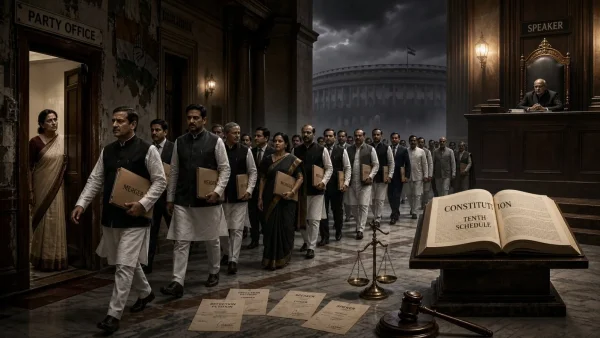
There is no time to waste for the three sides in this: the rebels, the TMC top brass, and the Speaker. The MPs are making their case under Paragraph 4 of the Tenth Schedule, which is meant to cover mergers. For Banerjee, it is about more than the numbers in Parliament; it is about who is in charge.
In the end, the Speaker is the one with the keys. The office will look at the paperwork and the claims before deciding if this is a separate faction or a matter for disqualification. But even then, it isn’t final. A 1992 ruling from the Supreme Court means there is always an avenue for review.
The constitutional side of things
You will find India’s rules on defection in the Tenth Schedule. Put in place by the 52nd Amendment in 1985, it was a way to put a stop to floor-crossing and keep governments from toppling. It is aimed at two things: when you leave your party of your own volition, and when you don’t follow the whip, like by not showing up to vote.
If the party doesn’t let it slide in 15 days, the seat is gone. The one exception is a merger. But to make good on that, you have to prove it is not just a plain defection and meet some hard requirements, like the two-thirds rule.
What the TMC has to figure out
Some recent decisions in the Shiv Sena row have made it clear: the legislative and the parent party are one and the same. The Trinamool line is that the MPs can’t unilaterally merge the party. The 20, however, say they have and they’ve told the Speaker as much.
Where we go from here
These 20 won’t be in any danger right away if they can pass the legal hurdle of a merger. It comes down to whether the Speaker, and the courts if need be, see it as a bona fide arrangement under the Tenth Schedule.
It will be decided on these points:
– Do the signatures and the story add up?
– Is the two-thirds mark met?
– Does the Speaker give it his seal of approval or not?
– And if it goes to the Supreme Court, what do they say?
For Banerjee, the fallout could be serious. After ceding ground in the state, she doesn’t want to see her authority in the organisation erode if the rebels are given the nod. Should the merger not hold up, disqualification is on the table.
Putting the law to the test
In a way, you can view this as a kind of referendum on how the law is written. Some will tell you parties have become adept at working around it, so who holds the Speaker’s office has become more of a factor than the letter of the law. You can see that friction now more than ever.
Then there is the irony of it all. Banerjee has been known to be on the receiving end of leniency in Bengal, where defectors were allowed to keep their seats. Now, those very kinds of moves are what is putting her party’s cohesion in jeopardy, and the law is being looked at with a fine-tooth comb.
After a split of this magnitude, the talk of reform is only going to get louder. Some would like to see an all-party sit-down to rework the provisions. But don’t expect an easy agreement; each side can think of a time when the vagueness of the current system might be to their advantage.
But it is more than just one side winning or losing. In a democracy, you have to have some trust between the voter and the one he puts in office. When you put tactics ahead of that, you are chipping away at the foundations of Indian democracy, no matter how you spin it in the short run.