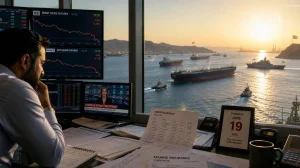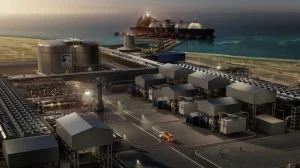
The message from oil executives is that we’re running a little too thin on stored product. The coming weeks will be telling as to whether we keep our composure or see prices lurch. It all comes down to how quickly a deal with Iran can be put in place to get things moving through the Strait of Hormuz and put some meat back on the bones of our stockpiles.
You would think the numbers would be jumping in response, but in a way, they haven’t been. U.S. oil was 4.1% lower on Sunday night, at $81.42 a barrel, and over 25% off where it was in early April when we were near $113. Yet for all that, the reserves have been bled for some time now.
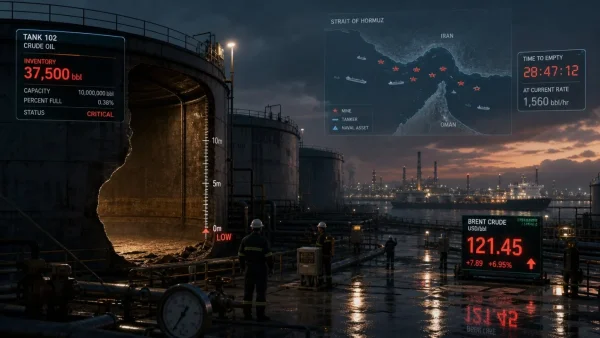
Take Cushing, Oklahoma, for instance. The buffer is wearing thin. We’re at 21 million barrels, a drop of about a million in the last week. Storage people will tell you that once you get to the 20-million mark, you start to run into trouble with deliveries and the like.
For 15 weeks and more, the U.S. and others have been tapping into their tanks, salt caverns and strategic hedges to make up for the millions of barrels held up on the other side of the strait. It’s put a strain on commercial stocks and left very little room for a misstep.
Inventories Near Operational Floors
We’ve seen the U.S. pull some 66 million barrels out of the Strategic Petroleum Reserve since the end of March. The reserve is a series of salt caverns on the Gulf Coast, put in place in ’75 in the wake of the Arab embargo. The administration has given the go-ahead for 172 million to be released.
Keep this up and you could be out of that allotment by early September. If it’s used up, SPR numbers would be at 243 million barrels, which is as low as it has ever been. For context, we had over 700 million in 2009.
Any more of that and you limit what the U.S. can do if a hurricane or some other disruption comes along and rips up the supply chain. That is something the people watching Cushing move toward its limits have on their mind.
‘Whenever you get to tank bottoms, the whole operation gets bogged down,’ says John Auers, who does refined fuel analytics. He notes that you need 10 to 15% in the tank to run smooth. The outlet is set for that, and there is sludge at the bottom of it all.
Auers is careful to point out the 20-million figure at Cushing isn’t a wall. You can still pump, just not as fast. But when you lose that kind of flexibility, the market has a way of making a show of it.
The Cushing Constraint
So with Cushing at 21 and the 20-million mark being a problem spot, traders are working out what happens when the rest of the world’s hubs run into the same brick wall. It’s no longer a matter of theory. We are edging close to the minimum the system can handle.
Neil Chapman of Exxon calls the U.S. inventory levels ‘unheard-of.’ He’s also put out a word of caution that once you can’t move the barrels as easily, physical prices could be as much as $150 or $160 a barrel.
‘You can argue over whether it will be two or three weeks before you hit those lows. But when you do, you will see the numbers go up,’ he told a room in New York the other day.
Iran Deal Promises Relief, But Not Overnight
On Sunday the U.S. and Iran came to terms on a deal, to be inked in Switzerland on Friday, that should put the Strait of Hormuz back in business in short order. It is a key piece of the pipeline for 20% of the world’s oil.
But don’t expect the market to right itself in a day. Even with a deal, it is a matter of months to get back to where we were, and filling up the empty tanks will take even more time. So prices will likely stay up, as any number of officials and industry types will be the first to admit.
President Trump has said we have to be sure the mines are gone. And you can bet the shippers and their underwriters will be leery of the waterway for a while. That alone may put a damper on exports for some time after the formalities are done.
Conflicting Signals On Current Flows
Energy Secretary Chris Wright made the case last week that 7 million barrels a day of product are getting through with the military’s help. If that holds, it would be some relief.
Chevron’s Mike Wirth doesn’t quite buy it. ‘It is probably not quite that much,’ he says. You’ve heard him on TV time and again: a global supply squeeze is coming as our storage dries up and we lose any room to manoeuvre.
Wil VanLoh of Quantum Capital Group doesn’t mince words. “It is going to get ugly,” he says. “The world has never had to write off 10 million barrels a day of oil demand” in the way it’s having to now, with crude not making it to where it needs to be.
Executives Warn Of Price Shock And Policy Risks
Oil men will tell you that unless some new supply comes in, prices have to go up to put a halt to the run on what we have in the ground. It’s not so much about the ups and downs of a given day; it’s a system that can’t be pushed below its floor.
For months the administration has been saying the heat on energy prices will cool once we have a deal with Tehran. Trump for his part has made it clear he’s not worried about the political cost of his stand-off with Iran, no matter what’s happening at the pump.
But if this doesn’t end in a hurry, you could have a perfect storm. With the midterms in view and polls showing Americans are fed up with the Iran situation, falling inventories could be the spark.
Short-Term Prices Versus Long-Term Security
U.S. crude was down 4.1% to $81.42 on Sunday after the open. We’ve seen a better than 25% drop from back in early April when we were near $113. The numbers at the gas station have come down, for a while at least.
Wright says the White House isn’t expecting a spike. “I do not think so…we got a challenge, but I think we are solving the challenge,” he says, citing work to keep things moving.
Taylor Rogers, a spokeswoman for the president, put it like this: “When the president forces this conflict to a successful end, gas prices will be back to multiyear lows and the markets will be in a better place.”
Geopolitics Keeps The Clock Ticking
A deal to lift the American cordon and open the strait is only the first step, U.S. officials say. There are some thorny nuclear talks to follow. They are at odds over what to do with Iran’s highly enriched uranium.
If those questions aren’t put to rest, the strait’s security will be in doubt for the long haul. And even with the mines out of the water, that kind of uncertainty makes shippers hold back.
The White House line is that a deal will put an end to the pressure. But the more we let inventories run down, the harder the market is going to lurch when it has to.
What To Watch Next
We’ll see in the next few weeks if we can put a lid on inventory levels before the big hubs max out. Folowers of the market will be on to the strait, the tanks at Cushing and how fast the SPR is being drawn down.
How you handle shipping risk will be the difference. You can have an open strait and still have insurers and shippers treading carefully while they finish clearing things up. When your stockpiles are that low, every day counts.
Then there is the question of emergency reserves. If you pull any more after 243 million, you’re chipping away at what you can do in a hurricane or the like. That is a hard call for policymakers.
Here is what to keep an eye on:
– The U.S.-Iran signing in Switzerland this Friday
– What the daily tonnage looks like in the strait
– Cushing’s weekly numbers versus the 20 million mark
– How the SPR is tracking to 243 million
– Any sign of a run-up to $150 or $160
In the field, the math is what it is. You need 10 to 15% in the tank to make it work. Get any lower and you have slow-downs, quality headaches and thin margins. One scheduling hiccup and you feel it.
And for the average driver, a little price relief now might be hiding a problem. You don’t put back what you’ve built up in 20 years in a week, particularly with a 20% of the world’s petroleum running through a hot spot.
From Chevron to Exxon, the top brass have said it: put some new barrels in the market or we will have to raise the price to make the numbers work.
So the real issue in the days ahead is not if there’s a deal, but if it can put oil in the tank as fast as we’re using it. If it can’t, the noise in the boardroom is going to be the same one you hear at the forecourt.