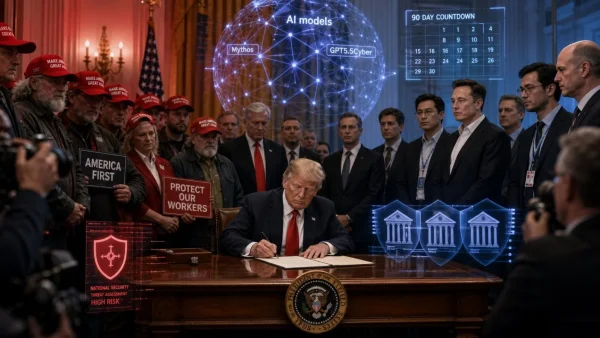
There’s a divide in President Donald Trump’s coalition and it is going to define how the U.S. polices artificial intelligence. An order could come down as early as Thursday, with the timing no doubt influenced by the kind of security anxieties you’re hearing from his supporters. It all comes down to whether or not firms can put out their most potent models without the kind of pre-vetting that banks and other key players are calling for.
What the draft order would change
Those in the know say the order won’t be a stick. It’s more of an open door for developers to talk with the government before they go to market, in an effort to head off demands for hard-and-fast mandates and put to rest some of the cyber risk warnings.
One person familiar with the thinking said the plan would have developers hand over their wares 90 days in advance. They would also be expected to let the likes of banks, who run critical infrastructure, have a look at them first.
The White House is even rounding up some of the top AI heads for a signing with the president, according to another source. It’s a way of showing that we’re looking for partners, not subjects, in the early going.
But don’t expect any details to be given away. A White House mouthpiece put down any chatter on the specifics as “speculation.” We put in for comment with the National Security Agency and they sent us back to the White House; National Cyber Director Sean Cairncross was no help either.
A Republican split over AI risk
To its proponents, a 90-day window for review is a way to find the weak spots without getting into a tangle with regulators right out of the gate. Then you have the critics who see it as not enough, especially when it comes to mandatory testing for the heavy-hitters, something some of Trump’s more vocal followers want.
You have people like ex-White House adviser Steve Bannon and conservative fixer Amy Kremer ratcheting up the pressure for the administration to make sure top-shelf models are put through their paces by the government. In a letter last Friday, the group made it plain they wanted the OK on anything “potentially dangerous” before it was let loose.
Kremer, for one, will tell you she’s not for new regulations in principle, but she thinks AI is a different animal and the public has to be shielded. She was behind the January 6, 2021, rally, though she says she didn’t cross the line with the thousands who did. Her stance is part of a change you’re seeing: old-timey Republicans were never for red tape, but some of the more visible ones are now asking for some guardrails.
New models intensify the debate
And with the likes of Anthropic’s Mythos and OpenAI’s GPT-5.5-Cyber coming to light, the ground has shifted. Two sources said these have only stoked the fear that a bad actor could use a tool you can buy off the shelf to automate a cyberattack.
Some in the security world think the alarm is overblown. But for the companies, there’s a warning that if policymakers decide to put the brakes on or make them retool to lower the risk, it’s going to cost them.
“Haven’t we had a massive wake-up call in the last few months on the sort of vulnerabilities AI can bring to the table?” asked former Rep. Brad Carson. Then there’s Neil Chilson of the Abundance Institute, who has a different take. He says that if you hold back on releases, you’re only buying a temporary advantage; in his view, the US ought to be putting out its systems and shoring up its defences.
On the other side of the table, lawmakers have put it to Cairncross to make sure the agencies are on top of any “sudden frontier AI capability jumps.” And the NSA is in on the administration’s wider discussions about how to handle Mythos, as two people in the know put it.
Industry influence and potential fallout
So far, Trump’s approach to AI in this second term has been in step with what the tech world wants: less red tape. You had David Sacks, the venture capitalist who was the president’s top AI hand until he moved on in March to co-run the tech advisory committee. The ties between the White House and the industry are no secret. When Trump was sworn in back in January 2025, you could see the likes of Mark Zuckerberg, Jeff Bezos, Sundar Pichai and Sam Altman in the front row.
Some in the sector would like to see the Commerce Department’s Center for AI Standards and Innovation take the lead on policy for the more advanced models. They say the companies are open to working with the centre’s scientists and security experts on a voluntary basis. That’s not new – OpenAI and Anthropic have been sending their wares in for a look-see for some time. (The center was called something else when Biden was in office.) Back in May, the Commerce Department put out word that Google, xAI and Microsoft were to be tested for security, but the fine print has since been scrubbed from their site. Neither the White House nor the department would say why.
A move by the president to put the brakes on large language model rollouts or to force some safety tweaks could eat into profits in the short run. But those in the industry will tell you that if you deploy with some care and have your defences in order, you come out stronger in the long haul.
Who is shaping the order
Behind the scenes, there’s been a good deal of work over the last month from Susie Wiles, the chief of staff, and her deputy Walker Barrett, along with Michael Kratsios and Sean Cairncross. A person involved in the planning says the AI firms had a say in the drafting. It all points to an administration that wants one way of doing things when it comes to pre-release access, testing, and talking to the parts of the economy, like finance, that are most at risk from cyber threats.
What comes next
By Thursday, the president may put his name to it. It would be a voluntary measure, calling for 90 days of engagement with developers and giving early access to the banks and the like. The White House has even mull over having the AI CEOs in the room for the signing to show they’re in on it.
You can expect some hard questions right away: what models does this apply to? How will the review process go? Will we get answers in a timely fashion? It will be up to the framework to put security concerns to rest without stifling what these companies do.
In a way, the administration is walking a line between its own base. You have the populists for some firm rules before anything goes live, and then the industry types who want to be able to ship and fix as they go. This order will tell you where the White House stands.
Here is how the two camps are positioning themselves:
– Populists want mandatory pre-approval for ‘potentially dangerous’ systems
– Industry allies prefer voluntary cooperation and minimal mandates
Assuming the timelines and the voluntary testing stick, you might see the critical providers find a flaw or two down the line. If the companies don’t go along with it, you can bet the calls for something mandatory will start up again. One thing is for sure: with Mythos and GPT-5.5-Cyber in the mix, AI oversight is no longer a matter of theory.