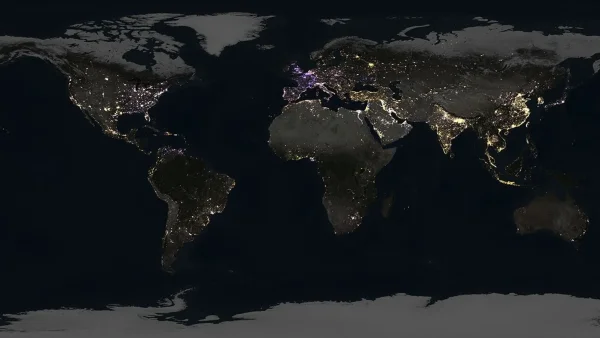
NASA has just released a global map of nighttime lights showing how much they’ve changed from 2014 to 2022. In the pictures, Uttar Pradesh and Bihar are easily the brightest places on Earth. People on social media were amazed by this, and it’s restarted conversations about development and access to power.
How the map was created
Researchers looked at over a million pictures of the Earth at night taken over nine years. These came from the Visible Infrared Imaging Radiometer Suite (VIIRS) and were analyzed using a new method created by a team at the University of Connecticut, led by Tian Li and Zhe Zhu.
The data covers most of the places people live, from 60 degrees south latitude to 70 degrees north. The analysis can pick up even small sources of light, as small as a toll booth on a dark highway, allowing a very detailed look at human activity from space.
Interpreting the colors and global trends
The map uses a simple coloring system: golden areas are where nighttime lights have gotten brighter, and purple areas are where they’ve gotten dimmer. This allows people to quickly see which places have become brighter or darker between 2014 and 2022.
The broad trends shown on the map are interesting. India, China, the Middle East, and parts of Central America are mostly gold, while large parts of Europe are purple. In the United States, the states in the west are mostly gold, and the eastern states have a mix of colors or are dimmer.
Why the UP-Bihar belt stands out
The Uttar Pradesh-Bihar area appears as one of the brightest places on Earth on the map. That increase in brightness shows that more people are getting electricity, industries are growing quickly, and a lot of people are living close together in a connected region.
Social media users said that having access to electricity and being able to use it for longer periods of time are the main reasons for this. Some people commented that power, which used to be on and off, is now available for most of the day, and as a result, the economy in the area might be expanding.
Reactions and what they mean for development narratives
The public’s reaction included being proud, being surprised, and questioning things. Many think the brightness visually shows improvements in infrastructure and how people are living. However, others say that just looking at the lights doesn’t give you a complete picture of development, and we still need to invest in health, schools, and protecting the environment.
Because it is a clear, visual way to measure things, the image is likely to influence how the public talks about issues. Policymakers and those who do planning could use maps like these as another way to find out where investments in infrastructure are helping and where there are still issues.
Policy implications and environmental concerns
How bright it is at night gives us information about how energy is being shared and the economic situation of different areas, but it also makes us think about how efficiently energy is used and how much light pollution there is. Nights being brighter can mean better services, but they can also mean that light is being wasted and nature is being harmed.
People in charge should think about both the benefits of more electricity and ways to use lighting efficiently, improve the power grid, and lessen any negative effects on the environment. Information from satellites can help with specific improvements and more informed energy planning.
Practical actions for communities and leaders
Local officials can utilize these maps to make improving the power grid a priority, encourage the use of renewable energy sources that are spread out, and put money into energy-saving streetlights. Citizens and non-government organizations can insist on openness about how money for electricity is being used and for ways of measuring progress that aren’t just about brightness.
NASA’s map of lights at night is a way to connect what is observed from space to the practical decisions that governments make. It proves that what happens on the ground is reflected in orbit, and it encourages us to take quick, careful steps to make sure that progress is available to everyone and can continue in the long term.