You could call it an industrial push for the record books. A report in the papers has it that the two groups are set to roll out as much as 2,000 trillion won ($1.3 trillion) over ten years. It is the cornerstone of three major undertakings from President Lee Jae Myung to make sure Korea is at the top of the AI food chain and to spread the wealth a bit outside of Seoul.
A $1.3 trillion bet on AI-era supremacy
If the numbers hold up, it’s a no-nonsense way of telling the US, China and Taiwan that Korea is here to keep its chip advantage. Citigroup put it in a note: you can count on the kind of scale the government is bringing to the table to see some steady growth in the local supply chain.
We’re talking everything from semiconductors to AI data centres and even hard-nosed physical AI like robotics. Lee’s people have called it a ‘great leap’ for the country, and you can expect the ministries for industry, science, climate and transport to be on hand with the policy to back it up.
Corporate blueprints take shape
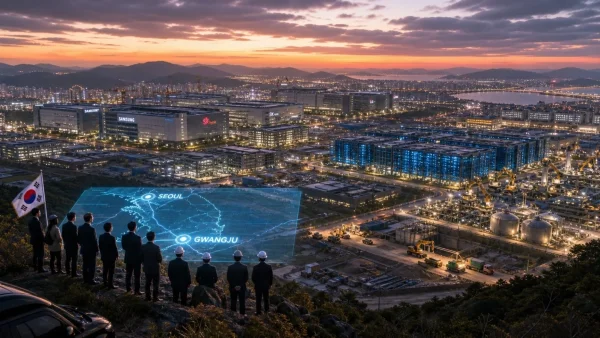
Word on the street is that Samsung Electronics and SK Hynix will each put down four or five new fabs in Gwangju, in the southwest. And there are plans for Samsung to put up some chip packaging in South Chungcheong province as well.
Then there’s SK Hynix, which is set to put more NAND capacity in North Chungcheong, per the paper. They already have a lot of hardware around the Seoul area, so this is more of an addition to what they have than a replacement.
Why the southwest matters now
For Lee, this is a matter of 'national survival‘ – a way to even out the playing field between regions and get ready for the AI age. “This isn’t a special favour for any one part of the country,” he put it on X when it came to building out a new ecosystem in the southwest.
Some in the industry see the upside in not being tied to Seoul’s bottlenecks, but they’ll tell you a state-of-the-art fab is a thirsty operation. You need power, water, logistics and good hands to run it. Without some serious co-ordination, you might not be able to put those in place fast enough to keep up with what AI is calling for.
Policy support and the stakes
The officials have a lot of ground to cover to make this happen. The plan is to lay out the tools for the job at an event around 0500 GMT (2 p.m. your time), says Lee’s office.
The government is on the hook for:
– Making sure there is enough power and water
– Access to land and the rest of the infrastructure
– Training up the workforce
– Some housing in the vicinity of the new sites
Market reaction reveals the split-screen
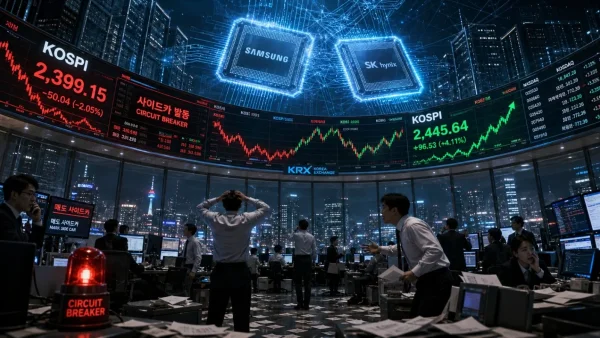
It was a different story in the early hours of trading. With so much infrastructure work in the offing, you saw a move in the construction and engineering names. Asia Cement was up 15%, Hanil 7%.
But the rest of the market didn’t follow suit. The KOSPI was down 2% and change. Even the big ones like Samsung and SK Hynix were in the red by 4% and 3% respectively, as the global tech rally had a moment to cool off.
Politics at the edge of industrial policy
Some in the opposition are wondering if there is an agenda here. After all, 85% of the voters in the region put Lee in office last year. His numbers have been in the tank for a while, at 46.5% according to Realmeter.
Lee has put that to rest, saying the call will be made on the most sound industrial logic with the full weight of the government. The point is to grow national AI capacity, not to uproot what we have, the presidency maintains.
What happens next
Lee is due to present the ‘Three Mega Projects for the Great Leap Forward’ at the presidential office. Once the officials have had their say, the companies will come forward with their side of the story. We should hear from Jay Y. Lee of Samsung and Chey Tae-won of SK Group.
They won’t be the only ones in the room. Lee’s office says to expect some from LG, HD Hyundai Robotics, the power and water resource corps, among others. Semiconductors and AI will be the order of the day.
There was talk earlier of Samsung alone spending in excess of 1,000 trillion won. Kim Yong-beom, the policy chief, let slip on Friday that the figures to be put on the table would be ‘very unusual.’
At the end of the day, for the likes of Samsung and SK, it’s about the demand for chips and data centre build-outs. For Korea, it is a test of whether a heavy hand from the state and a bit of regional spread can put them in a position to lead the AI supply chain for the long haul.