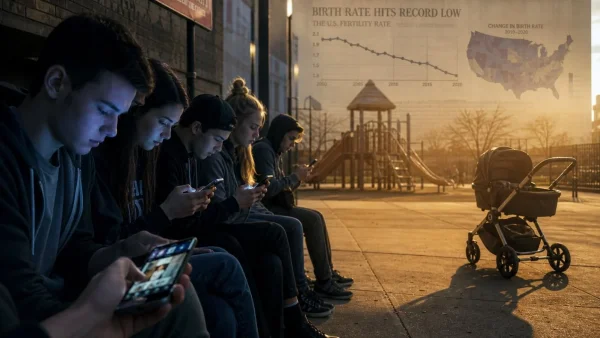
You could call it a provocative piece of work. It’s put some weight behind an ongoing policy question: did the iPhone have a hand in America’s baby bust? The researchers’ take is that if you had a smartphone from the get-go, you were part of a steeper decline in US births, and that the digital world is changing the rules of family life.
A fertility puzzle meets a digital turning point
Up until now, the usual suspects for the slide in US fertility were the economy and the way we live: the cost of a house or a nanny, student loans, putting off marriage, and so on. All true. But then 2007 came along, and with it, the iPhone.
In a normal cycle, you see a lull in births during a recession and a pick-up when things turn around. Not this time. Caitlin Myers, an economist at Middlebury, has a term for it: a “baby-less recovery.” The post-crisis boom didn’t do much for the birth rate.
We’re talking a 22% drop from where we were, and an all-time low. That kind of timing made the researchers wonder if there was more to it than just finances and nuptials – if technology was in the mix.
What the researchers actually measured
Myers and Ezekiel Hooper of the National Bureau of Economic Research put together a working paper that makes use of an oddity from the iPhone’s first few years. Back between 2007 and 2011, you were on AT&T if you had one, and the rollout of fast mobile broadband was anything but even from one county to the next.
So they set up a sort of natural experiment. They pitted the areas that got the network quickly against the ones that had to wait, and followed the numbers from 2007 to 2011 in counties with over 90 percent access as opposed to under 10 percent.
The ones with better access had a harder fall in fertility. Put simply, the authors think having an iPhone early on could be responsible for as much as half of the overall dip in the US rate back then.
Who was most affected
It was the young ones who felt the change the most. In the high-access counties, the number of 15- to 19-year-old girls giving birth was down 26 percent; in the low-access side, it was 14. Even women in their 20s saw a bigger let-off where the phones were most prevalent.
As you get older the effect is not as strong, but it’s there. The places with the head start on the iPhone always had the steepest declines among young adults, the very people who are quick to alter their social routine with a new gadget.
How a phone could change intimacy
They aren’t going to say there is one direct line of cause and effect. What the paper does is lay out some reasonable explanations for the kind of behavioural changes we’ve seen since the smartphone era: you’re on the web more, you’re not in the room with people as much, and you’re in front of a screen for your entertainment.
It’s a simple equation. When you can text, post on social media or watch what you want on demand, you don’t have as many chances for the kind of encounter that might end in an unintended pregnancy. You can’t make a baby by swiping through your feed.
Then there is the matter of a click away to online porn and the constant pull of being connected. In Hooper’s words, a lot of young folks are turning to their phone for some of the interaction they used to look for in person.
The authors point to a few ways this is playing out:
– You see less of your peers in the flesh
– Texting and DMs have taken the place of early-stage dating
– There’s more time in front of a private screen and less on an outing
– For some, online porn is a stand-in for being with someone
The sceptics’ side of things
If you talk to demographers or economists, they’ll tell you not to make it too simple. Fertility in the U.S. was on a downswing long before we had our first iPhone, and teen births have been in the tank for a while. It’s a structural thing.
Then there are other changes at work. The late 2000s brought in better access to IUDs and the like. Add in the cost of housing, what women are doing in the workforce, and a certain level of economic unease, and you have a lot of moving parts.
There’s also the matter of timing. Back in 2007 or 2008, you didn’t have the app ecosystem or the kind of social media we do now, let alone a dating-app culture. A lot of the smartphone habits that keep us from socialising didn’t become the norm until later, so it’s hard to draw a straight line from one to the other.
Myers will be the first to put it in context. “We all thought it was the recession at first,” he says. Births tend to be pro-cyclical. But when the recovery came and we still didn’t see any babies, we had to look closer. Our study is just one part of that story.
What this means for policy
When a country wants to put up its birth rate, the go-to is usually money: tax breaks, subsidies, the works. And sure, making life more affordable is key. But if you’re dealing with a generation that’s more isolated, a check in the mail isn’t going to change much.
This isn’t a call for the government to come in and confiscate phones. The issue is cultural. If screens are altering the way we form families, then the baby bust is about more than what’s in the bank.
It’s a case for looking at the whole picture. You can fix childcare and housing, but you might also need to put in the kind of social infrastructure-be it community events or public spaces where it’s safe to be around people-that gives young people a chance to get to know each other.
*
Looking ahead
You can already hear some in the field saying we need to put this to the test. Can we replicate these findings as we move from the AT&T days into the app-heavy 2010s?
And how much of the shift is really down to contraception, or the way we handle education and healthcare? We have to sort through the noise to see where tech fits in.
Experts say we need to:
– Do the same with newer devices
– See if it holds up in other countries with the same problem
– Make sure we’re not confusing tech with better birth control
– Follow the kids who grew up in the middle of the dating-app craze
In the end**
No one device is to blame for the American baby bust. But the iPhone has a way of putting a magnifying glass on what was already happening, by redefining how we make time and make contact. The data is starting to show that a smartphone is more than a pastime; it’s a factor in the numbers.
If having a phone in your pocket has a way of curbing an unplanned pregnancy by changing your day-to-day, then you can’t just throw cheques and credits at the problem to get more of them. You have to deal with the reality of a world built around a screen, where you’re vying for some real connection against an endless feed.