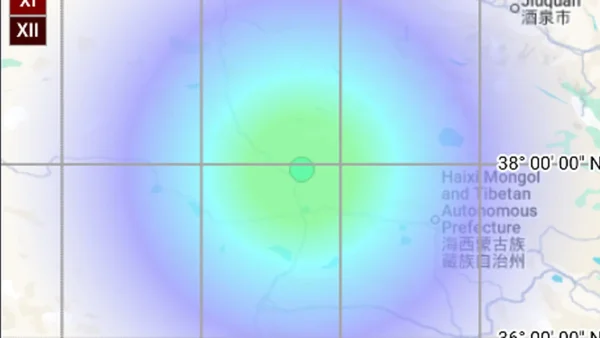
It was a hard 6.3 that jolted the northwest part of the country on 16 June, with at least a fatality and four hurt, says the authorities. You could feel the aftershocks in the high ground of Haixi, so there were quick evacuations and some on-the-spot evaluations as the evening wore on.
When it came at 5:06 p.m. (0906 GMT) in Beijing, it was in a thin part of the plateau where you have your mining and transport routes in rough terrain. The word from above is to be ready for more as they go about their damage control.
Timeline and epicentre
According to the China Earthquake Networks Center, the centre of it all was in Haixi Prefecture, 10 km down. It was a shallow enough affair to be felt in most of the region, and local agencies didn’t hesitate to put their emergency plans in motion.
Over in India, the National Center for Seismology put it in the books as well. They had a 6.3 at 14:36:56 IST, with the numbers at 37.833 N, 95.286 E, and 10 Km deep, in China.
Rescue operations and safety moves
You’ll find rescue teams out looking for the injured and going over the state of things in outlying towns and on the grid. At the coal mines close to where it happened, they’ve already pulled the workers out just to be safe while they run the numbers.
China’s earthquake administration has called in an emergency response to handle the search and make sure people are put up and looked after. They’re also on the lookout for any follow-on problems like landslides from the aftershocks.
This is what the authorities have put forward for now:
– Pulling out of the coal mines in the vicinity
– Sending in to the hard-to-reach, high-altitude spots
– A watch on any other kind of disaster risk
Aftershocks keep region on alert
There have been a few since the big one. One was in the 5 range, which is why the message to everyone is to be careful until the buildings have been given the once-over.
India’s seismologists clocked a 5.0 at 15:12:35 IST (Lat: 37.899 N, Long: 95.398 E, 10 Km). Then there was another one, 4.9, as the reports show. The activity is not done yet.
What to expect in coming hours
Expect the teams to be putting first aid and shelter for those who have to move ahead of anything else. They will be on the roads and in the mines in a hurry. With the ground still moving, they have to make sure the slopes and structures can hold up.
People are being told to do as they are told while the engineers get to work. The monitoring stations are on it, too, to see what comes next.
Why the impact could shift
We have one dead and four in the hospital as of late Tuesday, but we are still in the process of figuring it out in some of the more isolated parts of Haixi. The altitude and the weather don’t make for easy verification, so don’t be surprised if the count is revised.
If you are in the mining or logistics business in the neighbourhood, you may see some hiccups in your day-to-day as they do their due diligence. A 10 km depth with this many aftershocks makes for a complicated recovery.
Key data points at a glance
The story on the ground is driven by what is being seen in real time and shared across borders. These are the hard numbers for now:
– 6.3 at 5:06 p.m. Beijing time
– 10 km down, says the CENC
– One loss of life, four others, per the report
– Aftershocks: a 5, a 4.9, and a 5.0 from the NCS
Night is settling in on Qinghai and the job is to save lives and put the place right. We should have more from the authorities on Wednesday as they finish up in the corridor.