You could call it a high-stakes situation. India’s take on Russian oil in May was up, and with refiners making a beeline for a discount, so too has the country’s import tab and its vulnerability to the ebb and flow of sanctions, per some new figures from CREA.
It doesn’t come out of nowhere. You have China with its insatiable demand, Europe clamping down on product rules and trade lanes moving in a hurry. For India, that means the line between an easy deal and a regulatory headache is a bit harder to walk these days.
India’s May spike and the numbers behind it
By CREA’s reckoning, India put 5.8 billion euros ($6.7 billion) into Russian hydrocarbons last month. Crude was the story here – 4.8 billion euros (some $5.6 billion), or 83% of what came in from Russia. That is up from 4.5 billion in April, a 7% or so increase.
Overall, India hauled in 8% more crude in May than the month before. CREA puts some of that down to a 21% uptick in Russian product, which is to say the cheap stuff is still dictating how refiners do business and where they are shipping.
Refinery-led acceleration
If you look at the refiners, they were the ones behind the run-up. Volumes offloaded at the Vadinar plant in Gujarat were 36% higher than in April; Jamnagar saw a 14% rise. These are the places that have been key in mopping up Russian grades and making the most of lower-cost feedstock.
The state-owned operators have been on the buy side since they started up again earlier in the year. New Mangalore’s intake of Russian crude was 13% up in May, Visakhapatnam 42%. And over in Odisha, Paradip put in its best showing for Russian crude in two years, CREA says.
India’s place in shifting global energy flows
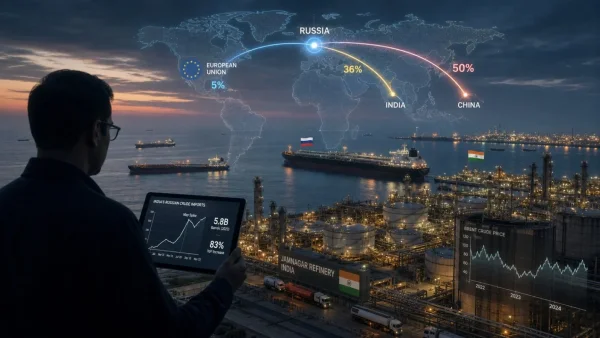
All this is part of a reconfigured order of things. CREA has China as the top of the table, having taken 50% of Russia’s crude in May. India is next with 36%, then Turkiye (6%) and the EU (5%). In the wider picture, China is still the pre-eminent customer for all of Russia’s fossil fuels.
In fact, for the top five importers, China was responsible for 38% of Russia’s export takings in May 2026 – 7.0 billion euros. Most of that was crude (69%), but there was also a fair bit of pipeline gas, coal, LNG and other oil products in the mix.
Refined products challenge for sanctioning countries
Then there is a potential chink in the armour. Even after the EU put a stop to importing oil made from Russian crude back in January 2026, 10 such shipments still made it to European ports in May, the report shows.
Take the 641 million euros in oil products that refineries in India, Turkiye, Brunei and Georgia sent to sanctioning nations in May 2026. The EU was one of the takers (174 million), as were Australia, the US and New Zealand. Some 214 million of those euros can be traced to Russian crude.
Some of what went to the US came out of Reliance in Jamnagar, SOCAR’s STAR in Turkiye or Tupras Izmit. Three months ago, 39% of what fed STAR and 15% of Jamnagar’s stock was from Russia.
Why it matters now
Ever since the Ukraine war and the sanctions that followed, Indian refiners have been propping up their books with discounted Russian crude. It has meant better margins and a boost for exports. The current data shows it is still a big part of the equation, even as India looks to the Middle East, Africa and the U.S. for some variety.
But the rules of the road are getting stiffer. With the EU on case and more eyes on where your feedstock is from, the stakes are higher for any Indian refiner trying to sell in a sanctioned market. One wrong move and you are looking at hold-ups, a hit to your name or a fine.
What comes next for Indian refiners and policymakers
You have to be more precise if you want to keep costs in check and the risk at bay. A few things to have on your radar:
– Keep an eye on sanctions exposure from end to end
– Widen your crude options without giving up on the margin
– Be open about where your feedstock is coming from
– Make sure your export plans fit with the new rules
– Size up your buying to what you need and can store
Make no mistake: the 5.8 billion euros in Russian hydrocarbons in May, with 4.8 in crude, are a win for the time being. The task is to hold on to that as the watchful eye of oversight and the tides of global energy continue to turn.