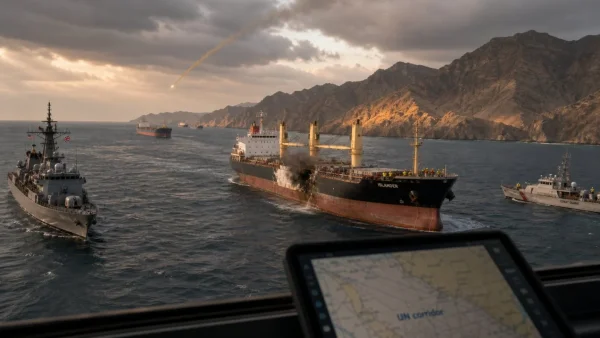
According to the British military, a ship in that very corridor was hit with a projectile on Thursday. The UKMTO has put out word that there are no casualties or any kind of environmental damage, even as more tankers make their way down the route off the coast of Oman with some trepidation.
Why the strike matters now
You could argue the whole point of this UN-endorsed lane is to give the world economy some breathing room and to take some of the sting out of Tehran’s hand in the current peace process. There was some of that in the markets: oil prices on Thursday for a time went under the $73-a-barrel mark we saw before the war.
We’re seeing better numbers in shipping, though not back to where they were. Insurers and those running the show seem to think the danger has passed, but what happened on Thursday is proof it hasn’t.
What we know about the incident
The UK Maritime Trade Operations centre can confirm the hit on the vessel and that nobody was hurt and there’s no pollution to speak of. The ship was on a course put forward by a UN body that runs right up against the Omani shore.
It’s not the first time you’ve seen a vessel leave the Gulf with the US military on its side. But to see them using the UN path on Thursday, in the face of all of Iran’s warnings, says there’s a bit of faith building in the industry.
A new route, old risks
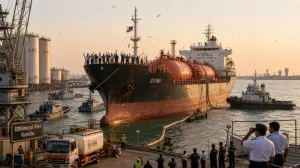
The Stoic Warrior and a few other tankers made the run from the UAE to Oman early on Thursday, going by the Musandam Peninsula. To the north of where they were is the strait’s middle, which used to be the go-to for a fifth of the planet’s oil and gas.
Iran claims to have put mines in that central waterway in the wake of the US and Israeli strikes on Feb. 28. One has been spotted, so operators are tending to stick with the coastal option that Oman and the IMO have put in place.
The change is plain to see. Lloyd’s List Intelligence has 125 crossings on the books for last week, up from 33 the prior one. S&P Global had 78 on Wednesday – a high since the hostilities started, if not quite the 130 a day you’d get in peacetime.
Richard Meade over at Lloyd’s List would call it a matter of calculation. You have some in the business who, feeling the risk is lower or at least thinking it is, are after the cargoes that have been sitting around.
Maersk has put it on the record: its Maersk Baltimore and a chartered vessel made it through the strait on Thursday.
Iran’s hard line
Over state media, Iran’s Revolutionary Guard Navy has made no bones about their view of the new route – they call it a no-go and an outright hazard, all because it was put in place with no input from Tehran. The only way to go is what we say, they say, and those who don’t will be made to answer for it.
Then there was the radio exchange on Wednesday. A tanker was told by the Guard, in so many words: “You are in my missile range and I may just open fire,” according to private security outfit Ambrey. Nothing more has been reported since the strike on Thursday.
Diplomacy and the 60-day mark
Whether this corridor can hold up is the real test for the diplomats at work. U.S. and Iranian negotiators are still haggling over an interim arrangement that would see ships pass safely through the Gulf and put some order to Iran’s stockpile of enriched uranium.
The two sides have 60 days to iron out the details, per a memo from last week. But even as the formalities are handled behind closed doors, President Trump and his counterparts in Iran have been at each other in public, with one side’s claims of give-and-take being hotly contested by the other.
In Bahrain, Secretary of State Marco Rubio told GCC ministers that Washington is with the Oman route and will make sure no one is slapping fees on ships. “If that doesn’t happen, we’re going to have a problem,” he said.
Here is where things stand after Thursday:
– UKMTO: No harm done, no spill
– The Guard: We don’t like the new path
– Rubio: Ships won’t be charged
– Bahrain: Some hope, if they play by the rules
Bahrain’s foreign minister was appreciative of the U.S. backing but was firm: it’s vital Iran does what it’s supposed to.
Strains on the truce in the region
Some distance from the strait, the lull in Lebanon is under pressure. Five have been killed in as many days from Israeli strikes, the authorities say, including three on Thursday when a car in the south was hit.
Hezbollah is calling it a breach of the ceasefire, though they haven’t struck back. The Israeli military says one of their reservists was downed and another wounded in the south on Thursday. The toll is high: more than 4,000 in Lebanon and 37 Israelis have been lost to the violence here since March.
Looking ahead
Keeping the Oman route open is the only way to unblock things and steady prices while the 60-day timer for a U.S.-Iran deal is on. What happened on Thursday is a reminder you can’t count on a safe run and that politics at sea is very much in play.
Shippers are rethinking their numbers, if not with some trepidation. For the rest of us, this is quickly becoming the moment of truth.