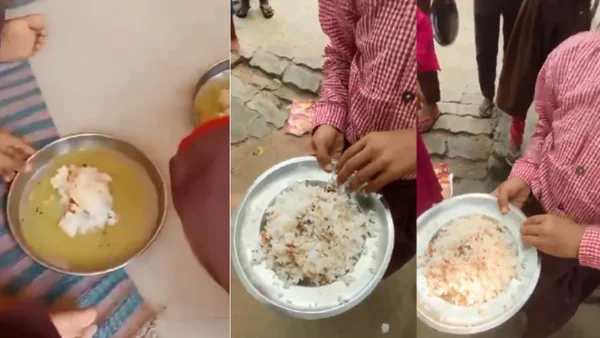
Uttar Pradesh is being projected as a trillion-dollar economy, while Madhya Pradesh has set its sights on a $2-trillion economy by 2047. The economic ambitions are enormous.
But alongside those grand targets comes a much more basic question:
What are children being served in government schools today?
Reports and viral visuals alleging meals consisting of watery rice, jeera, turmeric, burnt rice or even roti with salt have triggered outrage over the quality of school meals.
The contrast is striking: governments talk about building trillion-dollar economies, while some schoolchildren are allegedly struggling to receive a nutritious plate of food.
Is This Really a Mid-Day Meal?
The purpose of the school meal programme is not simply to put something on a child’s plate.
School meals are intended to address hunger and nutrition, encourage school attendance and improve children’s ability to concentrate in class.
That makes the quality of the meal just as important as the number of meals served.
A plate containing rice and water may technically resemble food.
But the bigger question is:
Does it provide the nutrition a growing child needs? That’s where the controversy begins.
Rice, Water, Jeera—and a Trillion-Dollar Economy
Imagine two government headlines appearing on the same day:
“State aims to become a trillion-dollar economy.”
And in another corner:
“Children served watery rice.”
The contrast practically writes its own political satire.
A trillion-dollar economy is a fantastic aspiration.
But economic growth should ultimately mean better lives for ordinary citizens, especially children.
Otherwise, GDP becomes an impressive number on paper while the child’s lunch plate remains unimpressive in reality.
What About Eggs?
The egg issue also needs careful treatment.
Whether eggs are served in school meals varies across states and schemes, and changes in menus can be linked to policy, budgetary and administrative decisions.
So the claim that “eggs were stopped specifically to serve salt and roti” should not be presented as an established fact without checking the particular state’s official menu and order.
But the underlying nutritional question remains legitimate:
If eggs or another protein-rich food are removed, what nutritionally adequate alternative is being provided? That is the question governments should answer.
The Real Issue Isn’t Vegetarian vs Non-Vegetarian
The debate should not become another political argument about eggs.
The real issue is nutrition.
Children need adequate:
protein;
calories;
micronutrients;
vegetables or other nutrient-rich foods;
fats;
and dietary diversity.
If an egg isn’t provided, the government should ensure an appropriate alternative.
Salt and roti alone cannot become a symbol of nutritional policy.
What Should the UP Government Do?
Instead of dismissing criticism as political propaganda, the government should make the system independently verifiable.
1. Publish school-wise menus
Parents should know what children are supposed to receive.
2. Conduct surprise inspections
Not ceremonial inspections. Unannounced inspections.
3. Display weekly menus publicly
Put them on school notice boards and online.
4. Test food quality
Random samples should be checked for nutritional value, contamination and hygiene.
5. Make suppliers accountable
If contractors or suppliers provide substandard food, penalties should follow.
6. Give parents a reporting mechanism
Parents should be able to report poor-quality meals with photographs and location details.
7. Publish inspection results
If the government says the system is working, show the evidence.
The Bigger Question: Meal or Merely a Formality?
This is where the phrase “mid-day meal” deserves some scrutiny.
A school meal should not become a box-ticking exercise:
Meal delivered — ✔️
Children fed — ✔️
Nutrition achieved — ?
The success of the programme should ultimately be measured by whether children are actually receiving safe, nutritious and adequate food.
A Little Sarcasm, Because the Contrast Is Hard to Ignore
Government: “Our state will become a trillion-dollar economy!”
Child: “What’s for lunch?”
Government: “Rice.”
Child: “With vegetables?”
Government: “No.”
Child: “Dal?”
Government: “No.”
Child: “Egg?”
Government: “No.”
Child: “Then?”
Government: “Jeera. And ambition.”
A trillion-dollar economy may take years.
A nutritious school meal should not.
Don’t Judge an Entire State by One Viral Video
There is another side that needs to be acknowledged.
A viral photograph or video can expose a genuine problem, but one incident cannot establish that every government school in Uttar Pradesh or Madhya Pradesh serves the same meal.
Authorities should investigate the specific school, verify the date and location, examine the menu and establish whether the food shown was actually the officially sanctioned meal.
That is how outrage becomes accountability rather than misinformation.
The Real Measure of Development
GDP targets are important.
Investment is important.
Infrastructure is important.
But development ultimately has to reach the school classroom and the child’s lunch plate.
If governments want to build trillion-dollar economies, they should also be able to guarantee that children sitting in government schools receive a meal that is nutritious, hygienic and worthy of being called a meal.
Because the strongest economy isn’t one that merely produces more money.
It’s one that produces healthier, better-educated children who can build its future.
So the question for the government isn’t simply:
“Is the mid-day meal being served?”
It should be: