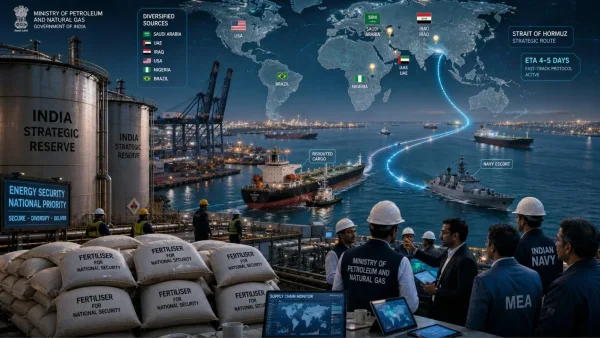
In an effort to put some of the market’s nerves at ease on Monday, India made clear there is no crunch in energy or fertilisers. The plan is for cargo to flow freely again in four or five days once the conflict in West Asia cools and the sea lanes are secure. It’s all about capping any wild swings in shipping and crude-related hedges.
What the panel was told
When they were before the Parliamentary Standing Committee on Transport, Tourism and Culture on May 25, 2026, senior officials from the government said they are ready for whatever supply shocks may come out of West Asia. They made this point after being put through their paces with questions on shipping, import exposure and what their contingency plans are.
The presentation was fronted by the Ministry of Ports, Shipping and Waterways, with some from External Affairs, Commerce and the Petroleum Ministry in on it. The bottom line for those in the room: the government sees ‘no immediate crisis’ when it comes to fuel or fertiliser at home.
Buffers that change the risk calculus
Inventory is where India makes its stand. Telling the committee, representatives said their strategic energy stockpiles are enough to see them through 78-plus days. It is meant to be a cushion against hold-ups at a place like the Strait of Hormuz.
Then there was the matter of fertilisers, which drew some hard questions. Over 30 per cent of what we import in that category goes through the Hormuz, sources say. But the officials had an answer: we have diversified our buying and put other options in play so we are not over-reliant on one path.
Ports and shipping readiness
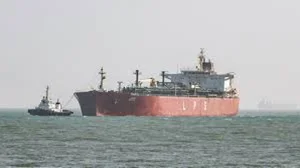
If the routes have to be rethought, the logistics side has a plan. Our ports can make do with rerouted ships, open up emergency berths and work with the schedule if the insurers or the navy tell us to change course.
As for the timing, shipping people gave the panel a straight answer. You let the hostilities subside and keep the channels open, and you can have things back to normal in ‘four to five days’.
Why this stance matters now
Everyone in the global market is looking to West Asia for a read on crude and trade. India is trying to put a pin in the risk premium that uncertainty creates by showing it is prepared and giving a window for things to right themselves.
This isn’t just one ministry’s job; it involves energy, trade, diplomacy and shipping. The idea is to have the coordination in place so that if we have to switch gears, the public doesn’t feel it.
You could boil the strategy down to three pillars, as was put to the briefing:
– Keep your strategic reserves where they should be
– Don’t put all your eggs in one basket with imports
– Have the ministries in sync for when you need to act
The fine print on the four-to-five-day claim
That kind of quick fix is contingent. It presumes the war-like conditions are gone and the major straits are open. A full-blown military problem would put a crimp in the timetable, but the point remains: we have the inventory and the back-up.
Those in the room were under no illusion that this covers both crude and fertiliser. ‘There is no crisis relating to energy sources or fertiliser. We are in contact with all markets, the US and beyond,’ is how one official put it to the lawmakers.
What comes next
The panel will be following up on these mitigation steps as time goes on. For the moment, the policy is to use the reserves, keep the import book open and let the ports be flexible if a ship is sent our way.
They have run the numbers on a number of scenarios. Delays at the Hormuz, a spike in insurance, a detour that puts a strain on a berth – the planning is there to muffle the impact of any of it.
De-escalate and you’ll see a return to regular sailing in ‘four to five days’. If not, we fall back on more than 78 days of energy on hand and the other contracts we have for fertiliser and crude.
The broader signal to energy markets
New Delhi is making a point of its own in a volatile time. With a specific timeline and a show of what we have in store, we are trying to lower the cost of doing business on freight and fuel that can otherwise feed into inflation.
For the ones who have to import and are watching every story out of West Asia, the message is plain: we have the buffers, we expect to keep trading, and once the fighting is over and the seas are clear, we will be back to it in no time.