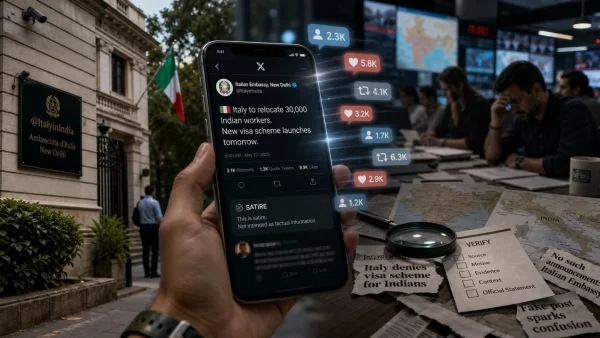
A fresh misinformation controversy has erupted online after a purported statement from the Embassy of Italy in India, allegedly criticising Congress leader Rahul Gandhi over his remarks concerning Prime Minister Narendra Modi and Italian Prime Minister Giorgia Meloni, began circulating widely.
The claim gained additional traction after it was reportedly amplified in media coverage.
But there is a crucial problem:
The account behind the purported embassy statement appears to be a parody/satire account—not the official Embassy of Italy account. That distinction completely changes the story.
First: What Is the Official Italian Embassy Account?
The Embassy of Italy in New Delhi’s official X account is @ItalyinIndia.
The account itself describes its profile as the “Official Twitter Profile of the Embassy of Italy in New Delhi.” (X (formerly Twitter))
The Italian government’s own diplomatic websites also identify the Embassy of Italy in New Delhi and provide its official contact details. (Italian Cultural Institute New Delhi)
The account being identified in online discussions as the source of the purported statement is @AINga5f, not the verified embassy account.
That is the central fact readers should understand before believing the headline.
So Did Italy Actually Condemn Rahul Gandhi?
There is currently no reliable evidence located in our verification that the Italian Embassy in New Delhi issued the purported condemnation. The available evidence instead points to the viral claim originating from a parody/satirical account.
That means headlines suggesting:
“Italian Embassy condemns Rahul Gandhi”
should not be presented as an established diplomatic fact unless an authentic statement from the embassy or Italian government is produced.
This is particularly important because an actual diplomatic condemnation would be a significant development in India-Italy relations.
What Actually Happened Between Modi and Meloni?
There was a genuine political controversy surrounding Rahul Gandhi’s comments about Prime Minister Modi’s interaction with Giorgia Meloni.
During Modi’s May 2026 Italy visit, Meloni shared a video in which she thanked Modi for giving her a packet of Melody toffees. The light-hearted exchange went viral and revived the “Melodi” social-media trend.
Rahul Gandhi subsequently criticised Modi, arguing that an “economic storm” was affecting India while the Prime Minister was focused on the Italy visit and the viral social-media moment.
Those remarks are real.
The alleged Italian Embassy condemnation, however, is a separate claim—and that is where the misinformation appears to have entered the story.
The Dangerous Part: A Real Event + A Fake Statement
This is precisely how misinformation becomes convincing.
The formula is remarkably effective:
Step 1: Start with a genuine event
Modi meets Meloni.
Step 2: Add a genuine political criticism
Rahul Gandhi criticises Modi.
Step 3: Create a fake authority
A parody account pretends to represent the Italian Embassy.
Step 4: Add an inflammatory statement
“Italy condemns Rahul Gandhi.”
Step 5: Let social media do the rest
And suddenly thousands of people believe that a foreign government has entered an Indian political dispute.
The fake claim borrows credibility from the real event. That’s why verification matters.
And Then Comes the Media Question
The most uncomfortable issue isn’t actually that a parody account posted something.
Parody accounts exist across the internet.
People can satirise politicians, governments, journalists and institutions.
The bigger question is:
How did an apparently satirical account get treated as a credible diplomatic source? If a media organisation publishes a report claiming that a foreign embassy has condemned an Indian political leader, basic verification should include:
checking the embassy’s official X account;
checking the embassy’s official website;
contacting the embassy;
checking the Italian government’s official channels;
looking for confirmation from established news agencies.
These aren’t extraordinary investigative techniques.
They’re Journalism 101.
The “Verified” Tick Is Not Enough
There’s another lesson here.
Social-media verification has become increasingly complicated.
A blue check, official-looking logo, diplomatic language or impressive follower count cannot substitute for source verification.
The correct question isn’t:
“Does this account look official?”
It is:
“Can this account be independently established as the official communication channel of the institution it claims to represent?”
In this case, the Italian Embassy’s official account is identifiable as @ItalyinIndia. (X (formerly Twitter))
Was Republic World Fooled?
If Republic World published or amplified the claim based on the parody account, that would raise a legitimate editorial question about source verification.
But it would be irresponsible to state as fact that Republic definitely knew the account was fake and deliberately published propaganda unless evidence establishes that.
There is a major difference between:
“A news organisation published an unverified claim.”
and
“A news organisation knowingly published a fake claim.”
The first can be established if the article relied on the parody account.
The second requires evidence of intent.
That distinction matters.
And What About the “IT Cell” Theory?
This is where speculation should stop.
The question:
“Was this an IT Cell account?”
is politically explosive, but there is currently no verified evidence establishing that @AINga5f is operated by a BJP IT-cell member or government-linked organisation.
It is perfectly legitimate to ask authorities to investigate coordinated misinformation.
But without evidence, the article should not identify the account as an “IT Cell account.”
Fake account? Evidence points that way.
Who operates it? Still requires proof.
Government/party connection? Not established.
That’s the responsible way to report it.
Should the Government Take Action?
If an account deliberately impersonated an embassy or falsely represented itself as an official foreign-government channel, that could potentially warrant investigation depending on the exact conduct and applicable law.
But the first step should be identification.
Authorities would need to establish:
Who controls the account?
Where was it operated from?
Was the account explicitly impersonating the embassy?
Was there an intention to deceive?
Who amplified the false claim?
Was there coordinated distribution?
Did anyone financially benefit?
Did the misinformation cause measurable harm?
Only after those questions are answered should accusations of a coordinated political operation be made.
The Media’s Responsibility Is Even Greater
An ordinary social-media user sharing a fake post can say:
“I didn’t know.”
A national news organisation has a different responsibility.
Especially when the claim concerns:
A foreign government
An Indian political leader
A diplomatic relationship
An alleged official condemnation
Such claims require a higher verification threshold.
A five-minute verification exercise could potentially have prevented a false diplomatic story from travelling across the internet.
The Irony Is Almost Too Perfect
The internet:
Random parody account:
“Embassy of Italy condemns Rahul Gandhi.”
Media:
“Breaking!”
Readers:
“Italy has spoken!”
Actual Embassy:
“We didn’t say that.”
Journalism:
“Whoops.”
The problem is that by the time the correction arrives, the fake headline has already travelled much further than the correction ever will.
This Isn’t About Rahul Gandhi or Narendra Modi
That’s the most important point.
The same standard should apply regardless of political affiliation.
If tomorrow a fake account claims:
“US Embassy condemns Modi.”
It should be verified.
If another fake account claims:
“China praises Modi.”
Verify it.
If another says:
“Italy condemns Rahul Gandhi.”
Verify it.
The source doesn’t become credible because the claim confirms your political beliefs. That’s precisely why misinformation works.
It tells people what they already want to believe.
What Should Republic World Do?
If its report relied on the parody account, the appropriate response would be straightforward:
1. Correct the story prominently.
Not silently.
2. Identify the original source.
Tell readers that the source was not the Italian Embassy’s official account.
3. Explain the verification failure.
Transparency builds credibility.
4. Update social-media posts.
Deleting a headline without explanation leaves the misinformation ecosystem intact.
5. Review editorial verification procedures.
Particularly for diplomatic claims.
And What Should the Government Do?
The government should apply the same standard to misinformation regardless of who benefits politically.
If there is evidence of deliberate impersonation or coordinated misinformation:
Investigate it.
If there isn’t:
Don’t manufacture a conspiracy.
And perhaps most importantly:
Don’t let political convenience determine which fake-news accounts get investigated.
The Real Story Isn’t “Italy vs Rahul Gandhi”
The real story is much more uncomfortable:
A parody account allegedly masqueraded as a diplomatic source, a politically charged claim travelled rapidly, and the verification process is now under scrutiny.
That is a story about the modern information ecosystem.
And it exposes a vulnerability far bigger than one fake tweet.
In the age of instant news, the first casualty isn’t always truth. Sometimes it’s verification.
Final Verdict**
Verified: Modi and Meloni had a genuine interaction in Italy, including the widely shared “Melody” moment.
Verified: Rahul Gandhi publicly criticised Modi over that episode. (Hindustan Times)
Verified: The official Embassy of Italy in India’s X account is @ItalyinIndia. (X (formerly Twitter))
Not established: That the Italian Embassy officially condemned Rahul Gandhi.
Strongly indicated by available evidence: The viral “embassy statement” originated from a parody/satirical account rather than the official embassy channel.
Not established: That the account was operated by a BJP IT-cell member or government agency.
And that distinction is exactly what responsible journalism is supposed to make.
The bigger lesson is simple: Before reporting what an embassy supposedly said, check with the embassy. Because if a national news organisation can mistake a parody account for a foreign government, the question isn’t merely “Who created the fake?”
It is also: