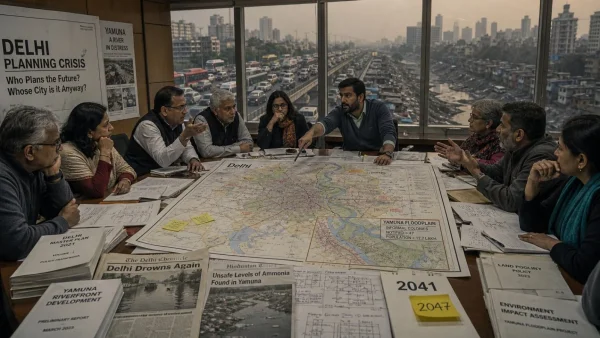
Delhi has a new long-term destination: 2047.
The Delhi Development Authority (DDA) has reportedly cleared a revised Master Plan for Delhi with 2047 as its horizon year, aligning the city’s planning framework with the broader Viksit Bharat @2047 vision.
At first glance, the change sounds ambitious.
But there is an obvious question that Delhi residents may reasonably ask:
If Delhi needed a Master Plan for 2041, why did it take so long—and why move the finish line to 2047 after years of delay? The answer is more complicated than simply saying that the government has “extended the deadline.”
The Master Plan Was Supposed to Be MPD-2041
The DDA began preparing the Master Plan for Delhi-2041 (MPD-2041) several years ago.
The draft was approved by the DDA Authority in April 2021 and subsequently put before the public for objections and suggestions. The DDA says it received approximately 33,000 objections and suggestions. (Delhi Development Authority)
The process involved public consultations, hearings and revisions.
The DDA eventually approved the Master Plan on February 28, 2023, and sent it to the Union Ministry of Housing and Urban Affairs (MoHUA) for notification on April 13, 2023.
And then came the waiting.
Three Years Later, Delhi Is Still Waiting
By 2024, the plan had already been described as being stuck for years.
The delay wasn’t merely bureaucratic trivia.
Several important urban policies were dependent on the new planning framework, including aspects of:
land pooling;
green development;
affordable housing;
redevelopment;
unauthorised colonies;
slum rehabilitation;
transit-oriented development.
Reporting in 2024 said the delay had stalled implementation of several key policies. (ThePrint)
So the irony is difficult to miss:
Delhi prepared a plan for 2041—but spent years waiting for permission to implement it.
Then Came the 2047 Idea
In June 2026, The Indian Express reported that the Centre was considering changing the plan’s horizon year from 2041 to 2047 because the plan had already been delayed by around five years. Officials indicated that no final decision had been made at that stage.
The logic was straightforward:
A master plan normally works with a long-term horizon.
If the 2041 plan is only being finalised several years late, why not reset the horizon to 2047?
There is also an obvious political and policy reason: 2047 is the centenary of India’s independence and the target year for the government’s Viksit Bharat vision.
But changing a date on the cover isn’t enough.
A New Date Means New Planning Assumptions
This is an important point that can easily get lost in the political debate.
A master plan isn’t simply:
2041 → delete → 2047 → print.
Changing the horizon year means planners may need to revisit:
population projections;
housing requirements;
transport demand;
infrastructure capacity;
employment patterns;
land-use requirements;
environmental pressures;
water demand;
waste management;
public-service requirements.
The Indian Express report specifically noted that population projections would have to be reconsidered if the horizon year changes.
So a genuine 2047 plan should be based on new data, not merely an old plan with six years added to the title.
And Delhi Doesn’t Have the Luxury of Waiting Forever
Delhi is already dealing with problems that don’t respect planning timelines.
Traffic congestion doesn’t say:
“I’ll return in 2047.”
Air pollution doesn’t wait for the next master plan.
Neither do:
housing shortages;
unauthorised construction;
water stress;
waste;
sewage;
parking;
flooding;
congestion;
pressure on public transport.
Delhi’s population and built environment are changing every year.
That means urban planning needs to move at the speed of the city—not at the speed of government files.
The Yamuna O-Zone Adds Another Complication
One of the most politically and environmentally sensitive issues is Delhi’s Yamuna floodplain, or O-Zone.
The Indian Express reported that policy regarding unauthorised colonies in the O-Zone—where more than five lakh people live—was among the issues being considered in the revision debate.
The Delhi High Court has also dealt with restrictions on residential development in the eco-sensitive floodplain.
That creates a difficult policy problem:
How do you protect an environmentally sensitive floodplain while dealing fairly with people who already live there? A master plan cannot simply draw a line on a map and assume the people on the ground disappear.
What About Unauthorised Colonies?
Delhi’s urban planning challenge is particularly complicated because large populations live in areas that were not developed according to the formal planning framework.
The government has recently moved to regularise 1,511 unauthorised colonies on an “as-is-where-is” basis, according to reporting cited by The Indian Express.
This demonstrates another problem with long planning delays.
When planning doesn’t keep pace with reality, reality starts planning itself. People build homes.
Markets emerge.
Roads develop.
Population settles.
And eventually the government has to figure out how to regularise, rehabilitate or integrate what already exists.
The Master Plan Isn’t Just DDA’s Problem
It would also be wrong to portray this entirely as a DDA failure.
The DDA prepares the Master Plan, but implementation involves multiple agencies.
The DDA itself has stated that implementation is a collective responsibility involving central and Delhi government departments, local bodies, land-owning agencies, regulators and service providers. (Delhi Development Authority)
That means the delay involves a wider administrative ecosystem.
And that’s precisely why Delhi needs clearer institutional accountability.
If 10 agencies are responsible, citizens shouldn’t have to spend 10 years figuring out which agency is responsible for a delay.
The 2047 Question: Vision or Deadline Extension?
This is where the political debate begins.
Supporters can argue:
“Why remain stuck in 2041? Delhi needs a modern plan aligned with India’s 2047 development vision.”
That’s a legitimate argument.
Critics can ask:
“Was 2047 chosen because it is the right planning horizon—or because the original 2041 target became impossible to meet?”
That’s also a legitimate question.
The answer should come from the planning documents, not political slogans.
And Here’s the Sarcasm
Delhi:
“When will the Master Plan arrive?”
Government:
“2041.”
Delhi:
“It’s 2026.”
Government:
“Okay, 2047.”
Delhi:
“What about traffic?”
Government:
“2047.”
Delhi:
“Pollution?”
“2047.”
Delhi:
“Housing?”
“2047.”
Delhi:
“Yamuna?”
“Please check back in 2047.”
Of course, that’s satire.
But the frustration behind the joke is real:
A vision is useful only when today’s problems are being solved today.
The Real Danger of Endless Planning
A master plan can become an impressive document sitting on a shelf.
It can contain:
green mobility,
sustainable development,
affordable housing,
urban regeneration,
heritage conservation,
economic growth,
better infrastructure.
All wonderful words.
But Delhi residents ultimately experience:
a broken footpath,
a flooded road,
a traffic jam,
an overflowing drain,
an unauthorised colony without adequate infrastructure,
or a neighbourhood without sufficient public transport.
The distance between policy language and street-level reality is the real test of the Master Plan.
What Should the Government Do Now?
If the horizon is genuinely being moved to 2047, the government should publish a clear roadmap.
1. Explain why 2047 is necessary
Don’t simply change the date. Explain the planning rationale.
2. Publish the revised projections
Population, housing, transport, water, waste and infrastructure requirements should be transparent.
3. Publish the implementation calendar
Which projects will happen by 2027, 2030, 2035, 2040 and 2047?
4. Assign responsibility
Every major policy should have a responsible agency and deadline.
5. Publish progress annually
Citizens should be able to see whether targets are actually being met.
6. Protect the Yamuna
Development and environmental protection cannot be treated as mutually exclusive.
7. Stop treating 2047 as an excuse for postponement
The long-term vision must produce short-term action.
2047 Should Be a Destination, Not a Parking Lot
There is nothing inherently wrong with aligning Delhi’s future planning with 2047.
In fact, a long-term vision can be useful.
But there is a fundamental difference between:
“We are planning Delhi for 2047.” and
“We couldn’t finish planning Delhi for 2041, so we’re moving the goalpost to 2047.”
Only implementation will tell which interpretation is correct.
The official DDA material still publicly describes the MPD-2041 draft, while recent reporting indicates that the 2047 shift was under consideration. (Delhi Development Authority)
So the headline should not be interpreted as meaning that Delhi has already received a fully notified, operational MPD-2047.
The Bigger Question
Delhi doesn’t need another beautiful vision document alone.
It needs execution.
A city cannot become world-class simply because its master plan has a futuristic date.
It becomes world-class when:
roads work,
public transport works,
housing is affordable,
the Yamuna is protected,
air quality improves,
neighbourhoods have basic services,
and government agencies actually meet deadlines.
*2047 is only 21 years away.
*For a city struggling with problems today, that may sound like a long time.
For urban planning, it isn’t.
So perhaps the question Delhi should be asking isn’t:
“Why has the deadline moved from 2041 to 2047?”**It is: “What exactly will be different in Delhi by 2047—and what are you going to deliver by next year?”