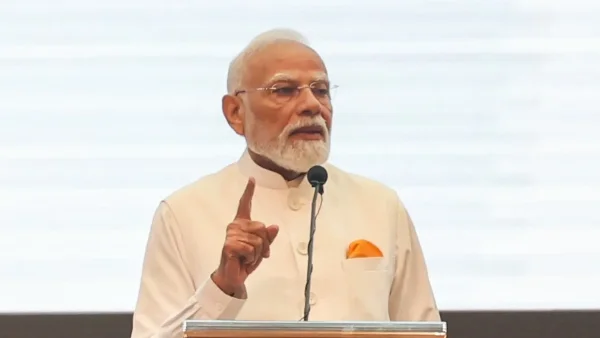
Prime Minister Narendra Modi turned an unlikely motif into a diplomatic bridge in Jakarta, using the number 8 to celebrate India-Indonesia ties and his rapport with President Prabowo Subianto. The playful numerology doubled as cultural fluency, landing with an audience for whom eight signals prosperity, while spotlighting a visit packed with strategic outcomes.
In Indonesia, eight carries weight beyond superstition. Rooted in Chinese traditions and Feng Shui, the Mandarin sound of ‘ba’ echoes ‘fa’, linked to wealth. By leaning into that symbolism, Modi framed partnership as good fortune shared, not just policy signed.
A lucky number becomes diplomatic shorthand
Before Modi spoke, Subianto told the gathering that destiny made him the eighth President of Indonesia. He added that he had once hoped to be the seventh, but eight kept appearing in his career. He called eight his lucky number, setting the stage for a striking moment of camaraderie.
Modi picked up the thread, tying the digit to India-Indonesia links with quick arithmetic and humour. He reminded the audience that Subianto was the Chief Guest at India’s Republic Day parade last year, and used the coincidence to underline how personal chemistry can accelerate policy trust.
The dates Modi spotlighted
Modi began with Indonesia’s own calendar, noting that Independence Day falls on August 17, a date that reduces to eight. He then cited India’s Republic Day on January 26, observing that two plus six equals eight. Finally, he connected the number to Subianto’s birth date, October 17, where one plus seven makes eight.
Tone and takeaways from the diaspora event
The speech kept things light without losing focus. Modi riffed on a Bollywood favourite, saying that when India and Indonesia move forward together, it is not just ‘kuch kuch’, but ‘bahut kuch’ for both sides. He thanked Indonesians for their warmth and called Subianto ‘a true friend of India’.
Modi also recalled a line from Subianto that drew loud applause: the Indonesian leader had said he has India’s DNA, a remark he repeated that day. Separately, Subianto shared that a genome test before his January 2025 visit indicated Indian DNA, joking that Indian music makes him move and his ministers sing Indian songs.
What the visit delivered
Beyond symbolism, the trip produced tangible steps. Here are the key outcomes Modi’s office highlighted:
– 20 agreements across defence, maritime security, education, digital tech and critical minerals.
– Address to the Indonesian Parliament during the state visit.
– Indonesia’s highest civilian honour, the Bintang Adipurna, conferred on Modi.
– India’s support for conserving the nearly 1,000-year-old Prambanan Temple.
The heritage note matters. Prambanan in Yogyakarta is a UNESCO World Heritage Site that showcases civilisational links which leaders on both sides now cast as a foundation for development. Cultural stewardship and security cooperation appeared in the same frame, signalling a broader partnership map.
Why it matters now
Diplomacy often hinges on detail and delivery. By turning eight into a friendly code for prosperity and progress, both leaders found a language that resonates with ordinary people. The message was clear: camaraderie at the top and comfort with culture can shorten the distance between intent and impact.
With 20 agreements spanning hard security to critical minerals, the Jakarta outreach suggests a practical agenda beneath the playful math. Modi’s framing linked optimism with outcomes, making the case that India-Indonesia ties can be both relatable and results-driven.
For audiences in both countries, the narrative offered a takeaway that travels well. When shared symbols meet shared interests, momentum follows. If the number is a sign, the signal from Jakarta is that the relationship is set to add up to more.