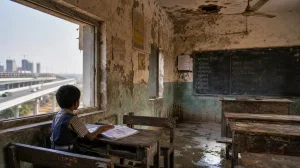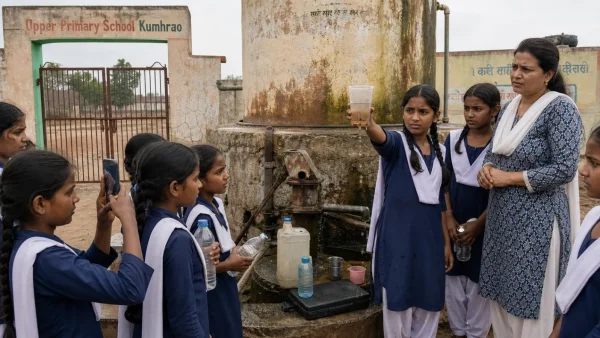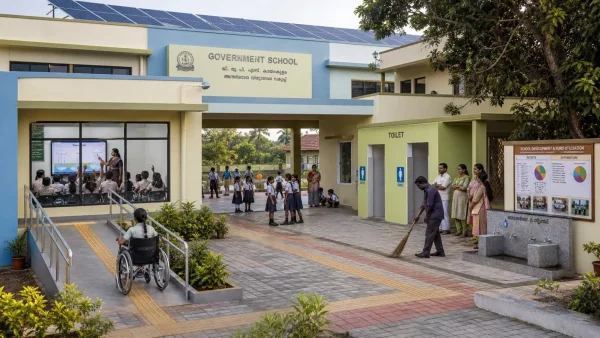
A government school in Kerala has drawn widespread attention on social media for its modern infrastructure, clean surroundings and student-friendly facilities. The images have triggered admiration—and a political debate over the condition of government schools across India.
A viral post accompanying the visuals challenged supporters of BJP-ruled states to produce a similar government school, turning an education issue into a political contest.
But beneath the political rhetoric lies a more important question: why should a well-equipped government school be considered exceptional in the first place?
Kerala’s Public-School Transformation
Kerala has spent years investing in the infrastructure of government and aided schools. State planning documents show significant spending on new school buildings, classrooms, smart classrooms, sanitation facilities, accessibility and other infrastructure.
The state’s approach has increasingly focused on transforming government schools from basic institutions into modern learning environments.
This transformation is particularly significant because government schools serve children from families who may not have the financial resources to choose expensive private institutions.
A Government School Should Not Look Like a Surprise
For many Indians, seeing a government school with attractive classrooms, functioning toilets, clean premises and modern facilities can still come as a surprise.
That itself exposes a deeper problem.
Public education should not depend on whether a particular school happens to receive political attention, becomes viral online or is located in a comparatively better-performing state.
A child should be able to expect:
A safe school building
Clean drinking water
Functional toilets
Adequate classrooms
Proper desks and learning materials
Qualified teachers
Electricity and internet connectivity
Facilities for children with disabilities
A safe environment for girls and boys
These should be basic public services—not extraordinary achievements.
The Debate Should Go Beyond BJP vs Kerala
The viral challenge specifically targets BJP-ruled states, but the education question is much larger than party politics.
India has states governed by the BJP, Congress, Left parties and numerous regional parties. Their school systems show significant differences in infrastructure and learning outcomes.
Some states perform strongly in particular indicators, while others continue to struggle with teacher shortages, inadequate buildings, sanitation, digital connectivity and maintenance.
Therefore, the real benchmark should not be political ideology.
The benchmark should be the quality of education available to the child.
If Kerala has developed successful models, other states should study them rather than dismissing them because of political differences.
Likewise, if another state develops an effective model, Kerala and other states should be willing to learn from it.
Where Does the Money Go?
The most important question for citizens is not simply how much a government announces for education.
It is what students actually receive for that money.
Governments routinely announce large education budgets and infrastructure programmes. But citizens rarely get a complete picture of how efficiently those funds are translated into functioning classrooms and facilities.
Greater transparency could include publicly accessible information on:
School-wise funding → construction status → expenditure → teacher vacancies → facilities available → maintenance requirements.
Such information would allow parents and citizens to judge government performance based on evidence rather than political speeches.
Children Should Not Become Political Props
Political parties will naturally claim credit when schools improve.
But children should not become props in a political battle.
A government school with excellent infrastructure is ultimately a success for the students who study there—not merely for the government that funded it.
Likewise, a school with broken toilets, unsafe buildings or inadequate teachers represents a failure that should concern citizens regardless of which party is in power.
The question should therefore be simple: Are children receiving the education and facilities they deserve?
The Bigger Challenge for India
India has one of the world’s largest school-going populations. Improving government schools is therefore not simply about infrastructure.
It is about India’s future workforce.
A modern building without good teachers will not solve the education crisis. A smart classroom without meaningful teaching will not produce better learning outcomes. And new desks cannot compensate for teacher vacancies.
True educational reform requires a combination of:
Infrastructure
Teacher recruitment
Teacher training
Strong foundational learning
Digital access
Vocational exposure
Accountability
Regular maintenance
Adequate funding
The Bottom Line
The Kerala school going viral should not merely provoke the question, “Can you show me such a school in a BJP-ruled state?”
It should provoke a much bigger question:
“Why can’t every child in India study in a school like this?” A functioning toilet should not be a political achievement.
A clean classroom should not be a viral sensation.
A safe school should not depend on geography.
And quality government education should not be a privilege.
If one state can demonstrate what is possible, the responsibility of every other government is to ask how quickly that standard can be replicated—not how quickly the achievement can be turned into a political argument.