A sarcastic statement about “raw ghani oil” has sparked discussion on social media, with the remark taking aim at what critics describe as the culture of privilege surrounding powerful officials and political leaders.
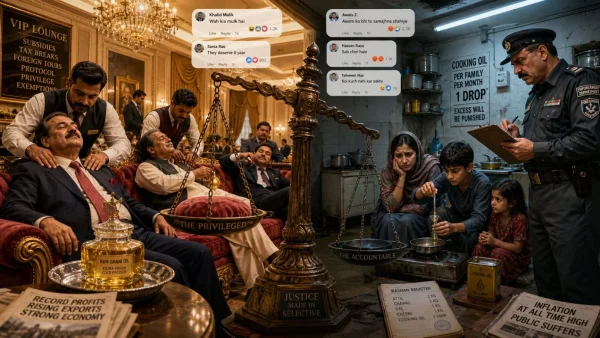
The comment—“Anyway, the use of raw ghani oil is less in cooking and more in the massages of officers and leaders; if the brother has taken a little bath, then what sin has he committed?”—appears to use humour and satire to question whether influential people receive preferential treatment that ordinary citizens do not.
From Oil to “VIP Treatment”
On the surface, the statement is about cooking oil and an alleged incident involving someone “taking a little bath.”
But the phrase “massages of officers and leaders” gives the remark its political edge.
The broader suggestion is that public officials and political figures can sometimes enjoy comforts, privileges or informal benefits that would be unacceptable—or simply unavailable—to ordinary citizens.
The language is clearly sarcastic, turning an apparently minor incident into a metaphor for the larger culture of VIP treatment.
Why the Remark Is Drawing Attention
The comment has resonated because complaints about preferential treatment are common in public life.
Critics frequently question situations in which:
Powerful individuals appear to receive special access.
Government machinery allegedly responds differently depending on who is involved.
Officials are accused of enjoying privileges unavailable to ordinary citizens.
Minor violations by influential people are treated differently from similar conduct by the public.
Whether any particular allegation is true, however, must be established through evidence rather than social-media commentary.
“What Sin Has He Committed?”—The Sarcasm Behind the Line
The second part of the remark—“if the brother has taken a little bath, then what sin has he committed?”—appears deliberately provocative.
The rhetorical question turns the incident into a commentary on accountability.
The implied argument is simple:
If an ordinary person would be questioned for the same conduct, why should a politically connected or powerful person automatically receive sympathy or protection? That is the issue at the heart of the satire.
Privilege vs Accountability
Democracy depends not only on elections but also on the principle that public officials remain accountable to the same laws and standards as everyone else.
When allegations involving influential people emerge, the public naturally expects:
Evidence.
An impartial inquiry.
Equal application of rules.
Transparency about the outcome.
Without those safeguards, even relatively small incidents can become symbols of a much larger distrust of institutions.
But Satire Is Not Evidence
The viral statement should be understood as political commentary and sarcasm, not as independent proof that officers or leaders actually received illicit benefits.
If the remark refers to a specific incident, the underlying facts—including the identity of the person involved, what actually happened and whether any official misconduct occurred—would need to be independently verified.
That distinction is important.
A provocative statement can raise questions, but only evidence can establish wrongdoing.
The Bigger Question
The controversy ultimately goes beyond oil or the alleged “bath.”
It is about whether ordinary citizens and powerful people are held to the same standards of accountability.
Because when people believe that status determines how rules are applied, trust in institutions suffers.
The real measure of good governance is not whether powerful people receive privileges. It is whether nobody is powerful enough to escape scrutiny. And that is precisely why sarcastic remarks like this one can gain traction—they turn an apparently trivial episode into a question about VIP culture, political privilege and equality before the law.