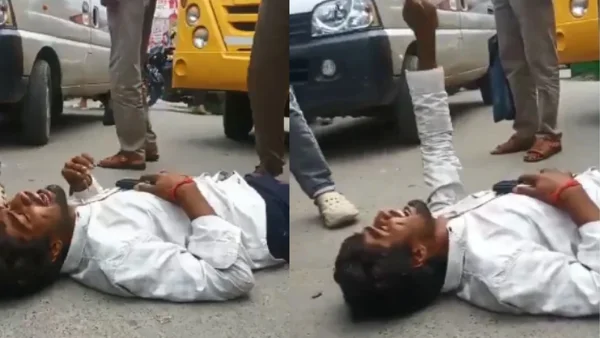
An emotional incident in the Dibiyapur police station area of Auraiya district has drawn attention to the difficulties faced by daily-wage and low-income drivers after an e-rickshaw driver reportedly broke down on the road following a ₹14,000 traffic fine.
According to the account circulating about the incident, the driver, identified as Ankit, suddenly lay down in the middle of an intersection and began crying loudly. His distress brought traffic to a standstill, with vehicles reportedly getting held up from several directions.
Local police subsequently reached the spot to understand what had happened.
He Was Taking His Wife for Treatment
When the sub-inspector reportedly asked Ankit why he had taken such an extreme step, he explained that he had been taking his wife to the hospital for medical treatment when he was stopped and a fine of approximately ₹14,000 was imposed on him.
For someone reportedly earning only around ₹200–₹400 a day, the amount represented an enormous financial burden.
The incident reportedly left him overwhelmed, with the fine coming at a particularly difficult moment when he was already trying to arrange treatment for his wife.
A Fine Bigger Than Weeks of Income
If Ankit’s reported daily earnings are accurate, a ₹14,000 penalty would represent roughly 35 to 70 days of his gross daily earnings, before accounting for fuel, vehicle maintenance, household expenses and other costs.
That calculation illustrates why the amount reportedly felt impossible for him to manage.
Traffic rules are intended to improve road safety and ensure compliance. But incidents involving economically vulnerable drivers also raise questions about how enforcement intersects with the ability to pay, particularly when penalties become many times larger than a person’s regular income.
The legality and exact basis of the ₹14,000 penalty would need to be verified from the official challan record.
Sub-Inspector Intervenes
The situation reportedly changed after the local sub-inspector spoke with Ankit and understood the circumstances.
According to the account, police intervention eventually helped resolve his immediate problem, allowing him to move forward rather than remaining stranded in the middle of the intersection.
The incident has since attracted attention because of the contrast between a routine traffic-enforcement action and the severe personal crisis it reportedly triggered.
The Larger Question: Enforcement vs. Compassion
The episode does not necessarily mean that traffic rules should be ignored.
Traffic violations can endanger the driver and other road users, and enforcement is an essential part of road safety.
But the incident raises another question:
How should authorities respond when a penalty places an economically vulnerable person in a situation he cannot realistically manage? There is a difference between asking people to obey traffic regulations and ensuring that enforcement does not push someone already facing a family emergency into despair.
The answer ultimately lies in lawful enforcement combined with humane grievance handling.
Why Such Incidents Matter
India’s roads include everyone from private-car owners to delivery workers, auto-rickshaw drivers and e-rickshaw operators whose daily earnings can be modest and unpredictable.
For such workers, even a relatively small unexpected expense can have an immediate impact on food, rent, fuel or medical expenses.
A large traffic penalty can therefore have consequences extending far beyond the road.
At the same time, authorities must verify the circumstances of each case rather than assuming that every fine is unfair simply because the person fined has a low income. A Traffic Stop Became a Human Story What began as a traffic-enforcement incident reportedly ended with an e-rickshaw driver crying in the middle of a busy intersection while trying to explain that he was already struggling to get his wife medical treatment.
The intervention by the local police officer reportedly helped bring the situation under control.
The incident is a reminder that behind every challan is a person—and sometimes, a family already fighting a much bigger battle.
The exact circumstances surrounding the ₹14,000 challan, including the violations cited and the manner in which the amount was calculated or resolved, should be confirmed through official records.
But regardless of the final details, the episode highlights the importance of both road discipline and humane enforcement.