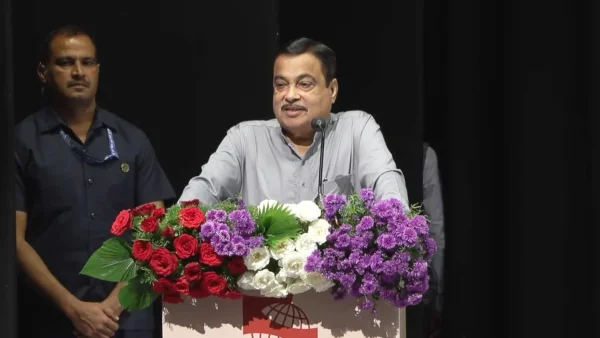
Union Road Transport and Highways Minister Nitin Gadkari has repeatedly argued that India needs massive private and institutional investment to build the infrastructure required for a rapidly growing economy. His latest remarks about mobilising ordinary Indians’ savings for infrastructure have once again brought the question of who should finance India’s highway expansion into the spotlight.
A viral version of the claim says Gadkari spoke about ₹15 lakh crore and offering ordinary citizens returns of around 18% for investing in infrastructure.
However, there is an important fact-checking point: the ₹15 lakh crore figure is not a newly discovered government fund lying idle. Gadkari has used the figure in the past to describe the scale of highway projects and investment targets. For example, in 2019 he said he was working on highway projects worth about ₹15 lakh crore, including green expressways.
So the viral presentation that “Gadkari has ₹15 lakh crore lying around” is misleading.
The Bigger Idea: Why Ask Citizens for Money?
Gadkari’s infrastructure strategy has increasingly emphasised private investment, public-private partnerships and alternative financing mechanisms.
The reason is straightforward.
Building highways, expressways, tunnels and bridges requires enormous amounts of capital.
The government cannot necessarily finance every project entirely through its annual budget.
The Ministry of Road Transport and Highways has therefore explored multiple financing models, including PPP structures, toll-based projects and other forms of private investment.
The government’s own 2026 budget analysis shows that the ministry’s capital expenditure has grown substantially over the past decade, while the private sector’s share in road construction has fallen from 51% in 2014-15 to around 15% in 2023-24. (PRS Legislative Research)
That makes attracting private capital increasingly important.
Where Does the “18% Return” Come From?
This is the part that needs particular caution.
An 18% return should not be interpreted as an ordinary bank-deposit interest rate or a guaranteed government return unless the specific investment product explicitly provides such a guarantee.
Infrastructure investments can generate returns through toll revenues, interest, project cash flows or other mechanisms, depending on the structure.
The risk can therefore be substantially different from keeping money in a conventional savings account or fixed deposit.
A headline saying “Gadkari will give common people 18%” can therefore create the wrong impression. Before investing, citizens would need to know:
Is the 18% guaranteed?
Who guarantees the principal?
What is the investment period?
Is the investment tradable?
What happens if a highway project earns less than expected?
Who bears construction and traffic risk?
Is the investment insured?
What happens if a project is delayed?
Are returns taxable?
These questions matter much more than the headline percentage.
Why Would Anyone Invest at 18%?
The attraction is obvious.
If a bank deposit offers a considerably lower return, an investment promising something close to 18% would appear extremely attractive.
But there is a fundamental financial principle:
Higher expected returns generally come with higher risk. A bank deposit and an infrastructure investment are not automatically comparable products.
A bank deposit is governed by a banking and deposit-regulation framework, while an infrastructure investment could expose the investor to project, credit, market, liquidity and regulatory risks depending on its structure.
So comparing “bank gives 4–6%, infrastructure gives 18%” without comparing risk is incomplete.
Why Gadkari Wants Domestic
Savings India has enormous household savings.
If even a small portion of those savings can be channelled into productive infrastructure, it could provide an additional source of capital for roads and other projects.
And the logic has some merit.
A highway is not simply a road.
It can:
reduce travel time,
improve freight movement,
connect markets,
support manufacturing,
create construction employment,
reduce logistics costs,
improve regional connectivity.
The government has argued that infrastructure investment can reduce logistics costs and improve India’s competitiveness. (Press Information Bureau)
Recent projects illustrate the scale involved.
For example, the government says 2,105 km of road projects worth ₹1.04 lakh crore are being developed across the Delhi-NCR region alone.
But Should a Peon or Constable Invest Their Savings?
This is where the political rhetoric needs to be separated from financial reality.
A low-income worker’s savings may represent:
emergency money + children’s education + healthcare + retirement security.
Such a person cannot necessarily afford the same level of risk as a large institutional investor.
Therefore, if the government wants ordinary citizens to participate in infrastructure financing, the structure must prioritise:
capital protection, transparency and liquidity.
*A product offering an attractive return but exposing small savers to significant losses could create serious problems.
What Happens If the Project Fails?
This is the question that should accompany every infrastructure-investment advertisement.
Suppose a toll road receives less traffic than projected.
Revenue falls.
Or construction gets delayed.
Or land acquisition takes longer.
Or construction costs rise.
Or interest rates change.
Or a concession agreement is renegotiated.
Who takes the loss? If the answer is the investor, the public needs to understand that before investing.
If the government guarantees the principal, then the government needs to disclose the potential fiscal liability.
There is no free money.
India Already Uses Different Infrastructure-Financing Models
The idea of using private money for roads is not new.
India has previously used models such as:
Build-Operate-Transfer arrangements
Toll-based concessions
Hybrid annuity models
Infrastructure investment structures
Bonds and debt financing
Public-private partnerships
Gadkari has himself spoken about reviving toll-based and other private-investment models for highways.
So the broader idea isn’t necessarily revolutionary.
The interesting question is whether ordinary household investors can be brought into the system safely and transparently.
The ₹15 Lakh Crore Number Needs Context
The viral claim makes it sound as though the minister has announced that ₹15 lakh crore is currently sitting in a government account.
That isn’t what the available evidence shows.
Gadkari previously described ₹15 lakh crore as the scale of highway projects/investment he was targeting, including major expressway projects.
More recently, the government’s infrastructure pipeline has involved projects worth enormous sums across different regions.
Therefore:
₹15 lakh crore = infrastructure investment/project scale, not ₹15 lakh crore of spare government cash. That distinction is crucial.
The Positive Side
If properly designed, allowing citizens to invest in infrastructure could have genuine advantages.
For India
More domestic capital could help accelerate infrastructure development.
For citizens
Investors could potentially earn returns from India’s infrastructure expansion.
For the economy
Better roads can improve logistics, connectivity and productivity.
For financial inclusion
Ordinary savers could participate in long-term national infrastructure rather than leaving investment entirely to large institutions.
But There Are Serious Risks
The proposal also raises several concerns.
1. Risk Misunderstanding
People may assume that an infrastructure investment is as safe as a bank deposit.
It isn’t necessarily.
2. Return Expectations
An advertised or projected 18% return could be misunderstood as guaranteed.
3. Small-Saver Vulnerability
Poorer households have less capacity to absorb losses.
4. Project Delays
Infrastructure projects frequently face land, environmental, regulatory and construction challenges.
5. Transparency
Investors need detailed information about where their money is going.
6. Conflict of Interest
The government must ensure that political enthusiasm for infrastructure does not override proper financial due diligence.
What Should Citizens Ask Before Investing?
Before putting even ₹1 into an infrastructure investment, investors should ask five simple questions:
Is my principal guaranteed?
Is the 18% return guaranteed or merely projected?
Who regulates the investment?
Can I withdraw my money before maturity?
Who bears the loss if the project fails?
If these answers aren’t clearly available in official documents, investors should not rely on a viral video or political speech.
The Bigger Debate: Can India’s Roads Be Built With India’s Savings?
There is nothing inherently wrong with asking citizens to participate in nation-building through investment.
In fact, infrastructure can be a productive destination for long-term capital.
But the relationship between government and citizen-investor must be based on full disclosure rather than patriotic appeal.
A citizen should invest because the product makes financial sense—not simply because a minister says the money will build the nation.
Conclusion**
Nitin Gadkari’s broader message is clear: India needs enormous amounts of capital to fund its infrastructure ambitions, and private and domestic investment can play an important role.
But the viral claim that ₹15 lakh crore is simply “lying around” is misleading, and the reported 18% figure should not be presented as a guaranteed return without identifying the specific investment scheme and its terms.
The real story is therefore not:
“Government will take money from poor people and give them 18%.”
It is:
“Can India create a safe, transparent financial mechanism through which ordinary citizens can participate in infrastructure investment?” If the answer is yes, it could unlock a huge pool of domestic capital.
But if ordinary people’s savings are being invited into infrastructure projects, one principle must remain non-negotiable:
The citizen must know exactly what risk they are taking before they are asked to build the nation’s roads with their savings.