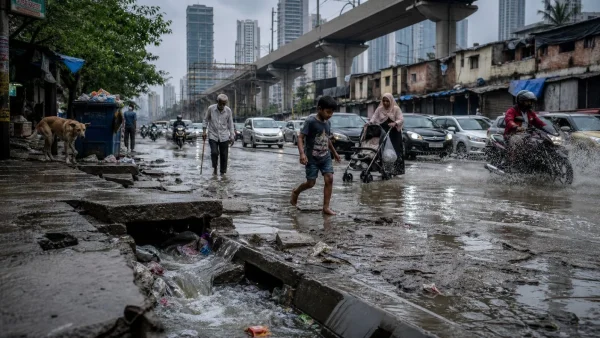
For millions of urban residents, the biggest challenges of daily life are often not dramatic policy debates but the seemingly ordinary problems outside their homes.
A waterlogged road can turn a routine commute into a dangerous journey. A broken footpath can force pedestrians onto busy roads. An uncovered drain can become a trap, particularly for children and elderly people. Stray dogs can make even a short walk feel unsafe.
These problems may appear small individually. Collectively, they reveal a much larger question about the quality of basic civic governance.
When a Road Becomes an Obstacle Course
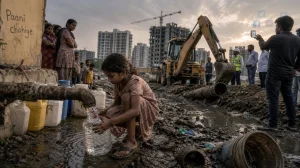
Waterlogging remains one of the most visible signs of inadequate urban drainage.
During heavy rain, roads can quickly become difficult to navigate when drainage systems are blocked, damaged or insufficient.
For pedestrians, the consequences can be particularly severe.
They may have to:
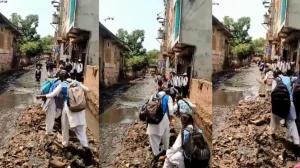
Walk through stagnant water
Step onto busy roads
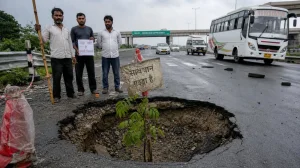
Navigate potholes hidden beneath water
Avoid open manholes and drains
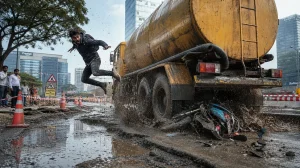
Deal with vehicles splashing contaminated water
Risk slipping or falling
For people travelling to work, school or hospitals, these are not occasional inconveniences. They can become part of everyday life during the monsoon.
The Footpath Problem
A city cannot be considered pedestrian-friendly simply because it has roads.
People also need safe, continuous and usable footpaths.
Yet broken pavements, encroachments, missing sections and poorly designed pedestrian infrastructure frequently force people to share road space with vehicles.
That creates a particularly serious problem for:
Children.
Senior citizens.
People with disabilities.
Women travelling alone.
People carrying luggage or pushing children.
A footpath that suddenly ends, is blocked by debris or disappears into a parking area is not merely inconvenient—it can push pedestrians into potentially dangerous traffic.
Open Drains: A Basic Safety Failure
Exposed drainage systems present another preventable hazard.
Open drains can become especially dangerous during rain, when flowing or stagnant water can obscure their depth.
They can also create:
Accident risks
Foul odours
Mosquito breeding
Waste accumulation
Sanitation problems
Contamination risks
The question residents often ask is straightforward:
Why should citizens have to identify and avoid hazards that municipal authorities are supposed to prevent?
Stray Dogs Add Another Layer of Anxiety
The presence of large numbers of stray dogs in residential and commercial areas has also become an important civic concern.
For many residents, particularly children and elderly people, encounters with aggressive or territorial dogs can be frightening.
At the same time, the issue cannot simply be reduced to removing animals from streets.
Effective management requires responsible implementation of measures such as:
Sterilisation
Vaccination
Animal birth-control programmes
Proper waste management
Response mechanisms for aggressive animals
Public awareness
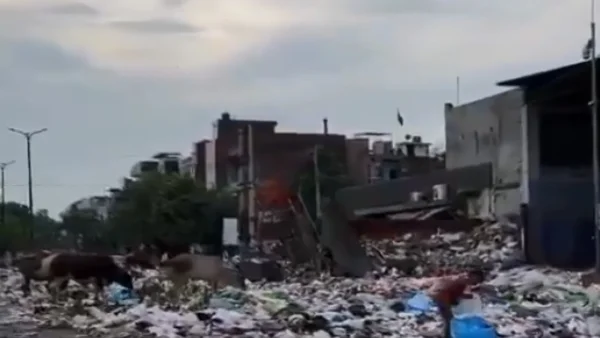
A cleaner city with better waste management can also reduce the availability of food waste that attracts large numbers of stray animals.
The Global-City Ambition vs Ground Reality
India’s major cities increasingly aspire to become global economic and technological centres.
New airports, expressways, business districts, metro systems and large infrastructure projects are frequently presented as symbols of India’s transformation.
Those ambitions are important.
But residents experience their city at street level.
A global city also needs a usable footpath.
A modern city needs functioning drainage.
A developed city needs safe pedestrian crossings.
A well-governed city needs roads that remain usable during ordinary rainfall.
The contrast becomes particularly stark when high-profile infrastructure projects exist alongside neglected neighbourhood-level facilities.
Basic Civic Amenities Are Not a Luxury
For an ordinary citizen, the quality of governance is often measured through very simple questions:
Can I walk safely to the market?
Can my child reach school without entering traffic?
Will rain turn my street into a lake?
Is the drain covered?
Can an elderly person use the footpath?
Can I walk outside without worrying about aggressive stray animals?
These are not extravagant demands.
They are fundamental elements of a functioning urban environment.
Who Is Responsible?
One difficulty in Delhi and several other major cities is that civic responsibility is divided among multiple agencies.
Depending on the location and problem, responsibility can involve:
Municipal corporations
Public Works Departments
Development authorities
Local bodies
Water and sewerage agencies
Traffic authorities
State governments
Resident welfare associations
This fragmentation can sometimes create a familiar cycle:
Citizen complains → Agency A says it is Agency B’s responsibility → Agency B redirects the complaint → Problem remains.
For residents, however, the distinction between agencies matters far less than getting the problem fixed.
The Need for Outcome-Based Governance
Rather than measuring urban development only through the number of projects announced or inaugurated, governments could also publish measurable neighbourhood-level indicators.
For example:
Percentage of roads free from major waterlogging
Length of continuous pedestrian pathways
Number of uncovered drains eliminated
Average time taken to repair dangerous roads
Garbage collection performance
Stray-animal complaint response times
Accessibility of public infrastructure
Such indicators would allow citizens to assess whether infrastructure spending is actually improving everyday life.
Development Should Be Felt at Street Level
India’s aspirations to become a developed and globally competitive nation require major investments in infrastructure, technology and industry.
But development ultimately has to reach ordinary neighbourhoods.
A city does not become world-class merely because it has impressive landmarks.
It becomes world-class when an ordinary citizen can safely walk home after work, cross a road, use a footpath and reach their destination without navigating open drains, stagnant water and broken infrastructure. The real test of urban governance is therefore not only what a city builds at its showcase locations.