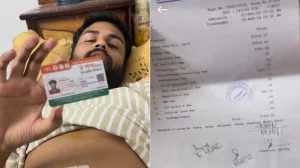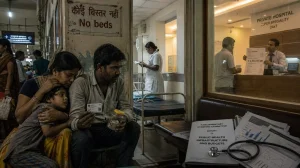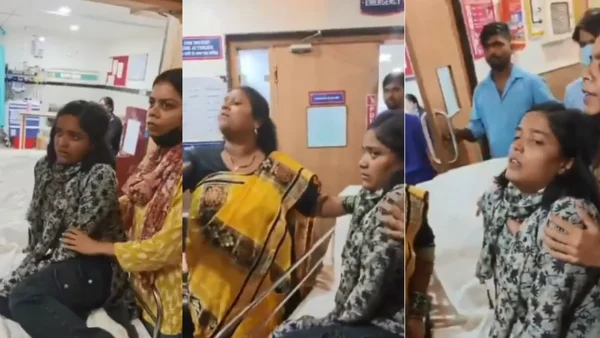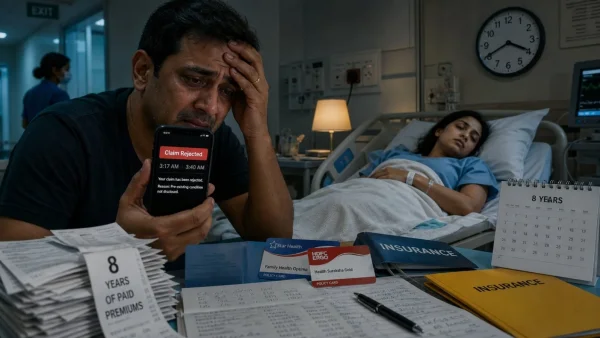
A health-insurance dispute involving a policyholder whose wife was hospitalised at Fortis Greater Noida has raised questions about the transparency and speed of insurance-claim decisions.
According to the account shared by the policyholder, he had been paying health-insurance premiums for approximately eight years without making a single claim. He says he maintained multiple separate policies with Niva Bupa, rather than relying on a single family-floater policy.
The policies reportedly provided coverage of around ₹25 lakh each for different family members.
The policyholder says he purchased the policies primarily for financial security in case of a serious medical emergency.
But when his wife eventually required hospitalisation, he claims that the insurance company rejected the claim despite the family’s long history of premium payments.
Wife Hospitalised After Typhoid Diagnosis
According to the policyholder’s account, his wife initially received treatment through the family’s doctor before being taken to hospitals as her condition required further medical attention.
She was eventually admitted to Fortis Hospital, Greater Noida, where doctors diagnosed her with typhoid, according to the account.
The family then approached the insurer for cashless/claim-related assistance.
What followed, the policyholder says, left him questioning the very purpose of maintaining health insurance for years.
Claim Rejected Within 23 Minutes
One of the most striking allegations concerns the timeline of the claim decision.
The policyholder says the claim request was submitted at approximately 3:17 a.m.
According to him, the rejection arrived at around 3:40 a.m.—just 23 minutes later.
He argues that the short interval raised serious questions about whether the documents and medical circumstances could have been properly examined before the claim was rejected.
The family subsequently submitted a clarification, hoping the insurer would reconsider the decision.
But, according to the policyholder, the claim was again rejected within approximately 10–15 minutes.
“What Was the Point of Paying for Eight Years?”
For the policyholder, the dispute is about more than one rejected claim.
His central question is straightforward:
If an insurer can reject a claim when a policyholder actually needs medical assistance, what is the purpose of paying premiums year after year. He says that during eight years of coverage, he had never filed a claim.
From his perspective, the insurance was purchased precisely to provide financial protection during an unexpected medical emergency.
The rejection therefore came at what he describes as the family’s first major moment of need.
Multiple Policies, Not Just One Family Floater
The policyholder says he deliberately maintained separate insurance coverage for members of his family.
According to his account, the policies included coverage for:
Himself
His wife
His wife’s parents
His child
Each policy was reportedly worth around ₹25 lakh.
He says this was a conscious decision to ensure that every family member had substantial individual protection instead of depending solely on a single family-floater policy.
That makes the alleged claim rejection particularly frustrating for him.
The Bigger Issue: Speed vs Proper Scrutiny
The dispute raises an important question about the way health-insurance claims are processed.
A claim can legitimately be rejected if it falls outside the terms and conditions of a policy—for example, because of an exclusion, waiting period, non-disclosure of a relevant pre-existing condition, inadequate documentation or another contractual reason.
Therefore, a rejection by itself does not establish wrongdoing by an insurer.
But where a policyholder believes that a claim was rejected without adequate examination, the insurer should be able to provide a clear and specific explanation.
The key issue in this case is therefore not simply that the claim was rejected.
It is why it was rejected and what evidence was considered before the decision was made.
What the Insurer Should Clarify
If the policyholder’s account is accurate, several questions naturally arise:
What was the precise reason for rejecting the claim?
Which policy clause was cited?
Were the medical records reviewed before the rejection?
Was the hospital asked to provide additional information?
Why was the initial decision reportedly reached within 23 minutes?
Why was the clarification reportedly rejected within another 10–15 minutes?
Was the decision reviewed by a medical professional or claims specialist?
What appeal or grievance mechanism is available to the policyholder?
These questions can only be conclusively answered by examining the actual claim documents and the insurer’s written rejection.
A Reminder About What Insurance Is Supposed to Provide
Health insurance is fundamentally based on risk pooling.
Policyholders pay premiums when they are healthy so that financial protection is available when illness or hospitalisation occurs.
That means the relationship depends heavily on trust.
Customers are expected to disclose relevant information accurately and pay premiums on time.
In return, they expect legitimate claims to be assessed fairly and transparently according to the policy contract.
When a claim is rejected, a detailed explanation becomes especially important.
One Viral Case Should Not Become a Verdict on the Entire Industry
The allegation described here represents one policyholder’s account. Without the policy documents, medical records, claim correspondence and the insurer’s response, it would be premature to conclude that the rejection was wrongful or that the company failed to follow its procedures.
The insurer should therefore be given an opportunity to explain the basis of its decision.
At the same time, the policyholder has every reason to seek a written explanation and use the applicable grievance and regulatory channels if he believes the decision was incorrect.
The Question at the Heart of the Dispute
For eight years, the policyholder says he treated insurance as a safety net.
He paid premiums.
He maintained multiple policies.
He never filed a claim.
Then, when his wife was hospitalised, he expected that safety net to work.
Instead, he says the claim was rejected within minutes and the subsequent clarification was rejected almost immediately.
That leaves one question that deserves a clear, evidence-based answer: Was the claim rejected because the policy genuinely did not cover the treatment—or was it rejected before the circumstances were adequately examined?
Until that question is answered with the actual claim documents and the insurer’s reasoning, the controversy will remain a dispute between a policyholder who says he was let down when he needed insurance most and an insurer whose side of the matter has yet to be established publicly.