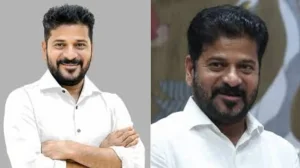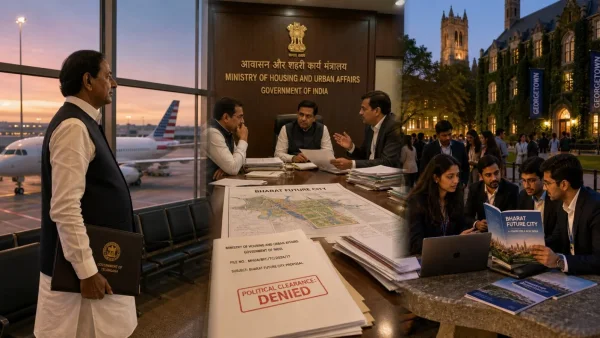
Telangana Chief Minister A. Revanth Reddy’s planned visit to the United States has been cancelled after the Ministry of External Affairs (MEA) denied political clearance for the US leg of his ongoing foreign tour.
Reddy had been scheduled to travel to the US as part of the “Telangana Rising” delegation, with meetings planned with leading educational institutions and other stakeholders. The Telangana government had sought central clearance for both the UK and US portions of the trip, but only the UK leg was approved.
The controversy intensified after the MEA described the decision as a denial of clearance on the “political angle.” However, the Centre later offered a more specific explanation: MEA spokesperson Randhir Jaiswal said the proposed programme was not considered appropriate to the office held and the stated purpose of the visit.
What Was Revanth Reddy Planning in the US?
According to reports, Reddy’s US itinerary included meetings with prominent universities and educational institutions, including Harvard, MIT, Northeastern University and Virginia Tech.
The Telangana government’s broader objective was to attract world-class institutions to the state, particularly as part of its plans for Bharat Future City and Hyderabad’s development as a global education and knowledge hub.
The Chief Minister had argued that bringing leading international universities to Telangana could provide Indian students with access to high-quality education, skills and research opportunities without requiring them to travel abroad.
Why Did the Centre Deny Clearance?
This is at the heart of the controversy.
The MEA has not said that Harvard, MIT or any particular university meeting was itself prohibited.
Instead, spokesperson Randhir Jaiswal said that foreign visits by chief ministers are assessed by the MEA and that the proposed programme must be appropriate to the office held and the purpose of the visit.
In this case, the ministry concluded that the requirement was not met and therefore denied clearance for the US portion. The government did, however, grant clearance for Reddy’s UK visit.
That distinction is important.
The available evidence does not establish that the Centre blocked the visit specifically because Reddy wanted to work with Harvard or MIT. The exact reasoning behind the assessment has not been publicly detailed beyond the MEA’s explanation.
Revanth Reddy Questions the Decision
Reddy has criticised the decision and argued that youth, education and nation-building should rise above political differences.
He said his objective was to bring leading global educational institutions to Telangana and create opportunities for Indian students.
The Chief Minister has framed the initiative as part of a broader effort to make Hyderabad a global knowledge and education destination.
He also instructed officials accompanying the delegation to continue with the US programme, even though he himself would not travel there. Reports say the delegation plans to pursue proposed discussions and agreements with universities.
A Political Controversy Has Now Emerged
The episode has quickly become another flashpoint between the Congress-led Telangana government and the BJP-led Union government.
Congress leaders have questioned why the UK portion of the trip was approved while the US portion was rejected.
Congress president Mallikarjun Kharge described the decision as “deeply unfair” and accused the Centre of selectively granting foreign-travel permissions.
The Centre, meanwhile, has defended its authority to assess such foreign visits and has pointed out that political clearance is a normal part of the process for visits by chief ministers and other dignitaries.
Is Bringing Global Universities to India a Political Issue?
This is where the controversy becomes bigger than one cancelled trip.
India has been attempting to expand international academic collaboration, attract foreign universities and build stronger research and education ecosystems.
Telangana’s proposal is consistent with that broader ambition.
If an Indian state government wants to persuade globally recognised institutions to establish campuses, collaborate on research or create educational programmes in India, such efforts could potentially benefit:
Students
Researchers
Start-ups
Faculty
Technology companies
The wider innovation ecosystem
But international engagement by elected state governments also operates within India’s foreign-policy and diplomatic framework.
That is why central clearance exists.
The Question That Remains Unanswered
The most important unanswered question is not simply “Why was Revanth Reddy stopped?”
It is:
What specific aspect of the proposed US programme was considered inappropriate for the office of a Chief Minister? The MEA has explained the principle but has not publicly provided detailed specifics about which proposed engagements failed that test.
Greater transparency could therefore help settle the controversy.
If there were legitimate diplomatic, protocol or programme-related concerns, explaining them clearly could prevent the issue from becoming a purely political confrontation.
The Education Mission Continues
Despite the cancellation of the Chief Minister’s US visit, the Telangana delegation has reportedly been directed to continue its engagements.
That means the proposed education partnerships may not necessarily disappear because Reddy himself cannot travel.
The state can still attempt to negotiate institutional collaborations through its officials and representatives.
The outcome of those discussions—particularly whether any formal agreements are eventually signed—will be more important in the long run than the controversy surrounding the cancelled trip.
A Larger Centre–State Question
The incident highlights an important feature of India’s federal system.
States increasingly seek international partnerships for investment, education, technology and skills, while the Union government retains a central role in foreign-policy matters and official overseas engagements.
The challenge is finding the right balance.
State governments need space to pursue legitimate economic and educational opportunities. The Union government also has a responsibility to ensure that official international engagements conform to national diplomatic and protocol requirements. The disagreement over Revanth Reddy’s US trip shows how quickly that balance can become politically contentious.
Conclusion
The cancellation of Revanth Reddy’s US visit has become a political controversy, but the underlying education initiative deserves separate attention.
The Telangana government says it wants to bring world-class universities and educational opportunities closer to Indian students. The Centre says the proposed US programme did not meet the criteria required for political clearance.
At present, there is no evidence establishing that Harvard or MIT themselves were the reason for the denial.
The clearest unanswered question remains why the proposed programme was considered unsuitable.