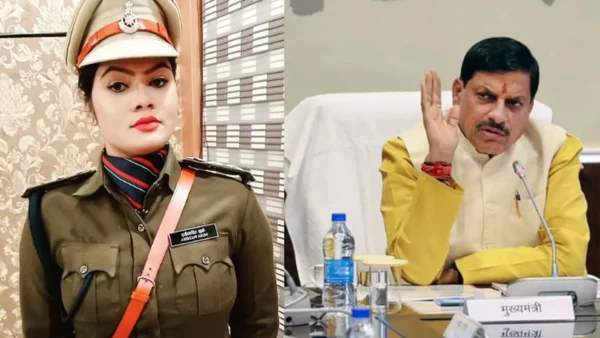
Madhya Pradesh Chief Minister Mohan Yadav has ordered the immediate suspension of Katni City Superintendent of Police (CSP) Neha Pachisia following the registration of an FIR alleging coercion, fraud and criminal conspiracy in connection with a disputed land transaction.
The allegations are considerably more serious than the viral social-media version of the story. Available reports do not establish that a ₹2-crore property was simply registered in the officer’s own name for ₹15 lakh. Instead, an official investigation reportedly assessed the property’s government guideline value at ₹82.86 lakh, while the disputed transaction was allegedly executed for ₹18.20 lakh. The documents reportedly show ₹15 lakh paid by cheque and ₹3.20 lakh in cash.
What Is the Allegation?
The case concerns land belonging to Ramesh Lodhi in the Kuthla police-station area of Katni.
According to the investigation cited by multiple reports, authorities allege that the Lodhi family was pressured into transferring the property at a price substantially below its guideline value, with the police machinery allegedly being used to exert influence.
The investigation reportedly found that the person in whose name the land was purchased, Maruf Ahmed Hanafi, did not appear to have sufficient funds in his account to independently finance the transaction.
Investigators reportedly found that ₹15 lakh was transferred into his account on April 15, 2026, the date of registration. Of this amount, ₹10 lakh allegedly came from an entity called Shine Partners and ₹5 lakh from an account linked to Kshitij Raj Barapatre. Investigators also reportedly noticed that the two accounts shared the same PAN details.
These findings form part of the investigation and would ultimately have to be tested through the legal process.
From Complaint to FIR
The matter reportedly came under scrutiny after complaints were investigated by Additional Superintendent of Police Anu Beniwal.
The investigation examined allegations concerning the land transaction as well as other complaints involving Pachisia.
Following the inquiry, a case was registered at Kuthla police station against Pachisia and two others. The reported FIR invokes provisions of the Bharatiya Nyaya Sanhita (BNS) relating to criminal conspiracy, public servant misconduct, extortion and cheating.
The development came after earlier administrative action had already reduced Pachisia’s responsibilities. Three police-station jurisdictions had reportedly been taken away from her amid separate allegations, and the matter had been under investigation for weeks.
CM Mohan Yadav Orders Suspension
After the FIR and investigation findings, Chief Minister Mohan Yadav directed the state Chief Secretary to initiate immediate suspension proceedings against Pachisia.
The CM’s office said that negligence, pressure or misuse of authority would not be tolerated in matters concerning law and order and that a fair investigation and strict action against those found responsible would be ensured.
The action is significant because the allegations involve a serving police officer accused of using the authority of her office in a private property transaction.
Was She Ordered to Be Sent to Jail?
This is another point where the viral version needs to be treated carefully.
The available reports confirm that an FIR was registered and suspension was ordered. They do not establish that Chief Minister Mohan Yadav personally ordered that Pachisia be “sent to jail immediately.”
Whether someone is arrested, granted bail, prosecuted or ultimately convicted is determined through the criminal-justice process.
Therefore, it would be inaccurate to present imprisonment as an established outcome at this stage.
High Court Had Earlier Declined Relief
The controversy had already reached the Madhya Pradesh High Court.
Pachisia had challenged the administrative decision to withdraw charge of three police stations. The High Court reportedly declined to interfere with that decision and rejected her petition seeking relief.
That development came before the subsequent FIR and suspension, adding another layer to the growing scrutiny surrounding her conduct as CSP.
Who Is Neha Pachisia?
Pachisia’s career has also attracted attention.
Before joining the police service, she reportedly worked as an air hostess and later entered the Madhya Pradesh state police service. She was appointed Katni CSP in 2025. Earlier reports have described her as having received recognition for policing initiatives and law-and-order work.
That background makes the current allegations particularly striking: an officer previously associated with public-service achievements is now facing a criminal investigation involving alleged misuse of official authority.
The Bigger Issue: Can Power Become Pressure?
The case raises a fundamental question for any law-enforcement system:
What happens when the person accused of using pressure is herself a police officer? Ordinary citizens depend on the police to protect their property and enforce the law.
If allegations arise that police authority was instead used to influence a private property transaction, the matter becomes much larger than an individual land dispute.
It becomes an issue of institutional accountability.
The government therefore faces two simultaneous responsibilities:
Protect the complainant’s rights.
And ensure that the accused officer receives due process.
Both principles are essential.
Suspension Is Not Conviction
It is important to underline that Neha Pachisia has been accused, not convicted.
The FIR and departmental investigation represent allegations and investigative findings. The criminal case must proceed according to law, and the evidence will ultimately determine whether the charges are proved.
At the same time, the government’s decision to suspend a senior police officer while the allegations are investigated sends a clear administrative message:
A uniform cannot place anyone above scrutiny.
The Real Test Begins Now
The suspension has answered one immediate question: Will the government act when serious allegations are made against a serving police officer?
The harder questions remain:
Will the land transaction be thoroughly investigated?
Will the money trail be established?
Will every person allegedly involved be questioned?
Will the complainant receive appropriate legal protection?
Will departmental responsibility also be fixed?
And, if the allegations are proved, will the prosecution result in a legally sustainable conviction?
For now, the case remains under investigation.
The message from Katni is clear: allegations of misuse of police power cannot simply be treated as an ordinary property dispute. But accountability must ultimately come through evidence, investigation and due process—not through viral claims alone.