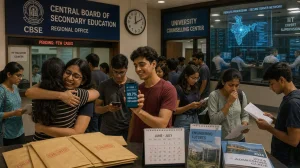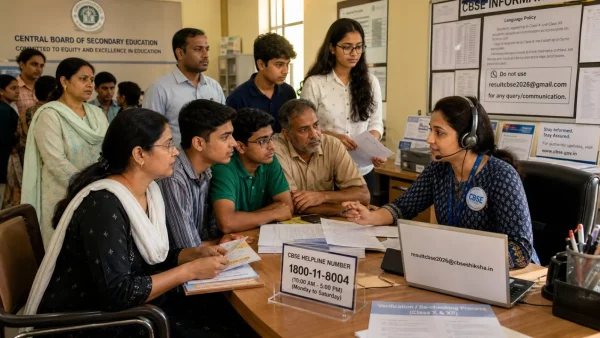
The numbers are in for the 2026 results and with them have come a wave of questions. So the board has made a point of opening up a toll-free line at 1800-11-8004 and an official inbox at [email protected]. Whether you’re a student, a parent or a school, these are your go-to for straight answers on what to do next.
Use these official access points:
– Toll-free helpline: 1800-11-8004.
– Official email for queries: [email protected].
– Do not write to [email protected].
– Open to students, parents and schools.
Why the new support matters
It has been a year of mixed signals. Out of 18,57,517 registered students, 85.20 per cent made it through – that’s 3.9 per cent less than we saw last year. Left to their own devices, even a minor query can turn into a lot of head-scratching, which is why the board is stepping in.
How students can reach CBSE
They say the new lines of communication are there for timely help, and to offer a bit of support where it’s needed. But they have also put out a word of caution: don’t be lured in by an unauthorised Gmail account that was accessed without permission. Misinformation has no place when you’re in a sensitive spot.
Stick to the authorised platforms, the board says. Have a question about rechecking or how to plan for a compartment? Put it to the helpline or the designated email and you’ll get a response in kind. In fact, in a recent post, officials were very firm on not using [email protected] because of the unauthorised access issue.
What the results say about performance
Some of the top performers are from the centrally run schools. Kendriya Vidyalaya Sangathan put in 98.55 per cent and Jawahar Navodaya Vidyalaya 98.47 per cent. For those weighing up their options for admissions or scholarships, it’s a telling stat.
You won’t find a conventional merit list from CBSE – they don’t like to stoke that kind of rivalry – but the high achievers are easy to spot. Some 94,028 of you (5.32 per cent) have 90 per cent or more under your belt, and 17,113 have 95 per cent and up.
The girls have once again had the edge over the boys, 88.86 per cent to 82.13 per cent. And transgender students have a 100 per cent pass rate. If you look at the regions, Thiruvananthapuram is on top with 95.62 per cent, with Chennai and Bengaluru not far behind. Delhi West is at 92.34 per cent and East at 91.73 per cent.
Next steps for schools and families
Before you make any moves on a re-evaluation, the board would have you call or write in to get the lay of the land on procedures and paperwork. It’s the only way to be sure you’re following the right path and not some unofficial advice.
Language policy update for the next academic cycle
On the policy front, there is a new rule for Class IX starting July 1, 2026: three languages, with two of them having to be native to India. It’s in line with the National Education Policy and the 2023 curriculum framework.
For the third language in Class X, there is no Board exam. The school will handle the assessment and it will show up on your certificate. Foreign languages are fine, but only as a third or optional fourth if you’ve already done your two Indian ones.
There are some leeway for Children with Special Needs and for foreign students back in India, on a case-by-case basis. Schools are told to pick from the CBSE list while minding the rules.
All in all, between the helpline, the email and the new language stance, the message is to take the pressure off and let the board be your source of truth.