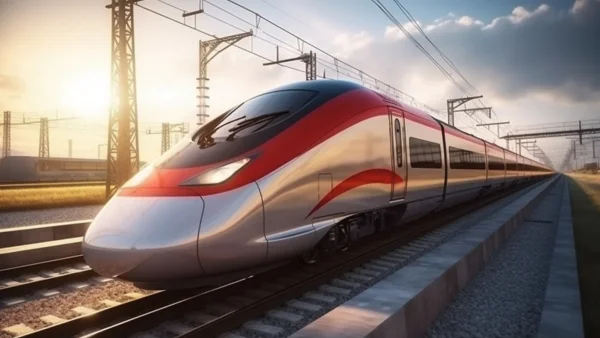
Stereo sound and ultrafast railways together with new Mumbai-Ahmedabad bullet train tremendous first opening operation Independence Day 2027. The Union Minister of Railways Ashwini Vaishnaw publicized the phased rollout stating that the first train ride would cover an area of 100 kilometers between Surat and Vapi in the month of August 2027.
Phased rollout: Surat-Bilimora to full corridor
The very first operational segment will be from Surat-Bilimora, soon followed by Vapi-Surat. Next the opening will be between Vapi and Ahmedabad, thereafter Thane to Ahmedabad and finally the entire Mumbai-Ahmedabad corridor will be available for the public. The officials are optimistic about this gradual approach as they consider it to be a compromise between speed and safety along with reliability. Vaishnaw made the amended plan quite clear: ‘The bullet train will be ready on August 15, 2027. The first section to open will be from Surat to Bilimora…then the Mumbai to Ahmedabad section will open.’ The minister also revealed that the originally planned 50 km demonstration had been increased to 100 km for the inaugural run. High-speed rail specifications and travel times The 508-km long Mumbai-Ahmedabad high-speed railway corridor will be built for operation at a speed of up to 320 kmph. When the entire corridor is operational, the travel time will be considerably reduced – 1 hour 58 minutes with only limited stops and 2 hours 17 minutes if it stops at all the 12 stations. Such travel times can change the patterns of business travel and regional people commuting. Moreover, the faster the connection, the more economic day trips become where previously they were only possible by conventional rail or road with a big overhead on time.
Engineering features and safety systems
The project incorporates Japan’s Shinkansen technology which is well-known for its dependability. Construction started in 2017 after the foundation stone was laid; the project suffered delays in land acquisition and other issues, thus the original operational target got pushed to 2027. Among the key engineering feats are an underwater tunnel of 7 kilometers near the Thane Creek, high-tech earthquake detection systems and streamlined structures to cope with the changing pressure during high speeds. These steps signify a strong commitment to passenger protection as well as operational robustness. Passenger comfort and accessibility The trains are going to be equipped with modern heating and cooling systems, baby-changing facilities, large wheelchair-accessible toilets, and special sickrooms.
The officials consider accessibility and inclusive design as an integral part of the passenger experience and therefore they are going to make high-speed rail usable for different traveler needs. The emphasis on comfort and amenities is in line with the international high-speed rail standards and thus ensures that a medium-distance trip will be a competitive and attractive alternative to air and road travel. Economic and regional impact Besides the swift travel, the corridor might also give the economies of the areas adjacent to it a boost. Better connectivity is generally the leading factor of change in business opportunities, such as higher property values around the stations and increased tourism and commerce. Policy and delivery considerations The phased operational plan gives the opportunity for the authorities to check their systems and then increase the number of services while still maintaining safety standards.
The officials have planned the entire timeline around careful commissioning of each segment rather than a one-time all-at-once launch. Independence Day 2027 is not that far off and the focus will be on final testing, trial runs, and communication of ticketing and service schedules which are clear. The minister encouraged the public to trust the project, allowing them to ‘buy a Bullet Train ticket on Independence Day 2027.’
In the long term the Mumbai-Ahmedabad bullet train can be seen as a giant leap national infrastructure-wise. If the project turns out to be on time and up to the standards laid down, it could be a model for other high-speed corridors in India.