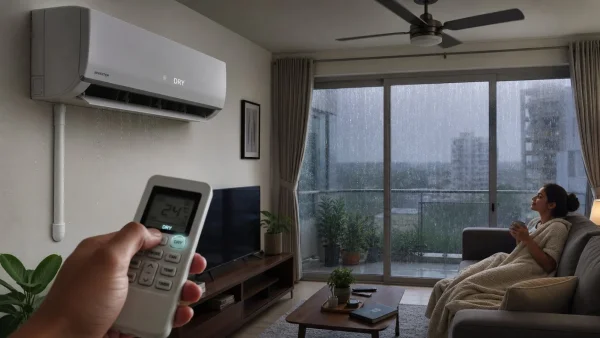
You may find your AC isn’t up to the task once the rains come. Don’t blame the unit. In cool mode you are after a lower number while the humidity makes for a sticky room and a higher energy tab. Make one adjustment: go to dry mode. It puts the moisture in its place and your comfort (and wallet) will thank you.
There is a lot of water in the air during the monsoon. It won’t let your sweat do its job of cooling you off. So even if the room is technically cooler, it’s still clammy. Most people just tell the AC to work harder, but that is only a form of waste.
Why cool mode is no good in the monsoon
The point of cool mode is to put out a lot of cold air in a hurry. The compressor is on full tilt to get the numbers down.
Yet when it is muggy, the air is full of it. Unless you get the moisture out, the stickiness is there. You can keep turning the dial, but you are not fixing the real problem and you are still using a lot of power for it.
The one button that makes a difference
With dry mode, the order of business is different. It is not in a rush to cool; it is after the water in the air. The fan eases up and the compressor will turn on and off to let the humid air run over the coils.
That slow-moving air lets the vapour condense and go. When the relative humidity is gone, your skin can cool off on its own. All of a sudden, the room is a bit more of a relief.
When to put it to use
It is the way to go in the monsoon or in any coastal spot where a room is more wet than hot.
You are not looking for a dramatic change in temperature. You want to clear the air so you can breathe easy when it gets heavy outside.
Do it right and you will save some on the bill
The compressor is what eats up the most. In cool mode it is going to run to make the room colder, regardless of the humidity. Dry mode has it cycling, which trims the hours on your meter.
If you have the AC on for a few hours in the rain, making this switch is a way to cut back on the electricity. You will see it add up over the season.
Mind this: if you set dry mode to something like 18C, the compressor will be on all the time to hit that mark. You lose the whole point of the feature and the savings with it.
Aim for 24 to 26C. That is what we suggest. The coils can do their work without being put through the wringer. 24C is fine in a room that has been dehumidified, whereas on a muggy day it is not enough.
Here is how to make it happen:
– Put the AC in dry mode when it is humid.
– 24-26C on the thermostat is the sweet spot.
– Shut the doors and windows.
– Give the filters a wash or a clean.
– A ceiling fan on low doesn’t hurt.
Don’t let the comfort in with the humidity
Dampness will find a way in. Leave the windows and doors alone while the dry mode is running or you will be starting over.
Filters are key in the rain. The monsoon is a breeding ground for dust and mould. If they are clogged, the coil can’t pull the water from the air very well.
Then you have air movement. Since you are not getting a wall of cold from the AC, a fan on low will circulate the drier air without being in your face.
Make the switch and here is what you will have
Your rooms will be more of an even keel, not so hard to be in. You won’t be up in the middle of the night fiddling with the remote. It is about having an environment you can live in, not one that is arctic.
Power use will come down as the compressor is not running at full throttle. This is something you will notice if you are on the AC for long periods in the monsoon.
With a little maintenance and a sensible setting, dry mode is the answer to the excess moisture. For a season like this, it is the more sensible, unobtrusive option than trying to force a lower temperature.