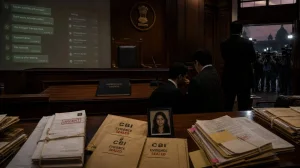
In a filing made to a Nashik court last week, the chargesheet for the TCS matter says there was a methodical plan to get to an employee. The victim has said she was put in a position where she had to view videos of Zakir Naik and other Islamic clerics from Pakistan.
What the chargesheet says
It all goes back to a 23-year-old at TCS who put in a complaint at Deolali Camp Police Station. The file alleges the people in question zeroed in on her emotional side, making out like they were the cure for any mental strain she was under.
She let the police know she was being steered toward online sermons to ‘get a handle on Islam’. She pointed to the likes of the Pakistani orator Tariq Jamil and our own Zakir Naik as the ones she was told to pay attention to.
In the words of the chargesheet, this was sold to her as a way to take the edge off. She was led to believe that if she went with the flow and accepted Islam, the stress would go away. And eventually, she did come around to ‘those things’.
The alleged campaign of influence
If you ask the investigators, the complainant laid out a clear pattern: a lot of talk about faith, being told to change up your day-to-day, and the constant message that a bit of spirituality would put her mind at ease. The accused, the chargesheet says, put it off as a form of support.
Then there is the matter of Danish Shaikh. A married man, he is accused of using the prospect of marriage to make a move on her. When she put him on the spot about where things were going and how her family would see it, he would put her at ease with some pious talk.
‘Don’t be afraid, I’m here for you, and so is Allah,’ is how she put it. He also told her to give up on the Bhagwan songs and the temple visits to lower her stress. On top of that, he had her reciting the Tasbeeh, the document adds.
Religious content, promises and financial access
She was also put on to the idea of saying Astaghfar for absolution. The line was: ‘Take Allah’s name and your sins are gone, your good works will show.’ All of it, she says, was tied up with the notion that it would do something for her headspace.
And then there’s the money side of it. She has it on record that Danish had the run of her bank details and UPI PIN, and knew exactly what was in her account. It’s one of the many ways the chargesheet says he had a hold on her.
You can find in the file that she was made to be part of some very specific religious talk – references to Prophet Ibrahim, Bakri Eid, Zamzam water, Qurbani, and the whole Jannah and Jahannum of it.
Roles attributed to the accused
We have three names for the time being: Danish Shaikh, Tausif Attar and Nida Khan, all of whom are in custody. The chargesheet also has AIMIM’s Matin Patel in the crosshairs, for his part in giving Khan a place to lay low when she was on the run.
Investigators say Patel was in on it even after he found out her bail was turned down. Before they could put her in the bag, Patel was stonewalling them with questions about where she was.
He would say, ‘You’ll have to ask Imtiaz Jaleel Sahib for that’, according to the chargesheet. But once they pressed him, he caved and let on where she was with her parents, brother and aunt.
Instructions and alleged coordination
Danish, she says, had Tausif and Nida in on it, to give her a primer on the religion. They would chime in now and then to fill her in.
Tausif in particular was on her to go on YouTube and put on some of Dr Israr Ahmed or Zakir Naik. She did as she was told; it was all in the name of education, or so she was made to think.
The same for the sermons of Tariq Jamil, the chargesheet has it. According to the investigators, the material and counsel put in front of her were meant to be a way to take some of the edge off her mental state.
The probe and what witnesses have to say
You’ll find 106 witness statements in the chargesheet. They come from all sides: the complainant, her mother, TCS staff and their superiors, the PoSH committee, and the officers who have been on the case.
There is a Special Investigation Team in place now. That was put together after a number of women at the IT firm’s Nashik office came forward with claims of everything from molestation and mental harassment to being forced into a conversion and having their religious feelings trampled. We are looking at more than one FIR here.
One was put in at Deolali Camp Police Station, but eight have been filed at Mumbai Naka in Nashik. The authorities tell us they are all being looked at at the same time as part of the SIT’s work.
Other allegations on the table
A few of the complainants say they were put on the spot to follow certain religious ways of doing things – be it in their diet, in prayer, or in the symbols they put on display.
Investigators see a pattern in the various statements that points to a kind of ongoing psychological pressure, not just a one-off. The chargesheet makes of this the heart of the matter.
It comes down to a workplace where, the complainants say, you can’t tell where your personal life ends and where the job begins. The SIT will have to decide if there is a common thread to these stories or if it was just a few bad actors.
What TCS is saying and what’s in store
TCS for its part has pointed to its zero-tolerance stance on this sort of thing. In the meantime, they’ve put a hold on the employees at the Nashik office who are in the crosshairs.
Now it’s up to the courts to make sense of the chargesheet, the timeline and the words on record. We’ll have to see what the defence has to say and whether any bail or custody orders come down the line.
The review is also going over digital footprints, like video and messages, to get at the intent. But for the most part, the chargesheet is built on what people have said.
To put it in a nutshell:
– A chargesheet was put before a Nashik court last week
– Three of the accused are in custody, another has been identified
– The Maharashtra government has an SIT on it
– One FIR at Deolali, eight at Mumbai Naka
– 106 witnesses have been heard
Why you should be paying attention
This isn’t just a list of quotes. The chargesheet is making a case for how some of the reassurances and the religious talk were tied to the complainant’s access and well-being. It’s a story about using the promise of some relief to change a person’s mind.
For our readers, there is a legal and a social side to this. We’re talking about safety at work, where you draw the line with persuasion, and how religion is handled in an office.
The claim that she was made to stop some things and do others is going to be put to the test in court. Was she being coerced? And was the religious instruction of her own volition or something else?
In the complainant’s words
Her statement is a mix of conflicting emotions: a fear of what her family would think, a desire for some stability, and a trust in the people she was dealing with. She says she was given marriage and spiritual promises in the same breath.
She has also laid out how she was led, bit by bit, into sermons and new ideas. “I thought my stress would go down if I became a Muslim,” she says, and that she found herself coming around to “those things” over time.
The investigators have put on record that she linked these suggestions to her day-to-day. The chargesheet puts it simply: the guidance was sold to her as a way to find some peace.
So what are we to make of it?
– Do the other witnesses back up what she’s saying?
– Can the case be made that the accused were in on it?
– How will the judge look at consent?
We’ll get some answers as the filings and the court move forward. For the moment, the chargesheet is the word, and the defence will no doubt have a lot to say about it.