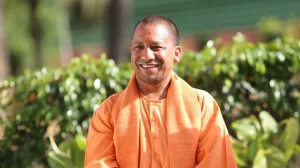
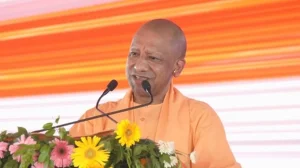
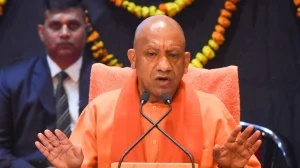
On Monday, May tth, 2026, the Chief Minister of Uttar Pradesh strongly defended India’s long-lasting identity, saying that attempts by people from other countries to destroy what India believes in spiritually have failed. He was speaking in Varanasi and said that “Sanatan” (an ancient faith) is a deep part of how Indians think, and the revival of temples all over the country is giving people more belief in themselves.
Why the remarks matter now
Adityanath says that India’s religious places aren’t simply old buildings, but important, constantly existing parts of who we are and how we feel about ourselves. He thinks making them strong again is central to the country being united, and recent improvements to them show India is getting stronger.
He directly connects fixing up old heritage with building up the nation. He says these projects show the ‘lasting desire’ of India’s ancient civilisation. In his view, temples and holy places are becoming both what people think of when they think of Indian culture and are helping that culture to be confident.
Credit to the Prime Minister and the revival drive
Yogi Adityanath says Prime Minister Modi is leading the country towards "One India, Great India” and is in charge of redeveloping important spiritual centres. Many important places are being given a much more impressive and beautiful new look.
For examples, he mentioned the completely rebuilt and improved Somnath temple in Saurashtra, the Kashi Vishwanath Dham in Kashi, Mahakal Mahalok in Ujjain, and the new Ram temple in Ayodhya. He congratulated the Prime Minister, speaking for all the people of Uttar Pradesh.
Adityanath distilled his message into core assertions that he said underpin the current moment of cultural renewal:
– Sanatan resides in India’s consciousness
– Invaders could not break India’s soul
– Some forces still resist cultural resurgence
– Somnath Swabhiman Parv reconnects roots
– Resurgence equals civilisational pride
Historical framing and pointed criticism
Looking back at history, Adityanath said that rulers from Mohammad Ghori to the Mughals all tried to get rid of India’s culture and spiritual beliefs. He says these attempts ultimately didn’t work, because the true heart of Sanatan is more than just buildings.
He specifically criticised Aurangzeb, saying he had the old Kashi Vishwanath temple torn down during his reign and replaced with something representing being ruled over. He said “They couldn’t break the soul of India”, and that Sanatan isn’t just inside the walls of a temple.
He believes those who tried to wipe out Sanatan “have now completely disappeared”, while Kashi Vishwanath Dham and Somnath temple still represent India’s self-respect. He stresses that things are continuing despite the difficulties and violence of the past.
Political undertones without names
Adityanath warns that there are still people opposing this revival. He says that people who were against rebuilding Somnath also caused problems with building the Ram temple in Ayodhya (he doesn’t say who these people or groups are).
He also feels that after India became independent, it could have done something about restoring national pride much sooner, but “didn’t have the will”. He thinks the current progress fixes this past hesitation and gives a clear way to be confident in our culture.
The Chief Minister says these current projects should continue “with respect”, despite the opposition. He sees restoring these places as absolutely necessary for the country to respect itself, and not just a short-term political thing.
Somnath, Kashi and the idea of civilisational pillars
Adityanath says Somnath and Kashi are the two most important spiritual places in India. Kashi Vishwanath Dham is on the holy Ganges river in the north, and Lord Somnath Mahadev (said to be the first Jyotirlinga) is on the west coast.
He describes rebuilding the Somnath temple as a “statement of being free from being ruled” and restoring the country’s self-respect. He says Sardar Vallabhbhai Patel decided to rebuild Somnath and ‘stuck to it’ despite difficulties.
He added that India’s first President, Dr Rajendra Prasad, went to the ceremony to re-establish the Somnath Mahadev Temple 75 years ago, even though the government at the time wasn’t in favour. Adityanath says this shows a long history of India standing up for itself.
Inside the Varanasi event and Gujarat rituals
These comments were made at the Somnath Sankalp Mahotsav in Varanasi, which was part of the Somnath Swabhiman Parv. Adityanath says this is an attempt to reconnect India with its past. He says it is a strong call for cultural awareness and spiritual traditions to be renewed.
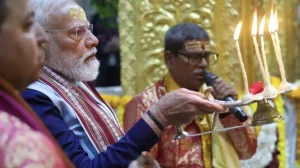
People at the Varanasi event watched on television as the Prime Minister performed a special, important puja (religious ceremony) at the Somnath Temple in Gujarat. This ceremony included Kumbhabhishek (a ritual pouring of water), hoisting a flag and other related traditions.
The way Adityanath is talking about things puts restoring heritage at the centre of a bigger cultural project, and it’s about more than just the buildings. As he sees it, the big question is whether this progress will continue without being stopped by criticism and disagreement.
The Chief Minister clearly thinks we should continue to develop temples and holy places as a way to show how confident our civilisation is. His supporters say this is bringing back pride; he says his critics are still there. What happens next will determine how places like Somnath and Kashi will affect how Indians live and what they think about in the future.