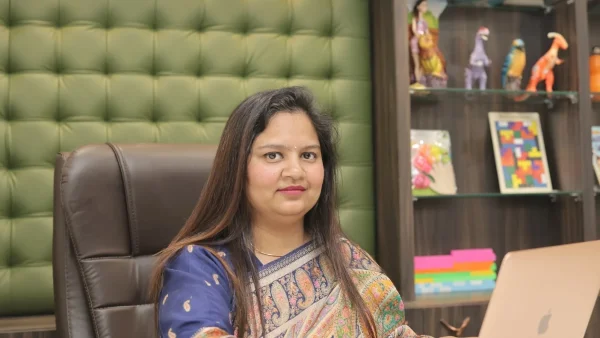
In India, where academic pressure often overtakes understanding, Dr. Vini Jhariya is leading the effort to revamp the way parents, schools, and clinicians support children. At Indore, she has replicated an ecology of assessment, therapy, inclusive education, and parenting support, helping to turn confusion into clarity and fragmented intervention into a cohesive and coordinated care.
Turning Personal Trauma Into Professional Dedication
Vini Jhariya’s journey into child psychology started off with her own academic experiences. She was bright in school but could not perform well in exams and started noticing how talented children are not taken care under the system. She got enlightened from that primary experience and that’s how the question was born as to why some of the capable children falter when a single type of intelligence is given precedence when measured.
Not willing to let that gap be, she ignited the proceedings for psychology as the solution. Her only central aim was to see that no child is considered incorrectly, just because they have not been looked at by a system that should have acknowledged the child’s strengths. This paramount drive that fuels the quality of her everyday practice is built upon a combination of empathy, precision, and long-term outcomes.
Clinical Expertise Anchored in Science
The clinical and child psychologist, with 10 years of busy professional life, has ascended Mount Everest: working across the widest range of children with autism spectrum disorder, ADHD, learning disabilities, developmental delays, emotional regulation challenges, and behavioral concerns, her practice insists on standardized psychological assessment and evidence-based intervention.
Each intervention plan is individualized and measurable. By incorporating structured developmental planning with progress tracking, Dr. Jhariya ensures interventions are executed not just with compassion, but with numbers as valuation. This ensures that the care given is customized, transparent, and responsible to families.
Creating a Maternal Child Development Environment
Seeing the gaps in terms of diagnosis, therapy, schooling, and parenting, Dr. Jhariya opened the Urjasvini Child Development Centre and Urjasvini Special School in Indore. Together, they offer an all-encompassing model where evaluation, intervention, inclusive education, and family training converge to function as one united pathway. The continuity wades away the dark and uncertain guesswork that plagues many families post a diagnosis. Clinicians, educators, and parents working on the common goals designed by the model help a child develop skills across the environments of her life, all the same way. Lower silos give more speed and better outcomes over a long distance.
How the Model Works on a Daily Basis
Assessment helps determine the overall profile of the child with respect to cognitive, behavioral, communication, academic, and adaptive functioning. Through this profile, interdisciplinary teams aim to decide on scientifically verified ways to realize stunt goals comprising the fine-tuning language, embracing executive function, teaching social skills, and reinforcing the ability to live independently.
The entire strategy is conceived and maintained according to justice & respect, focusing on indigenization and the recognition of the struggles inherent in the children and their families.
Therefore, being a part of an overall support system which should concern culture, families, co-inhabitability, disability and all types of violence, we shall respect it and broaden its real aspect of support within the elements of child welfare and the prevention of child-at-risk situations.
Within Dr. Jhariya’s philosophy, a simple rule developed from the child’s perspective: no child is the problem; the problem lies in not understanding. Thus, the fully functioning role and incremental independence alone will defeat the deficit narratives. Skills are trained systematically with strong emphasis on real-world usage and dignity.
However, early identification makes a lot of difference. An informed family can get moving from a state of dilemma to exactly what steps to take. This will pave the way for their emotional, intellectual, and psychological growth. When understood in time, children gain abilities that are useful for the rest of their lives.
Awareness, Inclusion, and a National Vision
Besides the clinical work, Dr. Jhariya is immersed in community awareness projects. This involves workshops in schools and institutions wherein she translates psychological science into culturally competent roles and responsibilities. The subjects covered in workshops would range from neurodevelopment and mental health literacy to inclusive education and early screening.
The advocacy is an initiative aimed at making psychological assessment commonplace, cultivating inclusive policies, and ensuring that early intervention is recognized as a national, not a mere privileged amenity. The design is a systemic change of consistent standards, educators who comply with them, and services that are available to a family exactly where it is economically.
The recognition that is becoming before them pertains to the impact garnered, even as Dr. Jhariya maintains staying committed to the outcomes, not the accolades. She epitomizes the new breed of Indian psychologists who bring together both personal experience and environmentally sensitive thinking with scientific integrity. Through building, she takes aim at getting the children free from labels and into learning, from disorientation toward functionality.
Why Does This Matter in the Context of India?
India is currently fighting the scenario where academic aspirations are burgeoning, while the needs for neurodevelopmental support are also climber higher with every passing moment as well. This is all due to limited early understandings and whole lots of inadequate mental support. The families are pulling their hair out, for ailing kids and babies; houses built upon foundations of temporary scope and conceptions of backwardness. Integrated child development ecosystems were supposed to manifest this deep-seated idea of charity and catch up to our evolving notions of feminine religious compassion; however, they were poorly organized communities that took up roles only too symbolical to the concerns of maternal responsibility and feminine charity, somehow filling the gap between morality and pure cultural necessity through an unofficial channel.
This will also be different for the schools. Consider this a blueprint to help invisible education on a contextual level with data and collaboration that serves a logical base for action. This analysis can be the answer for any keeping the early roots of cost less than the initiatives that would stem from receiving more odds for marketing to a policy decision.” It will leverage the fact that there are no classes in mixed neurodevelopmental language.” Additionally, it is broader for home usage and thus becomes extremely user-friendly for the family.
Through the construction of an ecosystem in support of child development, Dr. Vini Jhariya makes the learning stages virtuous linked around children than forced down upon their shoulders. By adding assessment, therapy, school, and mothering to support a multidisciplinary construct, she gives every child a structure, understanding, and opportunity to rise.