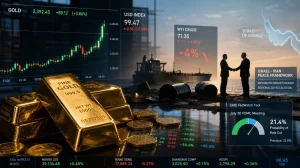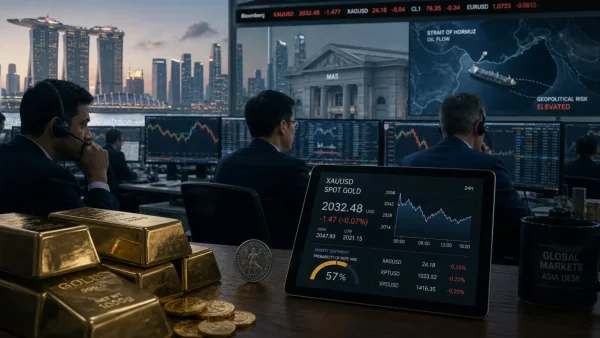
In Asian trade, gold put down roots after a hard-fought selloff. The signal to investors is unambiguous: wagers on rate hikes are back on the table. After Friday’s 3% plus drop – the steepest in a day since early June – bullion was trading in the $4,450 an ounce vicinity on August 31, 2026 as the market took stock of the Federal Reserve’s position.
Fed hawkishness resets rate path
US Federal Reserve Chair Kevin Warsh provided the impetus with his vow to bring inflation back to the 2% mark, putting it as a fixed objective. Traders have taken that as a cue for tighter policy and are now valuing a hike at the September meeting at better than 50-50 odds.
The repositioning was swift. Market indicators put the chance of a September move at 57%, up from 36% before Warsh spoke. He made it known the central bank would have work ahead if confidence in falling inflation erodes, leaving open the possibility of further hikes.
For an asset that does not yield anything like gold, higher rates are a headwind, making interest-bearing options more attractive. That was enough to drive the slide on Friday, though wider macro factors have propped up bullion through the month of August.
Treasury buybacks vs Fed discipline: a tug of war
You see another side of it in the monthly figures. Gold is on course for its best month since January with a 10% gain in August, helped along by the US Treasury’s mid-month decision to increase bond buybacks and reignite the debasement trade.
Nicky Shiels at MKS PAMP SA sees it as a contest between a dovish Treasury and a hawkish Fed. With the Fed’s call coming up and the buybacks underway, she anticipates the debasement trade will carry over into September to the benefit of gold.
The dollar has been something of a mixed bag. A 0.4% rise in the last session gave way to a marginal dip in the Bloomberg Dollar Spot Index, which did not derail gold’s recovery but held it in check.
Price check: gold and peers
Spot gold was down a fraction at $4,453.08 an ounce in Singapore at 9:22 a.m., having stabilised close to where it left off. Before that, at 0011 GMT, it was holding at $4,455.29 after a touch of its lowest point since the 19th of the month.
Futures were no less cautious. December delivery contracts for US gold were 0.6% off at $4,504.90. Silver was 0.1% lower at $66.29 in Singapore while palladium was down 2%; platinum showed little movement.
Another look at the numbers had spot silver unchanged at $66.34, with platinum edging up 0.1% to $1,822.46 and palladium up 0.2% to $1,424.89, all part of the choppy day for precious metals.
Geopolitics and energy add heat
It is not just the central banks causing inflation jitters. Oil prices have been bid up in the wake of US strikes on Iranian rocket launchers believed to be readying mines for a vital waterway, the first such action against Iran in over a month.
Iran has decried the latest US economic sanctions as state terrorism and its supreme leader has proscribed any acts to social cohesion. For the markets, the resulting costlier energy only makes the inflation problem the Fed is at pains to resolve more intractable.
What traders are watching next
Policy and geopolitics are front and centre, so there are a number of near-term catalysts to consider:
– US job openings and the ADP report
– Nonfarm payrolls and weekly jobless claims
– The Fed’s September rate call
– US Treasury bond buybacks due in September
– Germany CPI and China manufacturing PMI
There is no question about gold's appeal. It ran up 65% in 2025 on fears of debasement and one could make the case that has come back with the twists of August. Yet Friday was a lesson in how volatile the path can be when the Fed is resolute on 2% and the data has yet to break the tie.